James K Rilling, Minwoo Lee, Carolyn Zhou, Kenneth Hepburn, Molly M Perkins, Christian Gaser
{"title":"Caregiving is associated with lower brain age in humans.","authors":"James K Rilling, Minwoo Lee, Carolyn Zhou, Kenneth Hepburn, Molly M Perkins, Christian Gaser","doi":"10.1093/scan/nsaf013","DOIUrl":null,"url":null,"abstract":"<p><p>Middle-aged adults who are parents have better average cognitive performance and lower average brain age compared with middle-aged adults without children, raising the possibility that caregiving slows brain aging. Here, we investigate this hypothesis in two additional groups of caregivers: grandmothers and caregivers for people living with dementia (PLWD). Demographic, questionnaire, and structural Magnetic Resonance Imaging (MRI) data were acquired from n = 50 grandmothers, n = 24 caregivers of PLWD, and n = 37 non-caregiver controls, and BrainAGE was estimated. BrainAGE estimation results suggest that after controlling for relevant covariates, grandmothers had a brain age that was 5.5 years younger than non-grandmother controls, and caregivers of PLWD had brains that were 4.7 years younger than non-caregiver controls. Women who became grandmothers at a later age had lower brain age than those who became grandmothers at an earlier age. Among caregivers of PLWD, stress and caregiving burden were associated with increased brain age, such that the beneficial effect of caregiving on brain age was reduced in caregivers reporting more burden. Our findings suggest that caring for dependents may slow brain aging.</p>","PeriodicalId":94208,"journal":{"name":"Social cognitive and affective neuroscience","volume":" ","pages":""},"PeriodicalIF":3.1000,"publicationDate":"2025-03-13","publicationTypes":"Journal Article","fieldsOfStudy":null,"isOpenAccess":false,"openAccessPdf":"https://www.ncbi.nlm.nih.gov/pmc/articles/PMC11905976/pdf/","citationCount":"0","resultStr":null,"platform":"Semanticscholar","paperid":null,"PeriodicalName":"Social cognitive and affective neuroscience","FirstCategoryId":"1085","ListUrlMain":"https://doi.org/10.1093/scan/nsaf013","RegionNum":0,"RegionCategory":null,"ArticlePicture":[],"TitleCN":null,"AbstractTextCN":null,"PMCID":null,"EPubDate":"","PubModel":"","JCR":"","JCRName":"","Score":null,"Total":0}
引用次数: 0
Abstract
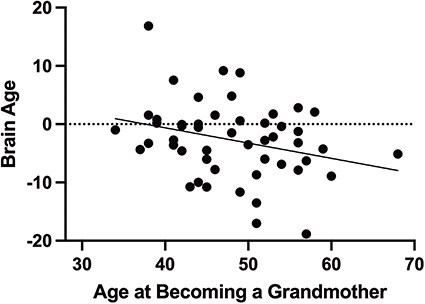
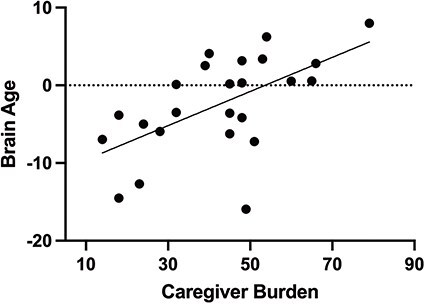
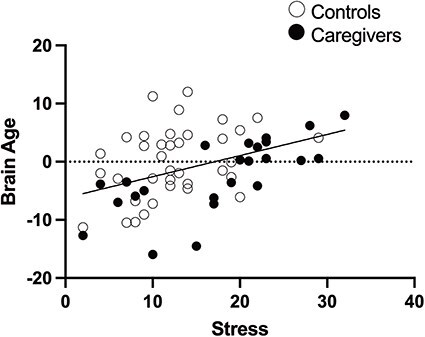
Middle-aged adults who are parents have better average cognitive performance and lower average brain age compared with middle-aged adults without children, raising the possibility that caregiving slows brain aging. Here, we investigate this hypothesis in two additional groups of caregivers: grandmothers and caregivers for people living with dementia (PLWD). Demographic, questionnaire, and structural Magnetic Resonance Imaging (MRI) data were acquired from n = 50 grandmothers, n = 24 caregivers of PLWD, and n = 37 non-caregiver controls, and BrainAGE was estimated. BrainAGE estimation results suggest that after controlling for relevant covariates, grandmothers had a brain age that was 5.5 years younger than non-grandmother controls, and caregivers of PLWD had brains that were 4.7 years younger than non-caregiver controls. Women who became grandmothers at a later age had lower brain age than those who became grandmothers at an earlier age. Among caregivers of PLWD, stress and caregiving burden were associated with increased brain age, such that the beneficial effect of caregiving on brain age was reduced in caregivers reporting more burden. Our findings suggest that caring for dependents may slow brain aging.



 京公网安备 11010802042870号
京ICP备2023020795号-1
京公网安备 11010802042870号
京ICP备2023020795号-1

 分享
分享

 求助内容:
求助内容: 应助结果提醒方式:
 扫码关注我们
