{"title":"One-Pot Synthesis of Innovative Multicomponent Complexes as Catalysts for Enhanced Decomposition of Ammonium Perchlorate","authors":"Wen-Shuai Dong, Pei-Pei Zhang, Mei-Qi Xu, Zu-Jia Lu, Zhi-Min Li, Kun Wang, Qi-Yao Yu, Jian-Guo Zhang","doi":"10.1002/smll.202411382","DOIUrl":null,"url":null,"abstract":"<p>The creation of multi-component energetic complex molecules, with functionalized groups, combined with synergistic catalysis among catalytic interactions between their components, offers a remarkable opportunity to boost the energy release of ammonium perchlorate (AP). This study uses a one-pot method to investigate a synthesis approach for coordinating anion complexes.Furthermore, the potential applications of this series of complexes as combustion catalysts are analyzed. The results show that mixing an energetic complex with AP, results in a distinct thermal decomposition pattern. Specifically, AG[Zn(DNPO)2]2H2O (AEP-2) and DAG[Zn(DNPO)2]2H2O (AEP-3) catalyze the decomposition of AP in a single exothermic reaction. The high-temperature decomposition of AP increased to 309.8 and 323.9 °C, respectively. Real-time infrared detection revealed H₂O, N₂O, NO₂, and HCl, confirming the accelerated high-temperature decomposition period of the catalyzed AP decomposition. Furthermore, the detection of CO₂ indicates that the energetic catalyst is also decomposed during this phase. Kinetic analysis of the decomposition process shows that the catalytic AP decomposed via a single nucleation pathway. The catalytic decomposition mechanism of this series of catalysts for AP thermal decomposition is elucidated based on these findings.</p>","PeriodicalId":228,"journal":{"name":"Small","volume":"21 15","pages":""},"PeriodicalIF":12.1000,"publicationDate":"2025-03-10","publicationTypes":"Journal Article","fieldsOfStudy":null,"isOpenAccess":false,"openAccessPdf":"","citationCount":"0","resultStr":null,"platform":"Semanticscholar","paperid":null,"PeriodicalName":"Small","FirstCategoryId":"88","ListUrlMain":"https://onlinelibrary.wiley.com/doi/10.1002/smll.202411382","RegionNum":2,"RegionCategory":"材料科学","ArticlePicture":[],"TitleCN":null,"AbstractTextCN":null,"PMCID":null,"EPubDate":"","PubModel":"","JCR":"Q1","JCRName":"CHEMISTRY, MULTIDISCIPLINARY","Score":null,"Total":0}
引用次数: 0
Abstract
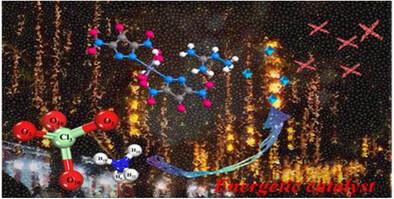
The creation of multi-component energetic complex molecules, with functionalized groups, combined with synergistic catalysis among catalytic interactions between their components, offers a remarkable opportunity to boost the energy release of ammonium perchlorate (AP). This study uses a one-pot method to investigate a synthesis approach for coordinating anion complexes.Furthermore, the potential applications of this series of complexes as combustion catalysts are analyzed. The results show that mixing an energetic complex with AP, results in a distinct thermal decomposition pattern. Specifically, AG[Zn(DNPO)2]2H2O (AEP-2) and DAG[Zn(DNPO)2]2H2O (AEP-3) catalyze the decomposition of AP in a single exothermic reaction. The high-temperature decomposition of AP increased to 309.8 and 323.9 °C, respectively. Real-time infrared detection revealed H₂O, N₂O, NO₂, and HCl, confirming the accelerated high-temperature decomposition period of the catalyzed AP decomposition. Furthermore, the detection of CO₂ indicates that the energetic catalyst is also decomposed during this phase. Kinetic analysis of the decomposition process shows that the catalytic AP decomposed via a single nucleation pathway. The catalytic decomposition mechanism of this series of catalysts for AP thermal decomposition is elucidated based on these findings.
期刊介绍:
Small serves as an exceptional platform for both experimental and theoretical studies in fundamental and applied interdisciplinary research at the nano- and microscale. The journal offers a compelling mix of peer-reviewed Research Articles, Reviews, Perspectives, and Comments.
With a remarkable 2022 Journal Impact Factor of 13.3 (Journal Citation Reports from Clarivate Analytics, 2023), Small remains among the top multidisciplinary journals, covering a wide range of topics at the interface of materials science, chemistry, physics, engineering, medicine, and biology.
Small's readership includes biochemists, biologists, biomedical scientists, chemists, engineers, information technologists, materials scientists, physicists, and theoreticians alike.



 京公网安备 11010802042870号
京ICP备2023020795号-1
京公网安备 11010802042870号
京ICP备2023020795号-1

 分享
分享
 求助内容:
求助内容: 应助结果提醒方式:
 扫码关注我们
