Chunfan Li, Yijie Sun, Yang Li, Chenlu Jiao, Xiaotong Fu, Xin Zhou, Zhihan Li, Shengjie Ling, Dongdong Ye, Ke Zheng
{"title":"Biomimetic Interface Engineering Approach for Universal Toughening of Rigid Fibers","authors":"Chunfan Li, Yijie Sun, Yang Li, Chenlu Jiao, Xiaotong Fu, Xin Zhou, Zhihan Li, Shengjie Ling, Dongdong Ye, Ke Zheng","doi":"10.1002/adfm.202501380","DOIUrl":null,"url":null,"abstract":"<p>The development of a straightforward, universally applicable methodology for transforming short, rigid fibers into ultra-long, high-toughness fibers is of significant theoretical and practical importance, presenting considerable challenges in its execution. Inspired by the intricate structure of natural silk, a biomimetic interface engineering technique is developed to fabricate extensive, high-toughness bamboo filaments. These filaments feature a unique design with alternating layers of soft silk fibroin acting as a flexible sheath between rigid bamboo microfibers, markedly enhancing the strain and toughness of the resulting bamboo-silk filaments (BSFs). Consequently, the BSFs exhibit an extraordinary toughness of 115 ± 17 MJ m<sup>−3</sup>, ≈12 times greater than that of pristine bamboo microfibers. By leveraging the tunable mechanical properties of silk fibroin, the approach offers a versatile strategy to bolster the toughness of various materials, including biopolymers (e.g., cellulose), synthetic polymers (e.g., aromatic polyamide), and inorganics (e.g., fiberglass). This enhancement is achieved by precisely modulating the interactions between the soft protein matrix and rigid inclusions, providing a novel approach for fabricating high-toughness fibers and significantly expanding the potential applicability of biomass, inorganic, or petrochemical-based fibers.</p>","PeriodicalId":112,"journal":{"name":"Advanced Functional Materials","volume":"35 31","pages":""},"PeriodicalIF":19.0000,"publicationDate":"2025-03-10","publicationTypes":"Journal Article","fieldsOfStudy":null,"isOpenAccess":false,"openAccessPdf":"","citationCount":"0","resultStr":null,"platform":"Semanticscholar","paperid":null,"PeriodicalName":"Advanced Functional Materials","FirstCategoryId":"88","ListUrlMain":"https://advanced.onlinelibrary.wiley.com/doi/10.1002/adfm.202501380","RegionNum":1,"RegionCategory":"材料科学","ArticlePicture":[],"TitleCN":null,"AbstractTextCN":null,"PMCID":null,"EPubDate":"","PubModel":"","JCR":"Q1","JCRName":"CHEMISTRY, MULTIDISCIPLINARY","Score":null,"Total":0}
引用次数: 0
Abstract
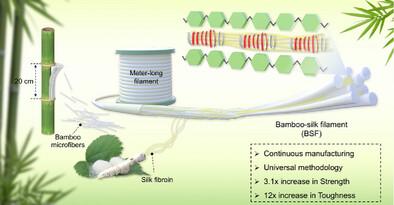
The development of a straightforward, universally applicable methodology for transforming short, rigid fibers into ultra-long, high-toughness fibers is of significant theoretical and practical importance, presenting considerable challenges in its execution. Inspired by the intricate structure of natural silk, a biomimetic interface engineering technique is developed to fabricate extensive, high-toughness bamboo filaments. These filaments feature a unique design with alternating layers of soft silk fibroin acting as a flexible sheath between rigid bamboo microfibers, markedly enhancing the strain and toughness of the resulting bamboo-silk filaments (BSFs). Consequently, the BSFs exhibit an extraordinary toughness of 115 ± 17 MJ m−3, ≈12 times greater than that of pristine bamboo microfibers. By leveraging the tunable mechanical properties of silk fibroin, the approach offers a versatile strategy to bolster the toughness of various materials, including biopolymers (e.g., cellulose), synthetic polymers (e.g., aromatic polyamide), and inorganics (e.g., fiberglass). This enhancement is achieved by precisely modulating the interactions between the soft protein matrix and rigid inclusions, providing a novel approach for fabricating high-toughness fibers and significantly expanding the potential applicability of biomass, inorganic, or petrochemical-based fibers.
期刊介绍:
Firmly established as a top-tier materials science journal, Advanced Functional Materials reports breakthrough research in all aspects of materials science, including nanotechnology, chemistry, physics, and biology every week.
Advanced Functional Materials is known for its rapid and fair peer review, quality content, and high impact, making it the first choice of the international materials science community.




 京公网安备 11010802042870号
京ICP备2023020795号-1
京公网安备 11010802042870号
京ICP备2023020795号-1

 分享
分享
 求助内容:
求助内容: 应助结果提醒方式:
 扫码关注我们
