Mingzhuang Liang, Jinwook Kim, Xiaomin Xu, Hainan Sun, Yufei Song, SungHyun Jeon, Tae Ho Shin, Zongping Shao and WooChul Jung
{"title":"Electricity-to-ammonia interconversion in protonic ceramic cells: advances, challenges and perspectives","authors":"Mingzhuang Liang, Jinwook Kim, Xiaomin Xu, Hainan Sun, Yufei Song, SungHyun Jeon, Tae Ho Shin, Zongping Shao and WooChul Jung","doi":"10.1039/D4EE06100D","DOIUrl":null,"url":null,"abstract":"<p >NH<small><sub>3</sub></small> is an attractive alternative fuel to hydrogen and methane, offering advantages such as easy compression at room temperature, straightforward storage and transportation, high volumetric energy density, and carbon-free nature. However, conventional NH<small><sub>3</sub></small> synthesis requires high temperatures and pressures, resulting in substantial energy consumption and increased equipment and maintenance costs. Protonic ceramic cells (PCCs), as a cutting-edge energy conversion technology, can realize NH<small><sub>3</sub></small> synthesis at moderate pressures and low-to-intermediate temperatures by utilizing surplus renewable electricity generated by wind and solar power. Additionally, PCCs can be employed to convert NH<small><sub>3</sub></small> into electricity to meet instantaneous demand, providing a means to address the seasonal and intermittent nature of renewable energy sources. Despite their potential, the commercial application of electricity-to-NH<small><sub>3</sub></small> interconversion in PCCs faces several challenges, primarily related to insufficient performance and durability. This review systematically explores the mechanisms and challenges of electricity-to-NH<small><sub>3</sub></small> interconversion in PCCs, highlights recent advancements in NH<small><sub>3</sub></small> synthesis using PCCs and direct NH<small><sub>3</sub></small>-fueled proton ceramic fuel cells (DA-PCFCs), and discusses perspectives for realizing high-efficiency electricity-to-NH<small><sub>3</sub></small> interconversion. This review aims to establish a scientific foundation for efficient electricity-to-NH<small><sub>3</sub></small> interconversion <em>via</em> PCCs and provides critical insights for designing high-performance and durable PCC components.</p>","PeriodicalId":72,"journal":{"name":"Energy & Environmental Science","volume":" 8","pages":" 3526-3552"},"PeriodicalIF":30.8000,"publicationDate":"2025-03-10","publicationTypes":"Journal Article","fieldsOfStudy":null,"isOpenAccess":false,"openAccessPdf":"https://pubs.rsc.org/en/content/articlepdf/2025/ee/d4ee06100d?page=search","citationCount":"0","resultStr":null,"platform":"Semanticscholar","paperid":null,"PeriodicalName":"Energy & Environmental Science","FirstCategoryId":"88","ListUrlMain":"https://pubs.rsc.org/en/content/articlelanding/2025/ee/d4ee06100d","RegionNum":1,"RegionCategory":"材料科学","ArticlePicture":[],"TitleCN":null,"AbstractTextCN":null,"PMCID":null,"EPubDate":"","PubModel":"","JCR":"Q1","JCRName":"CHEMISTRY, MULTIDISCIPLINARY","Score":null,"Total":0}
引用次数: 0
Abstract
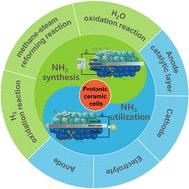
NH3 is an attractive alternative fuel to hydrogen and methane, offering advantages such as easy compression at room temperature, straightforward storage and transportation, high volumetric energy density, and carbon-free nature. However, conventional NH3 synthesis requires high temperatures and pressures, resulting in substantial energy consumption and increased equipment and maintenance costs. Protonic ceramic cells (PCCs), as a cutting-edge energy conversion technology, can realize NH3 synthesis at moderate pressures and low-to-intermediate temperatures by utilizing surplus renewable electricity generated by wind and solar power. Additionally, PCCs can be employed to convert NH3 into electricity to meet instantaneous demand, providing a means to address the seasonal and intermittent nature of renewable energy sources. Despite their potential, the commercial application of electricity-to-NH3 interconversion in PCCs faces several challenges, primarily related to insufficient performance and durability. This review systematically explores the mechanisms and challenges of electricity-to-NH3 interconversion in PCCs, highlights recent advancements in NH3 synthesis using PCCs and direct NH3-fueled proton ceramic fuel cells (DA-PCFCs), and discusses perspectives for realizing high-efficiency electricity-to-NH3 interconversion. This review aims to establish a scientific foundation for efficient electricity-to-NH3 interconversion via PCCs and provides critical insights for designing high-performance and durable PCC components.
期刊介绍:
Energy & Environmental Science, a peer-reviewed scientific journal, publishes original research and review articles covering interdisciplinary topics in the (bio)chemical and (bio)physical sciences, as well as chemical engineering disciplines. Published monthly by the Royal Society of Chemistry (RSC), a not-for-profit publisher, Energy & Environmental Science is recognized as a leading journal. It boasts an impressive impact factor of 8.500 as of 2009, ranking 8th among 140 journals in the category "Chemistry, Multidisciplinary," second among 71 journals in "Energy & Fuels," second among 128 journals in "Engineering, Chemical," and first among 181 scientific journals in "Environmental Sciences."
Energy & Environmental Science publishes various types of articles, including Research Papers (original scientific work), Review Articles, Perspectives, and Minireviews (feature review-type articles of broad interest), Communications (original scientific work of an urgent nature), Opinions (personal, often speculative viewpoints or hypotheses on current topics), and Analysis Articles (in-depth examination of energy-related issues).



 京公网安备 11010802042870号
京ICP备2023020795号-1
京公网安备 11010802042870号
京ICP备2023020795号-1

 分享
分享
 求助内容:
求助内容: 应助结果提醒方式:
 扫码关注我们
