Gaofeng Du, Shuhao Wang, Zhaoming Tong, Xinyu Ji, Xinqi Wei, Quanbin Zha, Tianyou Zhai and Huiqiao Li
{"title":"Dual thermal-stimulated self-adhesive mixed-phase interface to enable ultra-long cycle life of solid-state sodium metal batteries†","authors":"Gaofeng Du, Shuhao Wang, Zhaoming Tong, Xinyu Ji, Xinqi Wei, Quanbin Zha, Tianyou Zhai and Huiqiao Li","doi":"10.1039/D4EE05140H","DOIUrl":null,"url":null,"abstract":"<p >The pursuit of low-cost and intrinsically safe high-energy storage has significantly triggered the development of solid-state sodium–metal batteries. The solid–solid interface between the sodium anode and rigid electrolytes plays a critical role in the stable cycling of solid-state batteries. Undesirable interfacial contact during sodium deposition and stripping tends to induce the generation of voids and dendrites, leading to interface deterioration and cell failure. Herein, we constructed a self-adhesive and mixed-phase interface <em>via</em> a dual thermal stimulation strategy to enable an ultra-long cycling life of over 17 000 h (close to 2 years). A dense and robust SnF<small><sub>2</sub></small> interface layer was constructed on the surface of the solid electrolyte <em>via</em> a melting and self-adhesive effect induced by a physical thermal stimulation treatment. A secondary thermal activation was performed to trigger the <em>in situ</em> transformation of the interface layer into an ion/electron mixed ionic/electric conductor. Due to the robust contact and high conductivity of this self-adhesive mixed-phase interfacial layer, the cycling life of the sodium symmetric cell was dramatically increased from 50 h to 17 000 h with stable charging/discharging curves. Additionally, full cells coupled with the Na<small><sub>3</sub></small>V<small><sub>2</sub></small>(PO<small><sub>4</sub></small>)<small><sub>3</sub></small> cathode provided a capacity of 102.2 mA h g<small><sup>−1</sup></small> with a coulombic efficiency of 99.72% in the first cycle. The capacity maintained was 91.3 mA h g<small><sup>−1</sup></small> after 2000 cycles, with a capacity retention rate above 89.3%. This work provides a new strategy for constructing a robust and long-lasting stable interface in solid-state sodium–metal batteries.</p>","PeriodicalId":72,"journal":{"name":"Energy & Environmental Science","volume":" 8","pages":" 3689-3698"},"PeriodicalIF":30.8000,"publicationDate":"2025-03-11","publicationTypes":"Journal Article","fieldsOfStudy":null,"isOpenAccess":false,"openAccessPdf":"","citationCount":"0","resultStr":null,"platform":"Semanticscholar","paperid":null,"PeriodicalName":"Energy & Environmental Science","FirstCategoryId":"88","ListUrlMain":"https://pubs.rsc.org/en/content/articlelanding/2025/ee/d4ee05140h","RegionNum":1,"RegionCategory":"材料科学","ArticlePicture":[],"TitleCN":null,"AbstractTextCN":null,"PMCID":null,"EPubDate":"","PubModel":"","JCR":"Q1","JCRName":"CHEMISTRY, MULTIDISCIPLINARY","Score":null,"Total":0}
引用次数: 0
Abstract
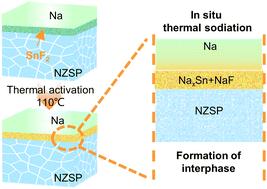
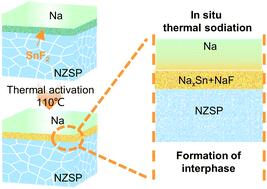
The pursuit of low-cost and intrinsically safe high-energy storage has significantly triggered the development of solid-state sodium–metal batteries. The solid–solid interface between the sodium anode and rigid electrolytes plays a critical role in the stable cycling of solid-state batteries. Undesirable interfacial contact during sodium deposition and stripping tends to induce the generation of voids and dendrites, leading to interface deterioration and cell failure. Herein, we constructed a self-adhesive and mixed-phase interface via a dual thermal stimulation strategy to enable an ultra-long cycling life of over 17 000 h (close to 2 years). A dense and robust SnF2 interface layer was constructed on the surface of the solid electrolyte via a melting and self-adhesive effect induced by a physical thermal stimulation treatment. A secondary thermal activation was performed to trigger the in situ transformation of the interface layer into an ion/electron mixed ionic/electric conductor. Due to the robust contact and high conductivity of this self-adhesive mixed-phase interfacial layer, the cycling life of the sodium symmetric cell was dramatically increased from 50 h to 17 000 h with stable charging/discharging curves. Additionally, full cells coupled with the Na3V2(PO4)3 cathode provided a capacity of 102.2 mA h g−1 with a coulombic efficiency of 99.72% in the first cycle. The capacity maintained was 91.3 mA h g−1 after 2000 cycles, with a capacity retention rate above 89.3%. This work provides a new strategy for constructing a robust and long-lasting stable interface in solid-state sodium–metal batteries.
期刊介绍:
Energy & Environmental Science, a peer-reviewed scientific journal, publishes original research and review articles covering interdisciplinary topics in the (bio)chemical and (bio)physical sciences, as well as chemical engineering disciplines. Published monthly by the Royal Society of Chemistry (RSC), a not-for-profit publisher, Energy & Environmental Science is recognized as a leading journal. It boasts an impressive impact factor of 8.500 as of 2009, ranking 8th among 140 journals in the category "Chemistry, Multidisciplinary," second among 71 journals in "Energy & Fuels," second among 128 journals in "Engineering, Chemical," and first among 181 scientific journals in "Environmental Sciences."
Energy & Environmental Science publishes various types of articles, including Research Papers (original scientific work), Review Articles, Perspectives, and Minireviews (feature review-type articles of broad interest), Communications (original scientific work of an urgent nature), Opinions (personal, often speculative viewpoints or hypotheses on current topics), and Analysis Articles (in-depth examination of energy-related issues).



 京公网安备 11010802042870号
京ICP备2023020795号-1
京公网安备 11010802042870号
京ICP备2023020795号-1

 分享
分享
 求助内容:
求助内容: 应助结果提醒方式:
 扫码关注我们
