{"title":"Modeling the percolation behavior of conductive particles/insulating polymer-based composites with equivalent circuit of resistance","authors":"Zizhu Wang , Juanjuan Zhang , George J. Weng","doi":"10.1016/j.polymer.2025.128262","DOIUrl":null,"url":null,"abstract":"<div><div>In conductive particle/insulating polymer composites, percolation behavior significantly affects their electrical properties. Based on particle concentration, the composites are classified into rich and poor regions. A theoretical model consisting of four parts has been developed to describe the entire process in which the shape of the rich regions evolves from spheres to ellipsoids, barrels, and finally cylinders as particle concentration increases. To determine electrical properties and percolation behavior of composites, different theoretical methods are employed. Specifically, the percolation threshold is identified by detecting the abnormal increase in the composite conductivity slope. Below this threshold, electrical properties are calculated using homogenization theory; after it, the equivalent circuit method is applied. Based on this model, key electrical parameters like conductivity, resistivity, and leakage current are computed for composites with carbon-based, metallic, and ferromagnetic particles in different polymer matrices. Results show good agreement between theoretical predictions and experimental data. Moreover, the study also explores the impacts of particle distribution, component properties, and interface thickness on percolation behavior, and discusses its double-percolation behaviors. This model offers new insights for predicting percolation behavior and opens up new perspectives for revealing electrical properties of this composite.</div></div>","PeriodicalId":405,"journal":{"name":"Polymer","volume":"324 ","pages":"Article 128262"},"PeriodicalIF":4.5000,"publicationDate":"2025-04-17","publicationTypes":"Journal Article","fieldsOfStudy":null,"isOpenAccess":false,"openAccessPdf":"","citationCount":"0","resultStr":null,"platform":"Semanticscholar","paperid":null,"PeriodicalName":"Polymer","FirstCategoryId":"92","ListUrlMain":"https://www.sciencedirect.com/science/article/pii/S0032386125002484","RegionNum":2,"RegionCategory":"化学","ArticlePicture":[],"TitleCN":null,"AbstractTextCN":null,"PMCID":null,"EPubDate":"2025/3/10 0:00:00","PubModel":"Epub","JCR":"Q2","JCRName":"POLYMER SCIENCE","Score":null,"Total":0}
引用次数: 0
Abstract
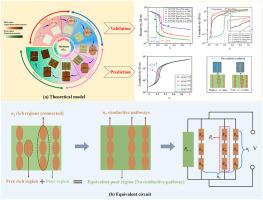
In conductive particle/insulating polymer composites, percolation behavior significantly affects their electrical properties. Based on particle concentration, the composites are classified into rich and poor regions. A theoretical model consisting of four parts has been developed to describe the entire process in which the shape of the rich regions evolves from spheres to ellipsoids, barrels, and finally cylinders as particle concentration increases. To determine electrical properties and percolation behavior of composites, different theoretical methods are employed. Specifically, the percolation threshold is identified by detecting the abnormal increase in the composite conductivity slope. Below this threshold, electrical properties are calculated using homogenization theory; after it, the equivalent circuit method is applied. Based on this model, key electrical parameters like conductivity, resistivity, and leakage current are computed for composites with carbon-based, metallic, and ferromagnetic particles in different polymer matrices. Results show good agreement between theoretical predictions and experimental data. Moreover, the study also explores the impacts of particle distribution, component properties, and interface thickness on percolation behavior, and discusses its double-percolation behaviors. This model offers new insights for predicting percolation behavior and opens up new perspectives for revealing electrical properties of this composite.
期刊介绍:
Polymer is an interdisciplinary journal dedicated to publishing innovative and significant advances in Polymer Physics, Chemistry and Technology. We welcome submissions on polymer hybrids, nanocomposites, characterisation and self-assembly. Polymer also publishes work on the technological application of polymers in energy and optoelectronics.
The main scope is covered but not limited to the following core areas:
Polymer Materials
Nanocomposites and hybrid nanomaterials
Polymer blends, films, fibres, networks and porous materials
Physical Characterization
Characterisation, modelling and simulation* of molecular and materials properties in bulk, solution, and thin films
Polymer Engineering
Advanced multiscale processing methods
Polymer Synthesis, Modification and Self-assembly
Including designer polymer architectures, mechanisms and kinetics, and supramolecular polymerization
Technological Applications
Polymers for energy generation and storage
Polymer membranes for separation technology
Polymers for opto- and microelectronics.




 京公网安备 11010802042870号
京ICP备2023020795号-1
京公网安备 11010802042870号
京ICP备2023020795号-1

 分享
分享
 求助内容:
求助内容: 应助结果提醒方式:
 扫码关注我们
