{"title":"Hemodynamic analysis of blood flow restriction training: a systematic review.","authors":"Ruifeng Huang, Yong Ma, Zizhe Yang, Zhikun Wang, Canyi Zeng, Yazhou Qin, Mengyao Jia","doi":"10.1186/s13102-025-01084-8","DOIUrl":null,"url":null,"abstract":"<p><p>Blood Flow Restriction Training (BFRT) is a low-load training technique that involves applying pressure to partially restrict arterial blood flow while occluding venous return. Despite its growing popularity, there is still no consensus on how combining BFRT with resistance or aerobic training influences hemodynamic responses, or on the safest and most effective methods for implementing it. This review aims to systematically identify the effects of BFRT on hemodynamic parameters. A systematic review was conducted following the Preferred Reporting Items for Systematic Reviews and Meta-Analyses (PRISMA) Statement guidelines. The Chinese literature search was performed in the China National Knowledge Infrastructure (CNKI) database. English literature search was conducted in the Web of Science, PubMed, and Google Scholar databases. The studies included human subjects, the outcome indicators included hemodynamic evaluation indicators, and only randomized controlled trials and randomized crossover trials were considered. Non-Chinese or English literature, duplicate studies, and those with missing data were excluded. The adapted STROBE checklist was used to assess the risk of bias, 44 articles were included in this review. Results indicated that BFRT has increased heart rate and blood lactate levels, while its effect on blood oxygen saturation varies. Additionally, BFRT significantly enhances cardiac output but may either have no significant effect or cause a decrease in stroke volume. Furthermore, BFRT improves pulse wave velocity from the femur to the posterior tibia, suggesting a positive influence on cardiovascular function. BFRT induces changes in arterial structure and function, with these indicators interacting to produce both positive and negative effects on cardiovascular health. The primary mechanisms by which BFRT influences hemodynamics include the activation of the sympathetic and vagus nerves, as well as the regulation of chemical mediators in body fluids that modulate cardiovascular function. Convenient, economical, non-invasive, and easily measurable hemodynamic indicators are expected to become an efficient tool for evaluating the effects of exercise training. Further research is needed to establish the optimal compression thresholds and durations for different populations and exercise types, as well as to assess the long-term impact of BFRT on hemodynamic parameters.</p>","PeriodicalId":48585,"journal":{"name":"BMC Sports Science Medicine and Rehabilitation","volume":"17 1","pages":"46"},"PeriodicalIF":2.8000,"publicationDate":"2025-03-12","publicationTypes":"Journal Article","fieldsOfStudy":null,"isOpenAccess":false,"openAccessPdf":"https://www.ncbi.nlm.nih.gov/pmc/articles/PMC11900080/pdf/","citationCount":"0","resultStr":null,"platform":"Semanticscholar","paperid":null,"PeriodicalName":"BMC Sports Science Medicine and Rehabilitation","FirstCategoryId":"3","ListUrlMain":"https://doi.org/10.1186/s13102-025-01084-8","RegionNum":3,"RegionCategory":"医学","ArticlePicture":[],"TitleCN":null,"AbstractTextCN":null,"PMCID":null,"EPubDate":"","PubModel":"","JCR":"Q1","JCRName":"REHABILITATION","Score":null,"Total":0}
引用次数: 0
Abstract
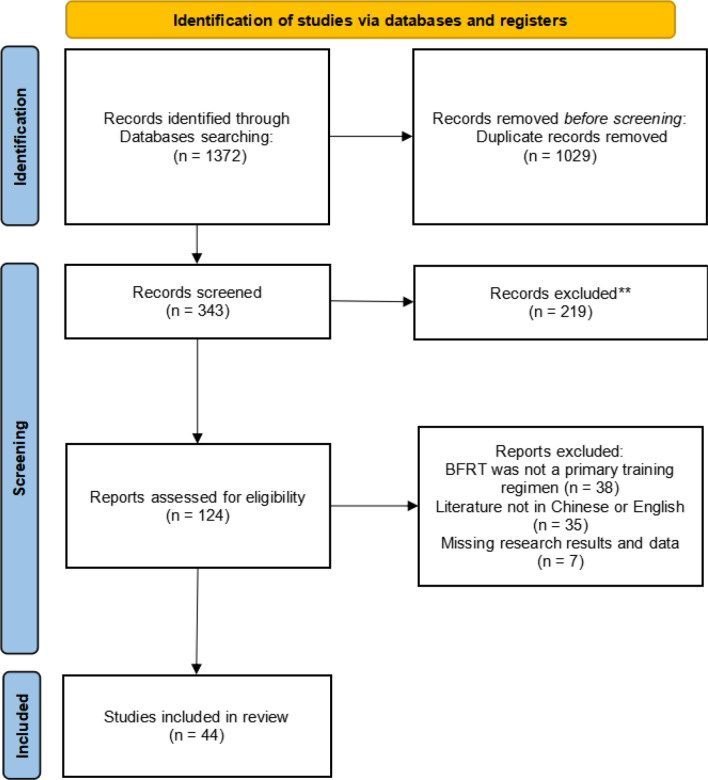
Blood Flow Restriction Training (BFRT) is a low-load training technique that involves applying pressure to partially restrict arterial blood flow while occluding venous return. Despite its growing popularity, there is still no consensus on how combining BFRT with resistance or aerobic training influences hemodynamic responses, or on the safest and most effective methods for implementing it. This review aims to systematically identify the effects of BFRT on hemodynamic parameters. A systematic review was conducted following the Preferred Reporting Items for Systematic Reviews and Meta-Analyses (PRISMA) Statement guidelines. The Chinese literature search was performed in the China National Knowledge Infrastructure (CNKI) database. English literature search was conducted in the Web of Science, PubMed, and Google Scholar databases. The studies included human subjects, the outcome indicators included hemodynamic evaluation indicators, and only randomized controlled trials and randomized crossover trials were considered. Non-Chinese or English literature, duplicate studies, and those with missing data were excluded. The adapted STROBE checklist was used to assess the risk of bias, 44 articles were included in this review. Results indicated that BFRT has increased heart rate and blood lactate levels, while its effect on blood oxygen saturation varies. Additionally, BFRT significantly enhances cardiac output but may either have no significant effect or cause a decrease in stroke volume. Furthermore, BFRT improves pulse wave velocity from the femur to the posterior tibia, suggesting a positive influence on cardiovascular function. BFRT induces changes in arterial structure and function, with these indicators interacting to produce both positive and negative effects on cardiovascular health. The primary mechanisms by which BFRT influences hemodynamics include the activation of the sympathetic and vagus nerves, as well as the regulation of chemical mediators in body fluids that modulate cardiovascular function. Convenient, economical, non-invasive, and easily measurable hemodynamic indicators are expected to become an efficient tool for evaluating the effects of exercise training. Further research is needed to establish the optimal compression thresholds and durations for different populations and exercise types, as well as to assess the long-term impact of BFRT on hemodynamic parameters.
血流限制训练(BFRT)是一种低负荷训练技术,包括施加压力来部分限制动脉血流,同时阻塞静脉回流。尽管BFRT越来越受欢迎,但对于BFRT与阻力训练或有氧训练相结合如何影响血流动力学反应,以及实施它的最安全和最有效的方法,仍然没有达成共识。本综述旨在系统地确定BFRT对血流动力学参数的影响。按照系统评价和荟萃分析(PRISMA)声明指南的首选报告项目进行系统评价。中文文献检索在中国知网数据库中进行。在Web of Science、PubMed和谷歌Scholar数据库中进行英文文献检索。研究纳入人类受试者,结局指标包括血流动力学评价指标,仅考虑随机对照试验和随机交叉试验。排除非中文或英文文献、重复研究和资料缺失的研究。采用改良的STROBE检查表评估偏倚风险,共纳入44篇文献。结果表明,BFRT可提高心率和血乳酸水平,但对血氧饱和度的影响存在差异。此外,BFRT显著提高心输出量,但可能没有显著效果或导致卒中量减少。此外,BFRT提高了从股骨到胫骨后的脉搏波速度,表明对心血管功能有积极影响。BFRT诱导动脉结构和功能的变化,这些指标相互作用,对心血管健康产生积极和消极的影响。BFRT影响血流动力学的主要机制包括激活交感神经和迷走神经,以及调节体液中调节心血管功能的化学介质。方便、经济、无创、易测量的血流动力学指标有望成为评价运动训练效果的有效工具。需要进一步的研究来确定不同人群和运动类型的最佳压缩阈值和持续时间,并评估BFRT对血流动力学参数的长期影响。
期刊介绍:
BMC Sports Science, Medicine and Rehabilitation is an open access, peer reviewed journal that considers articles on all aspects of sports medicine and the exercise sciences, including rehabilitation, traumatology, cardiology, physiology, and nutrition.



 京公网安备 11010802042870号
京ICP备2023020795号-1
京公网安备 11010802042870号
京ICP备2023020795号-1

 分享
分享
 求助内容:
求助内容: 应助结果提醒方式:
 扫码关注我们
