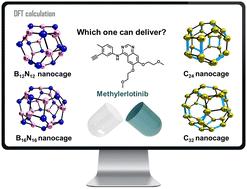
Comparative study of the therapeutic potential of C24, C32, B12N12, and B16N16 nanocages as drug delivery carriers for delivering an erlotinib derivative: DFT and QTAIM investigations†
Khourshid Mehdizadeh, Sourour PourFalatoon, Milad Nouraliei, Majid Farsadrooh, Hanseung Kim, Marzieh Ramezani Farani and Yun Suk Huh
{"title":"Comparative study of the therapeutic potential of C24, C32, B12N12, and B16N16 nanocages as drug delivery carriers for delivering an erlotinib derivative: DFT and QTAIM investigations†","authors":"Khourshid Mehdizadeh, Sourour PourFalatoon, Milad Nouraliei, Majid Farsadrooh, Hanseung Kim, Marzieh Ramezani Farani and Yun Suk Huh","doi":"10.1039/D4NR05393A","DOIUrl":null,"url":null,"abstract":"<p >The use of nanostructures as drug delivery vehicles for a wide range of anticancer medications to lessen their severe side effects by delivering them to the targeted tumor cell location is presently a broadly studied innovative biomedical application of different nanostructures. To investigate the capability of C<small><sub>24</sub></small> and C<small><sub>32</sub></small>, B<small><sub>12</sub></small>N<small><sub>12</sub></small>, and B<small><sub>16</sub></small>N<small><sub>16</sub></small> nanocages as nanocarriers for delivering the methyl erlotinib molecule, we conducted density functional theory (DFT) computations using the M06-2X/6-311G(d,p) and M06-2X/6-31G(d) levels of theory. The calculation of the adsorption energy of methyl erlotinib on the nanocages was performed in aqueous and gaseous phases. The adsorption energy values associated with the interaction between the nanocages and methyl erlotinib were negative, indicating that this interaction was exothermic in nature. The adsorption energy values in the aqueous state were higher than those in the gaseous state, suggesting a stronger interaction in the aqueous state, with the exception of the C<small><sub>32</sub></small> nanocage. Analyses of the density of states (DOS) and projected density of states (PDOS) were performed in order to examine the effect of methyl erlotinib adsorption on the electronic characteristics of selected nanocages. The findings indicated that the B<small><sub>12</sub></small>N<small><sub>12</sub></small> nanocage following methyl erlotinib molecule adsorption came nearer to the Fermi level than the other nanocages examined. Calculations based on the Quantum Theory of Atoms in Molecules (QTAIM) indicated that methyl erlotinib had a weak interaction with all selected nanocages. According to the values of the adsorption energy derived from both methodologies, the interaction between methyl erlotinib and the B<small><sub>12</sub></small>N<small><sub>12</sub></small> nanocage was determined to be more robust than the interaction between methyl erlotinib and the C<small><sub>24</sub></small> nanocage, while the interaction between methyl erlotinib and the B<small><sub>16</sub></small>N<small><sub>16</sub></small> nanocage was also stronger than that with the C<small><sub>32</sub></small> nanocage. Notable variations in the Δ<em>E</em><small><sub>g</sub></small> values were detected for methyl erlotinib@B<small><sub>12</sub></small>N<small><sub>12</sub></small> and methyl erlotinib@B<small><sub>16</sub></small>N<small><sub>16</sub></small> across all methods, suggesting that the conductivity of these two nanostructures improved more significantly following the adsorption of methyl erlotinib than that of other nanostructures. Consequently, the B<small><sub>12</sub></small>N<small><sub>12</sub></small> and B<small><sub>16</sub></small>N<small><sub>16</sub></small> nanocages can function as nanosensors for methyl erlotinib.</p>","PeriodicalId":92,"journal":{"name":"Nanoscale","volume":" 18","pages":" 11413-11425"},"PeriodicalIF":5.1000,"publicationDate":"2025-03-14","publicationTypes":"Journal Article","fieldsOfStudy":null,"isOpenAccess":false,"openAccessPdf":"https://pubs.rsc.org/en/content/articlepdf/2025/nr/d4nr05393a?page=search","citationCount":"0","resultStr":null,"platform":"Semanticscholar","paperid":null,"PeriodicalName":"Nanoscale","FirstCategoryId":"88","ListUrlMain":"https://pubs.rsc.org/en/content/articlelanding/2025/nr/d4nr05393a","RegionNum":3,"RegionCategory":"材料科学","ArticlePicture":[],"TitleCN":null,"AbstractTextCN":null,"PMCID":null,"EPubDate":"","PubModel":"","JCR":"Q1","JCRName":"CHEMISTRY, MULTIDISCIPLINARY","Score":null,"Total":0}
引用次数: 0
Abstract
The use of nanostructures as drug delivery vehicles for a wide range of anticancer medications to lessen their severe side effects by delivering them to the targeted tumor cell location is presently a broadly studied innovative biomedical application of different nanostructures. To investigate the capability of C24 and C32, B12N12, and B16N16 nanocages as nanocarriers for delivering the methyl erlotinib molecule, we conducted density functional theory (DFT) computations using the M06-2X/6-311G(d,p) and M06-2X/6-31G(d) levels of theory. The calculation of the adsorption energy of methyl erlotinib on the nanocages was performed in aqueous and gaseous phases. The adsorption energy values associated with the interaction between the nanocages and methyl erlotinib were negative, indicating that this interaction was exothermic in nature. The adsorption energy values in the aqueous state were higher than those in the gaseous state, suggesting a stronger interaction in the aqueous state, with the exception of the C32 nanocage. Analyses of the density of states (DOS) and projected density of states (PDOS) were performed in order to examine the effect of methyl erlotinib adsorption on the electronic characteristics of selected nanocages. The findings indicated that the B12N12 nanocage following methyl erlotinib molecule adsorption came nearer to the Fermi level than the other nanocages examined. Calculations based on the Quantum Theory of Atoms in Molecules (QTAIM) indicated that methyl erlotinib had a weak interaction with all selected nanocages. According to the values of the adsorption energy derived from both methodologies, the interaction between methyl erlotinib and the B12N12 nanocage was determined to be more robust than the interaction between methyl erlotinib and the C24 nanocage, while the interaction between methyl erlotinib and the B16N16 nanocage was also stronger than that with the C32 nanocage. Notable variations in the ΔEg values were detected for methyl erlotinib@B12N12 and methyl erlotinib@B16N16 across all methods, suggesting that the conductivity of these two nanostructures improved more significantly following the adsorption of methyl erlotinib than that of other nanostructures. Consequently, the B12N12 and B16N16 nanocages can function as nanosensors for methyl erlotinib.
期刊介绍:
Nanoscale is a high-impact international journal, publishing high-quality research across nanoscience and nanotechnology. Nanoscale publishes a full mix of research articles on experimental and theoretical work, including reviews, communications, and full papers.Highly interdisciplinary, this journal appeals to scientists, researchers and professionals interested in nanoscience and nanotechnology, quantum materials and quantum technology, including the areas of physics, chemistry, biology, medicine, materials, energy/environment, information technology, detection science, healthcare and drug discovery, and electronics.



 京公网安备 11010802042870号
京ICP备2023020795号-1
京公网安备 11010802042870号
京ICP备2023020795号-1

 分享
分享
 求助内容:
求助内容: 应助结果提醒方式:
 扫码关注我们
