Simone Bertucci, Davide Piccinotti, Mauro Garbarino, Andrea Escher, Gianluca Bravetti, Christoph Weder, Paola Lova, Davide Comoretto, Ullrich Steiner, Francesco Di Stasio and Andrea Dodero
{"title":"One-pot synthesis of photonic microparticles doped with light-emitting quantum dots†","authors":"Simone Bertucci, Davide Piccinotti, Mauro Garbarino, Andrea Escher, Gianluca Bravetti, Christoph Weder, Paola Lova, Davide Comoretto, Ullrich Steiner, Francesco Di Stasio and Andrea Dodero","doi":"10.1039/D5NR00216H","DOIUrl":null,"url":null,"abstract":"<p >Colloidal quantum dots (QDs) exhibit size-dependent, tuneable optical properties that render them useful in a wide range of technological applications. However, integration of QDs into structured materials remains a significant challenge due to their susceptibility to degradation under chemical or physical perturbations. Here, we present a facile, scalable one-pot co-assembly strategy to embed commercially available CdSe/ZnS core–shell quantum dots into photonic microparticles <em>via</em> the confined self-assembly of a poly(styrene)-<em>b</em>-poly(2-vinylpyridine) block copolymer in emulsion droplets. The resulting hybrid particles exhibit a well-defined concentric lamellar structure and the quantum dots are selectively incorporated into the domains formed by the poly(2-vinylpyridine) blocks. This design enables two different optical responses, <em>i.e.</em>, vivid, non-iridescent structural colouration from photonic bandgap effects and stable engineered photoluminescence from the embedded QDs. The use of swelling agents provides an effective means to tune the photonic bandgap spectral position, extending the optical range to the entire visible region. Optical experiments reveal a subtle interplay between the photonic structure and QD emission, and the emission properties remain intact despite variations in the structural periodicity and matrix refractive index. This work highlights a robust platform for the integration of functional nanomaterials into photonic architectures, offering significant potential for applications in advanced light sources, displays, and sensing technologies. The simplicity of the approach, combined with its scalability, sets the stage for future exploration into hybrid photonic materials with tailored optical properties.</p>","PeriodicalId":92,"journal":{"name":"Nanoscale","volume":" 16","pages":" 10194-10204"},"PeriodicalIF":5.1000,"publicationDate":"2025-03-14","publicationTypes":"Journal Article","fieldsOfStudy":null,"isOpenAccess":false,"openAccessPdf":"https://pubs.rsc.org/en/content/articlepdf/2025/nr/d5nr00216h?page=search","citationCount":"0","resultStr":null,"platform":"Semanticscholar","paperid":null,"PeriodicalName":"Nanoscale","FirstCategoryId":"88","ListUrlMain":"https://pubs.rsc.org/en/content/articlelanding/2025/nr/d5nr00216h","RegionNum":3,"RegionCategory":"材料科学","ArticlePicture":[],"TitleCN":null,"AbstractTextCN":null,"PMCID":null,"EPubDate":"","PubModel":"","JCR":"Q1","JCRName":"CHEMISTRY, MULTIDISCIPLINARY","Score":null,"Total":0}
引用次数: 0
Abstract
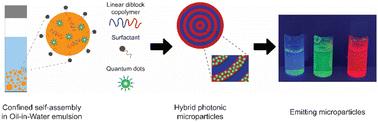
Colloidal quantum dots (QDs) exhibit size-dependent, tuneable optical properties that render them useful in a wide range of technological applications. However, integration of QDs into structured materials remains a significant challenge due to their susceptibility to degradation under chemical or physical perturbations. Here, we present a facile, scalable one-pot co-assembly strategy to embed commercially available CdSe/ZnS core–shell quantum dots into photonic microparticles via the confined self-assembly of a poly(styrene)-b-poly(2-vinylpyridine) block copolymer in emulsion droplets. The resulting hybrid particles exhibit a well-defined concentric lamellar structure and the quantum dots are selectively incorporated into the domains formed by the poly(2-vinylpyridine) blocks. This design enables two different optical responses, i.e., vivid, non-iridescent structural colouration from photonic bandgap effects and stable engineered photoluminescence from the embedded QDs. The use of swelling agents provides an effective means to tune the photonic bandgap spectral position, extending the optical range to the entire visible region. Optical experiments reveal a subtle interplay between the photonic structure and QD emission, and the emission properties remain intact despite variations in the structural periodicity and matrix refractive index. This work highlights a robust platform for the integration of functional nanomaterials into photonic architectures, offering significant potential for applications in advanced light sources, displays, and sensing technologies. The simplicity of the approach, combined with its scalability, sets the stage for future exploration into hybrid photonic materials with tailored optical properties.
期刊介绍:
Nanoscale is a high-impact international journal, publishing high-quality research across nanoscience and nanotechnology. Nanoscale publishes a full mix of research articles on experimental and theoretical work, including reviews, communications, and full papers.Highly interdisciplinary, this journal appeals to scientists, researchers and professionals interested in nanoscience and nanotechnology, quantum materials and quantum technology, including the areas of physics, chemistry, biology, medicine, materials, energy/environment, information technology, detection science, healthcare and drug discovery, and electronics.



 京公网安备 11010802042870号
京ICP备2023020795号-1
京公网安备 11010802042870号
京ICP备2023020795号-1

 分享
分享
 求助内容:
求助内容: 应助结果提醒方式:
 扫码关注我们
