Xianjin Ke , Qianqian Wu , Shikun Cai , Chengyun Wang , Ting Lu , Zhenjie Sun , Xiangyang Tian , Xian Wu , Bingjian Wang , Bo Sun
{"title":"Dl-3-n-Butylphthalide enhances the survival of rat bone marrow stem cells via a reactive oxygen species mediated Erk1/2 signaling pathway","authors":"Xianjin Ke , Qianqian Wu , Shikun Cai , Chengyun Wang , Ting Lu , Zhenjie Sun , Xiangyang Tian , Xian Wu , Bingjian Wang , Bo Sun","doi":"10.1016/j.brainres.2025.149551","DOIUrl":null,"url":null,"abstract":"<div><div>Survival of bone marrow stem cells (BMSCs) is crucial for successful bone marrow transplantation. However, the underlying molecular mechanisms remain inadequately understood. Our previous research has demonstrated that dl-3-n-butylphthalide (NBP) can protect rat BMSCs (rBMSCs) from cell death via its antioxidative properties and by activating the phosphoinositide 3-kinase (PI3K)/protein kinase B (Akt) pathway. The findings suggest that the PI3K/Akt pathway may be one of the primary targets through which NBP exert its protective effects. In this study, we explored an additional signaling pathway to further elucidate the molecular mechanisms involved in NBP-mediated protection against oxidative stress injury in rBMSCs. Oxidative stress was induced in rBMSCs using hydrogen peroxide (H<sub>2</sub>O<sub>2</sub>), imitating the cerebral ischemia microenvironment surrounding transplanted cells in vitro. The protective effects of NBP on rBMSCs against apoptosis were observed, achieving by decreasing the level of reduce reactive oxygen species (ROS) and malondialdehyde (MDA) while simultaneously increasing the concentration of superoxide dismutase (SOD). Notably, these protective effects were partially inhibited by U0126, an extracellular signal-regulated kinase1/2 (Erk1/2) inhibitor, which enhanced the suppression of NBP’s antiapoptotic effects. Our results indicated that NBP could protect rBMSCs from apoptosis through modulation of ROS/Erk pathways. Further investigations are warranted to clarify the unknown mechanisms.</div></div>","PeriodicalId":9083,"journal":{"name":"Brain Research","volume":"1855 ","pages":"Article 149551"},"PeriodicalIF":2.6000,"publicationDate":"2025-05-15","publicationTypes":"Journal Article","fieldsOfStudy":null,"isOpenAccess":false,"openAccessPdf":"","citationCount":"0","resultStr":null,"platform":"Semanticscholar","paperid":null,"PeriodicalName":"Brain Research","FirstCategoryId":"3","ListUrlMain":"https://www.sciencedirect.com/science/article/pii/S000689932500109X","RegionNum":4,"RegionCategory":"医学","ArticlePicture":[],"TitleCN":null,"AbstractTextCN":null,"PMCID":null,"EPubDate":"2025/3/12 0:00:00","PubModel":"Epub","JCR":"Q3","JCRName":"NEUROSCIENCES","Score":null,"Total":0}
引用次数: 0
Abstract
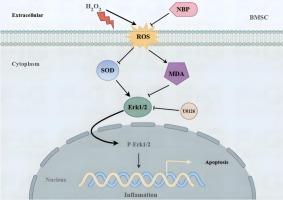
Survival of bone marrow stem cells (BMSCs) is crucial for successful bone marrow transplantation. However, the underlying molecular mechanisms remain inadequately understood. Our previous research has demonstrated that dl-3-n-butylphthalide (NBP) can protect rat BMSCs (rBMSCs) from cell death via its antioxidative properties and by activating the phosphoinositide 3-kinase (PI3K)/protein kinase B (Akt) pathway. The findings suggest that the PI3K/Akt pathway may be one of the primary targets through which NBP exert its protective effects. In this study, we explored an additional signaling pathway to further elucidate the molecular mechanisms involved in NBP-mediated protection against oxidative stress injury in rBMSCs. Oxidative stress was induced in rBMSCs using hydrogen peroxide (H2O2), imitating the cerebral ischemia microenvironment surrounding transplanted cells in vitro. The protective effects of NBP on rBMSCs against apoptosis were observed, achieving by decreasing the level of reduce reactive oxygen species (ROS) and malondialdehyde (MDA) while simultaneously increasing the concentration of superoxide dismutase (SOD). Notably, these protective effects were partially inhibited by U0126, an extracellular signal-regulated kinase1/2 (Erk1/2) inhibitor, which enhanced the suppression of NBP’s antiapoptotic effects. Our results indicated that NBP could protect rBMSCs from apoptosis through modulation of ROS/Erk pathways. Further investigations are warranted to clarify the unknown mechanisms.
期刊介绍:
An international multidisciplinary journal devoted to fundamental research in the brain sciences.
Brain Research publishes papers reporting interdisciplinary investigations of nervous system structure and function that are of general interest to the international community of neuroscientists. As is evident from the journals name, its scope is broad, ranging from cellular and molecular studies through systems neuroscience, cognition and disease. Invited reviews are also published; suggestions for and inquiries about potential reviews are welcomed.
With the appearance of the final issue of the 2011 subscription, Vol. 67/1-2 (24 June 2011), Brain Research Reviews has ceased publication as a distinct journal separate from Brain Research. Review articles accepted for Brain Research are now published in that journal.




 京公网安备 11010802042870号
京ICP备2023020795号-1
京公网安备 11010802042870号
京ICP备2023020795号-1

 分享
分享
 求助内容:
求助内容: 应助结果提醒方式:
 扫码关注我们
