J. Harmon O'Driscoll , M.G. Healy , A. Siggins , J. McGinley , E. O'Brien , J. Wang , P. Holloway , P.-E. Mellander , L. Morrison , S. Scannell , P.C. Ryan
{"title":"Quantifying the influence of climate change on pesticide risks in drinking water","authors":"J. Harmon O'Driscoll , M.G. Healy , A. Siggins , J. McGinley , E. O'Brien , J. Wang , P. Holloway , P.-E. Mellander , L. Morrison , S. Scannell , P.C. Ryan","doi":"10.1016/j.scitotenv.2025.179090","DOIUrl":null,"url":null,"abstract":"<div><div>Climate change can influence pesticide contamination and resulting human health risks due by altering weather conditions that drive pesticide fate and transport. However limited research has examined these effects, leaving regulatory frameworks and adaptation strategies unable to address future pesticide risks. This study develops a novel probabilistic model to quantify climate change impacts on pesticide-related human health risks under two different climate scenarios, using study locations in the north-east and south-west of Ireland. Results indicate that pesticide concentrations in drinking water are projected to exceed legal limits more frequently, and by greater amounts, under all climate scenarios, with associated health risks increasing by an average of 18 % under RCP 4.5 (2050) and 38 % under RCP8.5 (2100). The model results also indicate significant regional variation in health risk, with risk 48 % higher in the south-west than the north-east under baseline conditions. Climate change effects intensify these regional variances with risk up to 70 % higher under RCP4.5 (2050), and 85 % higher under RCP8.5 (2100). Despite these increases, overall pesticide human health risks are likely to remain low in Ireland under future climates. This study presents a probabilistic framework that may be applied internationally to quantify the impact of climate change on human health risk at a local-scale and may be adapted for different site conditions and climate projections to suit users' needs. This approach can inform future pesticide management programmes by identifying vulnerable areas and key pesticides under changing climate conditions, emphasizing the importance of incorporating climate change into pesticide risk mitigation and public health strategies.</div></div>","PeriodicalId":422,"journal":{"name":"Science of the Total Environment","volume":"972 ","pages":"Article 179090"},"PeriodicalIF":8.0000,"publicationDate":"2025-03-17","publicationTypes":"Journal Article","fieldsOfStudy":null,"isOpenAccess":false,"openAccessPdf":"","citationCount":"0","resultStr":null,"platform":"Semanticscholar","paperid":null,"PeriodicalName":"Science of the Total Environment","FirstCategoryId":"93","ListUrlMain":"https://www.sciencedirect.com/science/article/pii/S0048969725007259","RegionNum":1,"RegionCategory":"环境科学与生态学","ArticlePicture":[],"TitleCN":null,"AbstractTextCN":null,"PMCID":null,"EPubDate":"","PubModel":"","JCR":"Q1","JCRName":"ENVIRONMENTAL SCIENCES","Score":null,"Total":0}
引用次数: 0
Abstract
Climate change can influence pesticide contamination and resulting human health risks due by altering weather conditions that drive pesticide fate and transport. However limited research has examined these effects, leaving regulatory frameworks and adaptation strategies unable to address future pesticide risks. This study develops a novel probabilistic model to quantify climate change impacts on pesticide-related human health risks under two different climate scenarios, using study locations in the north-east and south-west of Ireland. Results indicate that pesticide concentrations in drinking water are projected to exceed legal limits more frequently, and by greater amounts, under all climate scenarios, with associated health risks increasing by an average of 18 % under RCP 4.5 (2050) and 38 % under RCP8.5 (2100). The model results also indicate significant regional variation in health risk, with risk 48 % higher in the south-west than the north-east under baseline conditions. Climate change effects intensify these regional variances with risk up to 70 % higher under RCP4.5 (2050), and 85 % higher under RCP8.5 (2100). Despite these increases, overall pesticide human health risks are likely to remain low in Ireland under future climates. This study presents a probabilistic framework that may be applied internationally to quantify the impact of climate change on human health risk at a local-scale and may be adapted for different site conditions and climate projections to suit users' needs. This approach can inform future pesticide management programmes by identifying vulnerable areas and key pesticides under changing climate conditions, emphasizing the importance of incorporating climate change into pesticide risk mitigation and public health strategies.
期刊介绍:
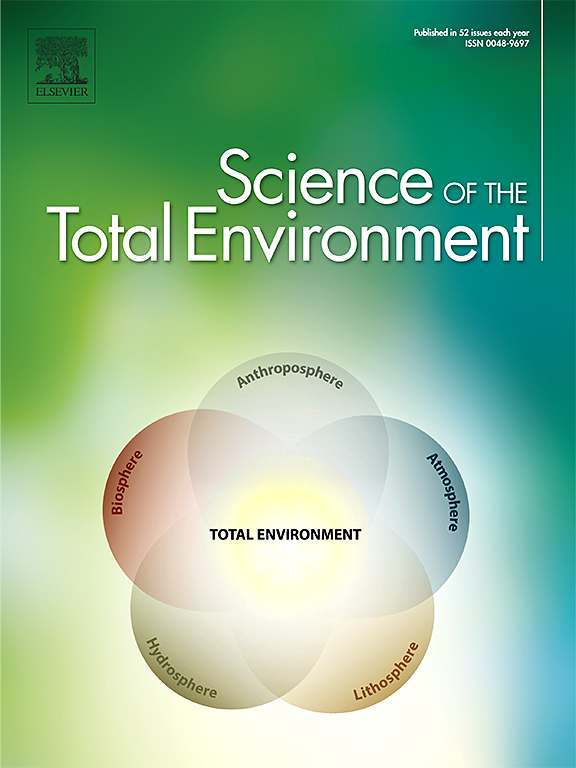
The Science of the Total Environment is an international journal dedicated to scientific research on the environment and its interaction with humanity. It covers a wide range of disciplines and seeks to publish innovative, hypothesis-driven, and impactful research that explores the entire environment, including the atmosphere, lithosphere, hydrosphere, biosphere, and anthroposphere.
The journal's updated Aims & Scope emphasizes the importance of interdisciplinary environmental research with broad impact. Priority is given to studies that advance fundamental understanding and explore the interconnectedness of multiple environmental spheres. Field studies are preferred, while laboratory experiments must demonstrate significant methodological advancements or mechanistic insights with direct relevance to the environment.




 京公网安备 11010802042870号
京ICP备2023020795号-1
京公网安备 11010802042870号
京ICP备2023020795号-1

 分享
分享
 求助内容:
求助内容: 应助结果提醒方式:
 扫码关注我们
