Taewan Kim, Se-Yup Kim, Sooho Lee, Ji-Sang Park, Hyeonjun Lee and Doh C. Lee
{"title":"Gallium incorporation in blue-emitting In1−xGaxP alloy quantum dots facilitated by monomeric gallium precursors†","authors":"Taewan Kim, Se-Yup Kim, Sooho Lee, Ji-Sang Park, Hyeonjun Lee and Doh C. Lee","doi":"10.1039/D5QI00302D","DOIUrl":null,"url":null,"abstract":"<p >Demand for environmentally friendly quantum dots (QDs) in wide color-gamut displays has led to successful development of red- and green-emitting InP QDs with outstanding optical properties. While progress in developing blue-emitting variants remains challenging, In<small><sub>1−<em>x</em></sub></small>Ga<small><sub><em>x</em></sub></small>P alloy QDs have recently garnered attention as blue emitters. However, Ga incorporation in these In<small><sub>1−<em>x</em></sub></small>Ga<small><sub><em>x</em></sub></small>P QDs is hindered by the limited reactivity of conventional gallium halide-derived precursors having a dimeric molecular structure. Here, we adopt trimethylgallium which yields monomeric gallium carboxylates as a Ga precursor in the colloidal synthesis of In<small><sub>1−<em>x</em></sub></small>Ga<small><sub><em>x</em></sub></small>P QDs. This approach promotes efficient Ga incorporation into In<small><sub>1−<em>x</em></sub></small>Ga<small><sub><em>x</em></sub></small>P QDs with narrow size distributions. The use of zinc chloride and oleylamine for ZnS shell growth on the In<small><sub>1−<em>x</em></sub></small>Ga<small><sub><em>x</em></sub></small>P cores further adjusts the photoluminescence (PL) wavelength to the blue range and enhances PL quantum yield. The resulting In<small><sub>1−<em>x</em></sub></small>Ga<small><sub><em>x</em></sub></small>P/ZnS core/shell QDs exhibit a peak emission at 470 nm, 67% of photoluminescence quantum yield, and 40 nm of emission linewidth. Successful employment of these QDs into light-emitting diodes demonstrates their potential as a blue electroluminescent emitter for future QD displays.</p>","PeriodicalId":79,"journal":{"name":"Inorganic Chemistry Frontiers","volume":" 11","pages":" 3898-3908"},"PeriodicalIF":6.4000,"publicationDate":"2025-03-18","publicationTypes":"Journal Article","fieldsOfStudy":null,"isOpenAccess":false,"openAccessPdf":"https://pubs.rsc.org/en/content/articlepdf/2025/qi/d5qi00302d?page=search","citationCount":"0","resultStr":null,"platform":"Semanticscholar","paperid":null,"PeriodicalName":"Inorganic Chemistry Frontiers","FirstCategoryId":"92","ListUrlMain":"https://pubs.rsc.org/en/content/articlelanding/2025/qi/d5qi00302d","RegionNum":1,"RegionCategory":"化学","ArticlePicture":[],"TitleCN":null,"AbstractTextCN":null,"PMCID":null,"EPubDate":"","PubModel":"","JCR":"Q1","JCRName":"CHEMISTRY, INORGANIC & NUCLEAR","Score":null,"Total":0}
引用次数: 0
Abstract
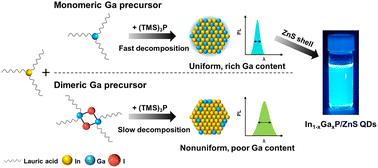
Demand for environmentally friendly quantum dots (QDs) in wide color-gamut displays has led to successful development of red- and green-emitting InP QDs with outstanding optical properties. While progress in developing blue-emitting variants remains challenging, In1−xGaxP alloy QDs have recently garnered attention as blue emitters. However, Ga incorporation in these In1−xGaxP QDs is hindered by the limited reactivity of conventional gallium halide-derived precursors having a dimeric molecular structure. Here, we adopt trimethylgallium which yields monomeric gallium carboxylates as a Ga precursor in the colloidal synthesis of In1−xGaxP QDs. This approach promotes efficient Ga incorporation into In1−xGaxP QDs with narrow size distributions. The use of zinc chloride and oleylamine for ZnS shell growth on the In1−xGaxP cores further adjusts the photoluminescence (PL) wavelength to the blue range and enhances PL quantum yield. The resulting In1−xGaxP/ZnS core/shell QDs exhibit a peak emission at 470 nm, 67% of photoluminescence quantum yield, and 40 nm of emission linewidth. Successful employment of these QDs into light-emitting diodes demonstrates their potential as a blue electroluminescent emitter for future QD displays.




 京公网安备 11010802042870号
京ICP备2023020795号-1
京公网安备 11010802042870号
京ICP备2023020795号-1

 分享
分享
 求助内容:
求助内容: 应助结果提醒方式:
 扫码关注我们
