Synergistic crystalline catalysts assembled with Wells–Dawson-type polyoxometalates and heterovalent metal complexes for efficient benzylic C–H bond oxidation†
Ze-Xuan Liu, Jing Du, Shuai Li, Miao-Qi Zhu, Yuan-Yuan Ma and Zhan-Gang Han
{"title":"Synergistic crystalline catalysts assembled with Wells–Dawson-type polyoxometalates and heterovalent metal complexes for efficient benzylic C–H bond oxidation†","authors":"Ze-Xuan Liu, Jing Du, Shuai Li, Miao-Qi Zhu, Yuan-Yuan Ma and Zhan-Gang Han","doi":"10.1039/D5QI00430F","DOIUrl":null,"url":null,"abstract":"<p >Integrating polyoxometalate and catalytically active metal centers with multiple chemical states provides a promising approach for the design of efficient catalysts for benzyl C–H bond oxidation. Herein, two synergistic crystalline catalysts assembled with the Wells–Dawson-type [P<small><sub>2</sub></small>W<small><sub>18</sub></small>O<small><sub>62</sub></small>]<small><sup>6−</sup></small> cluster and heterovalent Cu complexes were synthesized for benzylic C–H oxidation, with the formulae [Cu<small><sup>I</sup></small><small><sub>3</sub></small>Cu<small><sup>II</sup></small><small><sub>3</sub></small>(μ<small><sub>2</sub></small>-OH)<small><sub>6</sub></small>(H<small><sub>2</sub></small>O)<small><sub>1.5</sub></small>(DTAB)<small><sub>3</sub></small>][H<small><sub>3</sub></small>P<small><sub>2</sub></small>W<small><sub>18</sub></small>O<small><sub>62</sub></small>]·18H<small><sub>2</sub></small>O (<strong>1</strong>) and [Cu<small><sup>I</sup></small><small><sub>2</sub></small>(DTAB)<small><sub>2</sub></small>]{[Cu<small><sup>I</sup></small><small><sub>2</sub></small>(μ<small><sub>3</sub></small>-Cl)][Cu<small><sup>I</sup></small><small><sub>4</sub></small>(μ<small><sub>3</sub></small>-Cl)](DTAB)<small><sub>4</sub></small>}[P<small><sub>2</sub></small>W<small><sub>18</sub></small>O<small><sub>62</sub></small>]·9H<small><sub>2</sub></small>O (<strong>2</strong>) (DTAB = 1,4-di[4<em>H</em>-1,2,4-triazol-4-yl]-benzene). Compound <strong>1</strong> possesses 2-D copper–ligand cationic layers composed of heterovalent [Cu<small><sup>I</sup></small><small><sub>3</sub></small>Cu<small><sup>II</sup></small><small><sub>3</sub></small>(μ<small><sub>2</sub></small>-OH)<small><sub>6</sub></small>]<small><sup>3+</sup></small> chains, in which the protonated [H<small><sub>3</sub></small>P<small><sub>2</sub></small>W<small><sub>18</sub></small>O<small><sub>62</sub></small>]<small><sup>3−</sup></small> polyanions intercalate between them. Compound <strong>2</strong> has a sandwich-like 2-D lamellar structure consisting of three copper–organic units (binuclear {Cu<small><sup>I</sup></small><small><sub>2</sub></small>}, trinuclear {Cu<small><sup>I</sup></small><small><sub>3</sub></small>Cl}, and tetranuclear {Cu<small><sup>I</sup></small><small><sub>4</sub></small>Cl} units), in which the [P<small><sub>2</sub></small>W<small><sub>18</sub></small>O<small><sub>62</sub></small>]<small><sup>6−</sup></small> clusters are encapsulated. The heterovalent copper species and [P<small><sub>2</sub></small>W<small><sub>18</sub></small>O<small><sub>62</sub></small>]<small><sup>6−</sup></small> clusters within the two compounds make them dual-site synergistic catalysts and the roles of each component in the selective oxidation of benzyl C–H bonds were explored. Using the oxidation of diphenylmethane (DPM) as a model reaction, the two synergistic catalysts displayed <em>ca.</em> 95% and 92% DPM conversion with >98% benzophenone (BP) selectivity within 8 h. Mechanism investigations revealed that both copper sites and polyanionic clusters as active centers corporately promoted the adsorption and activation of the <em>t</em>-BuOOH oxidant in the radical-mediated DPM oxidation reaction <em>via</em> coordination and hydrogen bonding interactions to generate active <em>t</em>-BuO• and •OH radicals, accelerating the oxidation of DPM and the formation of BP. Additionally, this kind of synergistic catalyst showcased excellent substrate compatibility and recoverability, as well as robust structural stability. This work affords a promising approach for designing efficient POM-based crystalline catalysts for benzyl C–H bond oxidation.</p>","PeriodicalId":79,"journal":{"name":"Inorganic Chemistry Frontiers","volume":" 12","pages":" 4078-4090"},"PeriodicalIF":6.4000,"publicationDate":"2025-03-18","publicationTypes":"Journal Article","fieldsOfStudy":null,"isOpenAccess":false,"openAccessPdf":"","citationCount":"0","resultStr":null,"platform":"Semanticscholar","paperid":null,"PeriodicalName":"Inorganic Chemistry Frontiers","FirstCategoryId":"92","ListUrlMain":"https://pubs.rsc.org/en/content/articlelanding/2025/qi/d5qi00430f","RegionNum":1,"RegionCategory":"化学","ArticlePicture":[],"TitleCN":null,"AbstractTextCN":null,"PMCID":null,"EPubDate":"","PubModel":"","JCR":"Q1","JCRName":"CHEMISTRY, INORGANIC & NUCLEAR","Score":null,"Total":0}
引用次数: 0
Abstract
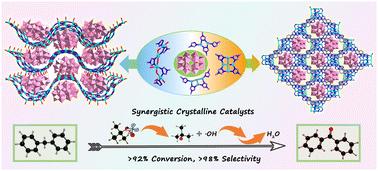
Integrating polyoxometalate and catalytically active metal centers with multiple chemical states provides a promising approach for the design of efficient catalysts for benzyl C–H bond oxidation. Herein, two synergistic crystalline catalysts assembled with the Wells–Dawson-type [P2W18O62]6− cluster and heterovalent Cu complexes were synthesized for benzylic C–H oxidation, with the formulae [CuI3CuII3(μ2-OH)6(H2O)1.5(DTAB)3][H3P2W18O62]·18H2O (1) and [CuI2(DTAB)2]{[CuI2(μ3-Cl)][CuI4(μ3-Cl)](DTAB)4}[P2W18O62]·9H2O (2) (DTAB = 1,4-di[4H-1,2,4-triazol-4-yl]-benzene). Compound 1 possesses 2-D copper–ligand cationic layers composed of heterovalent [CuI3CuII3(μ2-OH)6]3+ chains, in which the protonated [H3P2W18O62]3− polyanions intercalate between them. Compound 2 has a sandwich-like 2-D lamellar structure consisting of three copper–organic units (binuclear {CuI2}, trinuclear {CuI3Cl}, and tetranuclear {CuI4Cl} units), in which the [P2W18O62]6− clusters are encapsulated. The heterovalent copper species and [P2W18O62]6− clusters within the two compounds make them dual-site synergistic catalysts and the roles of each component in the selective oxidation of benzyl C–H bonds were explored. Using the oxidation of diphenylmethane (DPM) as a model reaction, the two synergistic catalysts displayed ca. 95% and 92% DPM conversion with >98% benzophenone (BP) selectivity within 8 h. Mechanism investigations revealed that both copper sites and polyanionic clusters as active centers corporately promoted the adsorption and activation of the t-BuOOH oxidant in the radical-mediated DPM oxidation reaction via coordination and hydrogen bonding interactions to generate active t-BuO• and •OH radicals, accelerating the oxidation of DPM and the formation of BP. Additionally, this kind of synergistic catalyst showcased excellent substrate compatibility and recoverability, as well as robust structural stability. This work affords a promising approach for designing efficient POM-based crystalline catalysts for benzyl C–H bond oxidation.




 京公网安备 11010802042870号
京ICP备2023020795号-1
京公网安备 11010802042870号
京ICP备2023020795号-1

 分享
分享
 求助内容:
求助内容: 应助结果提醒方式:
 扫码关注我们
