Oleg N. Senkov , Bryan J. Crossman , Michael J. Mills
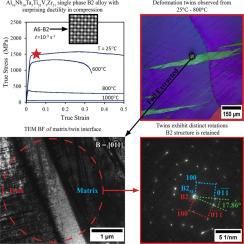
{"title":"Deformation twinning in a refractory high entropy alloy with B2-ordered crystal structure","authors":"Oleg N. Senkov , Bryan J. Crossman , Michael J. Mills","doi":"10.1016/j.actamat.2025.120926","DOIUrl":null,"url":null,"abstract":"<div><div>A B2-ordered Al<sub>16</sub>Nb<sub>10</sub>Ta<sub>5</sub>Ti<sub>33</sub>V<sub>5</sub>Zr<sub>31</sub> refractory high entropy alloy (RHEA) was previously found to exhibit good plasticity in compression from 20 °C to 1000 °C, partially attributed to the extensive deformation twinning occurring within this temperature range. This study observed that deformation twins form almost immediately after yielding, with their density increasing as plastic strain accumulates. Microstructural and crystallographic analyses show that the B2-ordered crystal structure is retained in these twins, which form through the rotation of domains within the parent grain (matrix) about 〈110〉 or 〈112〉 axes to discrete angles that match coincidence-site lattice (CSL) relationships. Conventional shear twin formation is energetically unfavorable in this alloy under the studied conditions because this mechanism requires extensive atomic shuffling to maintain the B2 order. Twins with rotation angles of 10.10°, 13.44°, 14.65°, 16.10°, 17.86°, 20.05°, 22.84°, 26.53°, 31.59°, and 38.94° were identified and analyzed. Twins with larger rotation angles are typically observed at higher plastic strain levels. A rotational twin formation mechanism, consistent with the experimental observations, is proposed and discussed.</div></div>","PeriodicalId":238,"journal":{"name":"Acta Materialia","volume":"290 ","pages":"Article 120926"},"PeriodicalIF":9.3000,"publicationDate":"2025-05-15","publicationTypes":"Journal Article","fieldsOfStudy":null,"isOpenAccess":false,"openAccessPdf":"","citationCount":"0","resultStr":null,"platform":"Semanticscholar","paperid":null,"PeriodicalName":"Acta Materialia","FirstCategoryId":"88","ListUrlMain":"https://www.sciencedirect.com/science/article/pii/S1359645425002186","RegionNum":1,"RegionCategory":"材料科学","ArticlePicture":[],"TitleCN":null,"AbstractTextCN":null,"PMCID":null,"EPubDate":"2025/3/17 0:00:00","PubModel":"Epub","JCR":"Q1","JCRName":"MATERIALS SCIENCE, MULTIDISCIPLINARY","Score":null,"Total":0}
引用次数: 0
Abstract
A B2-ordered Al16Nb10Ta5Ti33V5Zr31 refractory high entropy alloy (RHEA) was previously found to exhibit good plasticity in compression from 20 °C to 1000 °C, partially attributed to the extensive deformation twinning occurring within this temperature range. This study observed that deformation twins form almost immediately after yielding, with their density increasing as plastic strain accumulates. Microstructural and crystallographic analyses show that the B2-ordered crystal structure is retained in these twins, which form through the rotation of domains within the parent grain (matrix) about 〈110〉 or 〈112〉 axes to discrete angles that match coincidence-site lattice (CSL) relationships. Conventional shear twin formation is energetically unfavorable in this alloy under the studied conditions because this mechanism requires extensive atomic shuffling to maintain the B2 order. Twins with rotation angles of 10.10°, 13.44°, 14.65°, 16.10°, 17.86°, 20.05°, 22.84°, 26.53°, 31.59°, and 38.94° were identified and analyzed. Twins with larger rotation angles are typically observed at higher plastic strain levels. A rotational twin formation mechanism, consistent with the experimental observations, is proposed and discussed.
期刊介绍:
Acta Materialia serves as a platform for publishing full-length, original papers and commissioned overviews that contribute to a profound understanding of the correlation between the processing, structure, and properties of inorganic materials. The journal seeks papers with high impact potential or those that significantly propel the field forward. The scope includes the atomic and molecular arrangements, chemical and electronic structures, and microstructure of materials, focusing on their mechanical or functional behavior across all length scales, including nanostructures.




 京公网安备 11010802042870号
京ICP备2023020795号-1
京公网安备 11010802042870号
京ICP备2023020795号-1

 分享
分享
 求助内容:
求助内容: 应助结果提醒方式:
 扫码关注我们
