{"title":"Extracellular vesicles modulate endothelial nitric oxide production in patients with β‑thalassaemia/HbE.","authors":"Kunwadee Phongpao, Wasinee Kheansaard, Nuttanan Pholngam, Thanaporn Sriwantana, Kittiphong Paiboonsukwong, Suthat Fucharoen, Kovit Pattanapanyasat, Nuthawut Sibmooh, Pornthip Chaichompoo, Saovaros Svasti","doi":"10.3892/br.2025.1957","DOIUrl":null,"url":null,"abstract":"<p><p>Thrombosis is a significant complication in patients with β-thalassaemia/haemoglobin E (HbE), particularly in splenectomised patients. The endothelium is a key regulator of vascular haemostasis and homeostasis, through the secretion of various regulatory molecules. Nitric oxide (NO), produced by endothelial cells (ECs), regulates vascular functions by acting as a potent vasodilator and an inhibitor of platelet activation. Decreased NO bioavailability, a marker of vascular dysfunction, could be a contributing factor leading to thrombosis. Microparticles or medium extracellular vesicles (mEVs) are associated with thrombosis and vasculopathy in various diseases. Furthermore, elevated levels of mEVs have been observed in splenectomised patients with β-thalassaemia/HbE and could induce the expression of coagulation proteins, inflammatory cytokines and adhesion molecules in ECs. However, the effects of mEVs on NO regulation by ECs is currently unclear. In the present study, mEVs obtained from splenectomised patients with β-thalassaemia/HbE had significantly decreased NO production in human pulmonary artery ECs without affecting endothelial nitric oxide synthase expression or phosphorylation. Decreased NO production was attributed to increased haemoglobin levels in mEVs from splenectomised patients, leading to enhanced NO scavenging. These findings highlight a mechanism whereby haemoglobin-carrying mEVs directly scavenge NO, contributing to vascular dysfunction in β-thalassaemia/HbE disease.</p>","PeriodicalId":8863,"journal":{"name":"Biomedical reports","volume":"22 5","pages":"79"},"PeriodicalIF":2.5000,"publicationDate":"2025-02-28","publicationTypes":"Journal Article","fieldsOfStudy":null,"isOpenAccess":false,"openAccessPdf":"https://www.ncbi.nlm.nih.gov/pmc/articles/PMC11904759/pdf/","citationCount":"0","resultStr":null,"platform":"Semanticscholar","paperid":null,"PeriodicalName":"Biomedical reports","FirstCategoryId":"1085","ListUrlMain":"https://doi.org/10.3892/br.2025.1957","RegionNum":0,"RegionCategory":null,"ArticlePicture":[],"TitleCN":null,"AbstractTextCN":null,"PMCID":null,"EPubDate":"2025/5/1 0:00:00","PubModel":"eCollection","JCR":"Q3","JCRName":"MEDICINE, RESEARCH & EXPERIMENTAL","Score":null,"Total":0}
引用次数: 0
Abstract
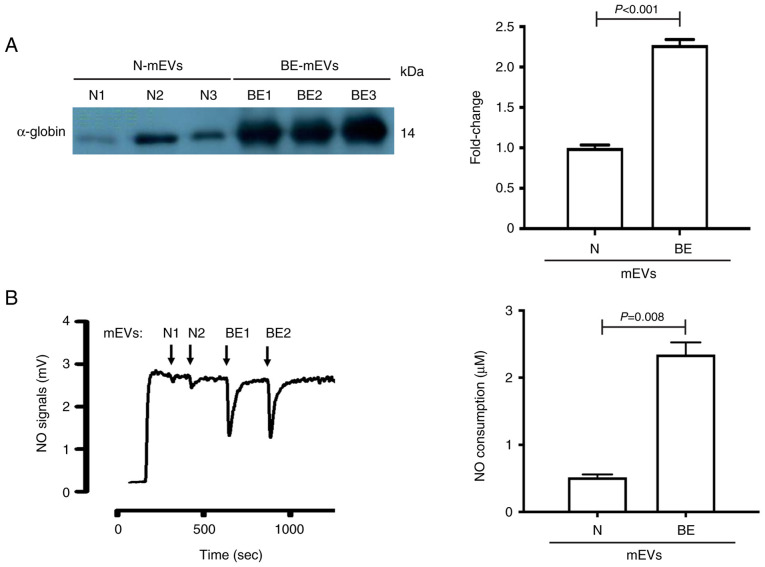
Thrombosis is a significant complication in patients with β-thalassaemia/haemoglobin E (HbE), particularly in splenectomised patients. The endothelium is a key regulator of vascular haemostasis and homeostasis, through the secretion of various regulatory molecules. Nitric oxide (NO), produced by endothelial cells (ECs), regulates vascular functions by acting as a potent vasodilator and an inhibitor of platelet activation. Decreased NO bioavailability, a marker of vascular dysfunction, could be a contributing factor leading to thrombosis. Microparticles or medium extracellular vesicles (mEVs) are associated with thrombosis and vasculopathy in various diseases. Furthermore, elevated levels of mEVs have been observed in splenectomised patients with β-thalassaemia/HbE and could induce the expression of coagulation proteins, inflammatory cytokines and adhesion molecules in ECs. However, the effects of mEVs on NO regulation by ECs is currently unclear. In the present study, mEVs obtained from splenectomised patients with β-thalassaemia/HbE had significantly decreased NO production in human pulmonary artery ECs without affecting endothelial nitric oxide synthase expression or phosphorylation. Decreased NO production was attributed to increased haemoglobin levels in mEVs from splenectomised patients, leading to enhanced NO scavenging. These findings highlight a mechanism whereby haemoglobin-carrying mEVs directly scavenge NO, contributing to vascular dysfunction in β-thalassaemia/HbE disease.
期刊介绍:
Biomedical Reports is a monthly, peer-reviewed journal, dedicated to publishing research across all fields of biology and medicine, including pharmacology, pathology, gene therapy, genetics, microbiology, neurosciences, infectious diseases, molecular cardiology and molecular surgery. The journal provides a home for original research, case reports and review articles.






 京公网安备 11010802042870号
京ICP备2023020795号-1
京公网安备 11010802042870号
京ICP备2023020795号-1

 分享
分享
 求助内容:
求助内容: 应助结果提醒方式:
 扫码关注我们
