{"title":"Transfer learning-enhanced CNN-GRU-attention model for knee joint torque prediction.","authors":"Hao Xie, Yingpeng Wang, Tingting Liu, Songhua Yan, Jizhou Zeng, Kuan Zhang","doi":"10.3389/fbioe.2025.1530950","DOIUrl":null,"url":null,"abstract":"<p><strong>Introduction: </strong>Accurate prediction of joint torque is critical for preventing injury by providing precise insights into the forces acting on joints during activities. Traditional approaches, including inverse dynamics, EMG-driven neuromusculoskeletal (NMS) models, and standard machine learning methods, typically use surface EMG (sEMG) signals and kinematic data. However, these methods often struggle to reveal the complex, non-linear relationship between muscle activation and joint motion, particularly with complex or unfamiliar movements. The generalization of joint torque estimation models across different individuals faces a significant challenge, as feature transferability tends to decline in higher, task-specific layers, reducing model performance.</p><p><strong>Methods: </strong>In this study, we proposed a CNN-GRU-Attention neural network model combining a neuromusculoskeletal (NMS) solver-informed (hybrid-CNN) augmented with transfer learning, designed to predict knee joint torque with higher accuracy. The neural network was trained using EMG signals, joint angles, and muscle forces as inputs to predict knee joint torque in different activities, and the predictive performance of the model was evaluated both within and between subjects. Additionally, we have developed a transfer learning method in the inter-subject model, which improved the accuracy of knee torque prediction by transferring the learning knowledge of previous participants to new participants.</p><p><strong>Results: </strong>Our results showed that the hybrid-CNN model can predict knee joint torque within subjects with a significantly lower error (root mean square error ≤0.16 Nm/kg). A transfer learning technique was adopted in the inter-subject tests to significantly improve the generalizability with a lower error (root mean square error ≤0.14 Nm/kg).</p><p><strong>Conclusion: </strong>The transfer learning-enhanced CNN-GRU-Attention with the NMS model shows great potential in the prediction of knee joint torque.</p>","PeriodicalId":12444,"journal":{"name":"Frontiers in Bioengineering and Biotechnology","volume":"13 ","pages":"1530950"},"PeriodicalIF":4.8000,"publicationDate":"2025-03-03","publicationTypes":"Journal Article","fieldsOfStudy":null,"isOpenAccess":false,"openAccessPdf":"https://www.ncbi.nlm.nih.gov/pmc/articles/PMC11911327/pdf/","citationCount":"0","resultStr":null,"platform":"Semanticscholar","paperid":null,"PeriodicalName":"Frontiers in Bioengineering and Biotechnology","FirstCategoryId":"5","ListUrlMain":"https://doi.org/10.3389/fbioe.2025.1530950","RegionNum":3,"RegionCategory":"工程技术","ArticlePicture":[],"TitleCN":null,"AbstractTextCN":null,"PMCID":null,"EPubDate":"2025/1/1 0:00:00","PubModel":"eCollection","JCR":"Q1","JCRName":"BIOTECHNOLOGY & APPLIED MICROBIOLOGY","Score":null,"Total":0}
引用次数: 0
Abstract
Introduction: Accurate prediction of joint torque is critical for preventing injury by providing precise insights into the forces acting on joints during activities. Traditional approaches, including inverse dynamics, EMG-driven neuromusculoskeletal (NMS) models, and standard machine learning methods, typically use surface EMG (sEMG) signals and kinematic data. However, these methods often struggle to reveal the complex, non-linear relationship between muscle activation and joint motion, particularly with complex or unfamiliar movements. The generalization of joint torque estimation models across different individuals faces a significant challenge, as feature transferability tends to decline in higher, task-specific layers, reducing model performance.
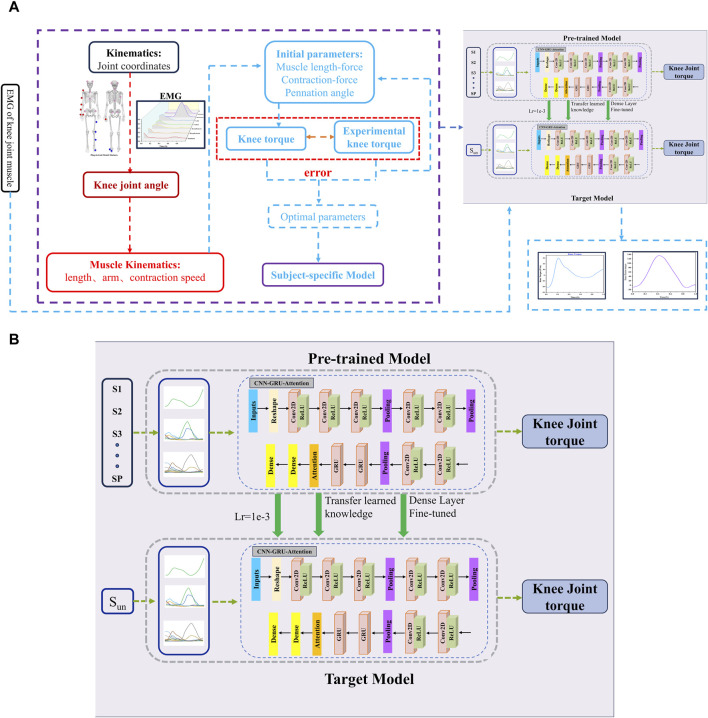
Methods: In this study, we proposed a CNN-GRU-Attention neural network model combining a neuromusculoskeletal (NMS) solver-informed (hybrid-CNN) augmented with transfer learning, designed to predict knee joint torque with higher accuracy. The neural network was trained using EMG signals, joint angles, and muscle forces as inputs to predict knee joint torque in different activities, and the predictive performance of the model was evaluated both within and between subjects. Additionally, we have developed a transfer learning method in the inter-subject model, which improved the accuracy of knee torque prediction by transferring the learning knowledge of previous participants to new participants.
Results: Our results showed that the hybrid-CNN model can predict knee joint torque within subjects with a significantly lower error (root mean square error ≤0.16 Nm/kg). A transfer learning technique was adopted in the inter-subject tests to significantly improve the generalizability with a lower error (root mean square error ≤0.14 Nm/kg).
Conclusion: The transfer learning-enhanced CNN-GRU-Attention with the NMS model shows great potential in the prediction of knee joint torque.
期刊介绍:
The translation of new discoveries in medicine to clinical routine has never been easy. During the second half of the last century, thanks to the progress in chemistry, biochemistry and pharmacology, we have seen the development and the application of a large number of drugs and devices aimed at the treatment of symptoms, blocking unwanted pathways and, in the case of infectious diseases, fighting the micro-organisms responsible. However, we are facing, today, a dramatic change in the therapeutic approach to pathologies and diseases. Indeed, the challenge of the present and the next decade is to fully restore the physiological status of the diseased organism and to completely regenerate tissue and organs when they are so seriously affected that treatments cannot be limited to the repression of symptoms or to the repair of damage. This is being made possible thanks to the major developments made in basic cell and molecular biology, including stem cell science, growth factor delivery, gene isolation and transfection, the advances in bioengineering and nanotechnology, including development of new biomaterials, biofabrication technologies and use of bioreactors, and the big improvements in diagnostic tools and imaging of cells, tissues and organs.
In today`s world, an enhancement of communication between multidisciplinary experts, together with the promotion of joint projects and close collaborations among scientists, engineers, industry people, regulatory agencies and physicians are absolute requirements for the success of any attempt to develop and clinically apply a new biological therapy or an innovative device involving the collective use of biomaterials, cells and/or bioactive molecules. “Frontiers in Bioengineering and Biotechnology” aspires to be a forum for all people involved in the process by bridging the gap too often existing between a discovery in the basic sciences and its clinical application.





 京公网安备 11010802042870号
京ICP备2023020795号-1
京公网安备 11010802042870号
京ICP备2023020795号-1

 分享
分享
 求助内容:
求助内容: 应助结果提醒方式:
 扫码关注我们
