{"title":"Different exosomes are loaded in hydrogels for the application in the field of tissue repair.","authors":"Yanyan Zhang, Wenjing Yan, Le Wu, Zihao Yu, Ying Quan, Xin Xie","doi":"10.3389/fbioe.2025.1545636","DOIUrl":null,"url":null,"abstract":"<p><p>Exosomes are double-membrane vesicular nanoparticles in the category of extracellular vesicles, ranging in size from 30 to 150 nm, and are released from cells through a specific multi-step exocytosis process. Exosomes have emerged as promising tools for tissue repair due to their ability to transfer bioactive molecules that promote cell proliferation, differentiation, and tissue regeneration. However, the therapeutic application of exosomes is hindered by their rapid clearance from the body and limited retention at the injury site. To overcome these challenges, hydrogels, known for their high biocompatibility and porous structure, have been explored as carriers for exosomes. Hydrogels can provide a controlled release mechanism, prolonging the retention time of exosomes at targeted tissues, thus enhancing their therapeutic efficacy. This review focuses on the combination of different exosomes with hydrogels in the context of tissue repair. We first introduce the sources and functions of exosomes, particularly those from mesenchymal stem cells, and their roles in regenerative medicine. We then examine various types of hydrogels, highlighting their ability to load and release exosomes. Several strategies for encapsulating exosomes in hydrogels are discussed, including the impact of hydrogel composition and structure on exosome delivery efficiency. Finally, we review the applications of exosomes-loaded hydrogels in the repair of different tissues, such as skin, bone, cartilage, and nerve, and explore the challenges and future directions in this field. The combination of exosomes with hydrogels offers significant promise for advancing tissue repair strategies and regenerative therapies.</p>","PeriodicalId":12444,"journal":{"name":"Frontiers in Bioengineering and Biotechnology","volume":"13 ","pages":"1545636"},"PeriodicalIF":4.8000,"publicationDate":"2025-03-03","publicationTypes":"Journal Article","fieldsOfStudy":null,"isOpenAccess":false,"openAccessPdf":"https://www.ncbi.nlm.nih.gov/pmc/articles/PMC11911322/pdf/","citationCount":"0","resultStr":null,"platform":"Semanticscholar","paperid":null,"PeriodicalName":"Frontiers in Bioengineering and Biotechnology","FirstCategoryId":"5","ListUrlMain":"https://doi.org/10.3389/fbioe.2025.1545636","RegionNum":3,"RegionCategory":"工程技术","ArticlePicture":[],"TitleCN":null,"AbstractTextCN":null,"PMCID":null,"EPubDate":"2025/1/1 0:00:00","PubModel":"eCollection","JCR":"Q1","JCRName":"BIOTECHNOLOGY & APPLIED MICROBIOLOGY","Score":null,"Total":0}
引用次数: 0
Abstract
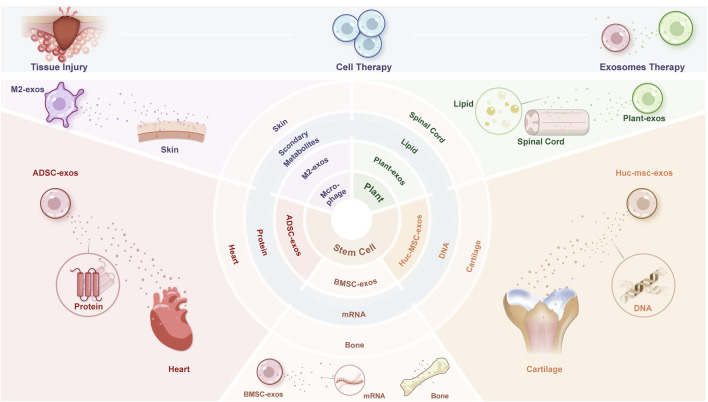
Exosomes are double-membrane vesicular nanoparticles in the category of extracellular vesicles, ranging in size from 30 to 150 nm, and are released from cells through a specific multi-step exocytosis process. Exosomes have emerged as promising tools for tissue repair due to their ability to transfer bioactive molecules that promote cell proliferation, differentiation, and tissue regeneration. However, the therapeutic application of exosomes is hindered by their rapid clearance from the body and limited retention at the injury site. To overcome these challenges, hydrogels, known for their high biocompatibility and porous structure, have been explored as carriers for exosomes. Hydrogels can provide a controlled release mechanism, prolonging the retention time of exosomes at targeted tissues, thus enhancing their therapeutic efficacy. This review focuses on the combination of different exosomes with hydrogels in the context of tissue repair. We first introduce the sources and functions of exosomes, particularly those from mesenchymal stem cells, and their roles in regenerative medicine. We then examine various types of hydrogels, highlighting their ability to load and release exosomes. Several strategies for encapsulating exosomes in hydrogels are discussed, including the impact of hydrogel composition and structure on exosome delivery efficiency. Finally, we review the applications of exosomes-loaded hydrogels in the repair of different tissues, such as skin, bone, cartilage, and nerve, and explore the challenges and future directions in this field. The combination of exosomes with hydrogels offers significant promise for advancing tissue repair strategies and regenerative therapies.
期刊介绍:
The translation of new discoveries in medicine to clinical routine has never been easy. During the second half of the last century, thanks to the progress in chemistry, biochemistry and pharmacology, we have seen the development and the application of a large number of drugs and devices aimed at the treatment of symptoms, blocking unwanted pathways and, in the case of infectious diseases, fighting the micro-organisms responsible. However, we are facing, today, a dramatic change in the therapeutic approach to pathologies and diseases. Indeed, the challenge of the present and the next decade is to fully restore the physiological status of the diseased organism and to completely regenerate tissue and organs when they are so seriously affected that treatments cannot be limited to the repression of symptoms or to the repair of damage. This is being made possible thanks to the major developments made in basic cell and molecular biology, including stem cell science, growth factor delivery, gene isolation and transfection, the advances in bioengineering and nanotechnology, including development of new biomaterials, biofabrication technologies and use of bioreactors, and the big improvements in diagnostic tools and imaging of cells, tissues and organs.
In today`s world, an enhancement of communication between multidisciplinary experts, together with the promotion of joint projects and close collaborations among scientists, engineers, industry people, regulatory agencies and physicians are absolute requirements for the success of any attempt to develop and clinically apply a new biological therapy or an innovative device involving the collective use of biomaterials, cells and/or bioactive molecules. “Frontiers in Bioengineering and Biotechnology” aspires to be a forum for all people involved in the process by bridging the gap too often existing between a discovery in the basic sciences and its clinical application.




 京公网安备 11010802042870号
京ICP备2023020795号-1
京公网安备 11010802042870号
京ICP备2023020795号-1

 分享
分享
 求助内容:
求助内容: 应助结果提醒方式:
 扫码关注我们
