A protocol of a randomized control trial to test the feasibility and efficacy of the EMPOWER social-emotional learning curriculum for youth aged 11-14 years in after-school settings.
Alice-Simone Balter, Madison Moloney, Clement Ma, Alina Lee, Sandra Pierre, Sheldon Parkes, Doga Pulat, Nicole Racine, Brendan F Andrade
{"title":"A protocol of a randomized control trial to test the feasibility and efficacy of the EMPOWER social-emotional learning curriculum for youth aged 11-14 years in after-school settings.","authors":"Alice-Simone Balter, Madison Moloney, Clement Ma, Alina Lee, Sandra Pierre, Sheldon Parkes, Doga Pulat, Nicole Racine, Brendan F Andrade","doi":"10.1371/journal.pone.0319398","DOIUrl":null,"url":null,"abstract":"<p><strong>Introduction: </strong>Promoting youth mental health and well-being is a global concern. Administering social-emotional learning programs in contexts that are familiar to youth have the potential to increase mental well-being by helping youth develop fundamental coping skills that may contribute to their resilience. Implementing social-emotional learning programs in after-school settings is a unique opportunity to improve mental well-being skills in communities that face inequities.</p><p><strong>Methods: </strong>The study is a partnership between investigators at an academic mental health hospital and an after-school program embedded within economically and socially vulnerable neighborhoods in a large metropolitan city in Ontario, Canada. This 20-week covariate-constrained randomized controlled trial will test the feasibility and preliminary efficacy of the EMPOWER social-emotional learning curriculum for youth aged 11-14 years in an after-school program. Twenty sites will be randomized to an intervention group or no-intervention control. Program staff in the intervention arm will receive training on the manualized curriculum and weekly coaching sessions to build capacity and support implementation over the 16-week program. Program staff and youth across both intervention and no-intervention control groups will be asked to participate in baseline and post-intervention data collection where they may complete questionnaires about youth's social-emotional learning skills, global quality of functioning, and resilience skills. The no-intervention control group will carry on with their regular programming while the intervention group implements the 16-week social-emotional learning curriculum, after the collection of baseline data. Program staff in the intervention group will be asked to complete weekly fidelity measures and monthly feasibility, acceptability, and appropriateness of implementation scales. Parents/caregivers of youth in the intervention group will be asked to participate in a brief interview to report their observations of their children's social-emotional learning skills.</p><p><strong>Dissemination: </strong>Results from this pilot study will be disseminated in a peer-reviewed journal and at community and academic conferences.</p>","PeriodicalId":20189,"journal":{"name":"PLoS ONE","volume":"20 3","pages":"e0319398"},"PeriodicalIF":2.6000,"publicationDate":"2025-03-17","publicationTypes":"Journal Article","fieldsOfStudy":null,"isOpenAccess":false,"openAccessPdf":"https://www.ncbi.nlm.nih.gov/pmc/articles/PMC11913269/pdf/","citationCount":"0","resultStr":null,"platform":"Semanticscholar","paperid":null,"PeriodicalName":"PLoS ONE","FirstCategoryId":"103","ListUrlMain":"https://doi.org/10.1371/journal.pone.0319398","RegionNum":3,"RegionCategory":"综合性期刊","ArticlePicture":[],"TitleCN":null,"AbstractTextCN":null,"PMCID":null,"EPubDate":"2025/1/1 0:00:00","PubModel":"eCollection","JCR":"Q1","JCRName":"MULTIDISCIPLINARY SCIENCES","Score":null,"Total":0}
引用次数: 0
Abstract
Introduction: Promoting youth mental health and well-being is a global concern. Administering social-emotional learning programs in contexts that are familiar to youth have the potential to increase mental well-being by helping youth develop fundamental coping skills that may contribute to their resilience. Implementing social-emotional learning programs in after-school settings is a unique opportunity to improve mental well-being skills in communities that face inequities.
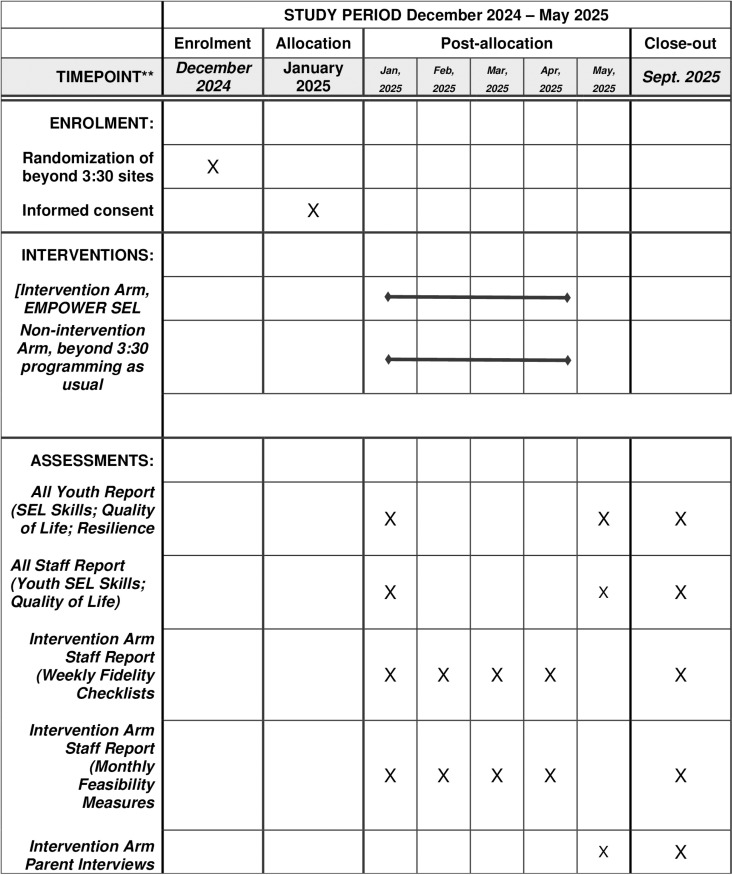
Methods: The study is a partnership between investigators at an academic mental health hospital and an after-school program embedded within economically and socially vulnerable neighborhoods in a large metropolitan city in Ontario, Canada. This 20-week covariate-constrained randomized controlled trial will test the feasibility and preliminary efficacy of the EMPOWER social-emotional learning curriculum for youth aged 11-14 years in an after-school program. Twenty sites will be randomized to an intervention group or no-intervention control. Program staff in the intervention arm will receive training on the manualized curriculum and weekly coaching sessions to build capacity and support implementation over the 16-week program. Program staff and youth across both intervention and no-intervention control groups will be asked to participate in baseline and post-intervention data collection where they may complete questionnaires about youth's social-emotional learning skills, global quality of functioning, and resilience skills. The no-intervention control group will carry on with their regular programming while the intervention group implements the 16-week social-emotional learning curriculum, after the collection of baseline data. Program staff in the intervention group will be asked to complete weekly fidelity measures and monthly feasibility, acceptability, and appropriateness of implementation scales. Parents/caregivers of youth in the intervention group will be asked to participate in a brief interview to report their observations of their children's social-emotional learning skills.
Dissemination: Results from this pilot study will be disseminated in a peer-reviewed journal and at community and academic conferences.
期刊介绍:
PLOS ONE is an international, peer-reviewed, open-access, online publication. PLOS ONE welcomes reports on primary research from any scientific discipline. It provides:
* Open-access—freely accessible online, authors retain copyright
* Fast publication times
* Peer review by expert, practicing researchers
* Post-publication tools to indicate quality and impact
* Community-based dialogue on articles
* Worldwide media coverage




 京公网安备 11010802042870号
京ICP备2023020795号-1
京公网安备 11010802042870号
京ICP备2023020795号-1

 分享
分享
 求助内容:
求助内容: 应助结果提醒方式:
 扫码关注我们
