Ehsan Mohammad Hosseini, Seyed Hossein Aghamiri, Mohsen Koosha, Mohammad Hasanpour, MohammadAmin Farajzadeh
{"title":"Hybrid endovascular and open surgical management of retained stab wounds: illustrative case.","authors":"Ehsan Mohammad Hosseini, Seyed Hossein Aghamiri, Mohsen Koosha, Mohammad Hasanpour, MohammadAmin Farajzadeh","doi":"10.3171/CASE24692","DOIUrl":null,"url":null,"abstract":"<p><strong>Background: </strong>Penetrating brain injuries (PBIs) are rare cases of traumatic brain injuries and are associated with high mortality. Initial management for PBIs focuses on airway, circulation, and cranial imaging evaluation. In the next step, physical examinations are essential, including understanding the mechanism of injury, conducting a thorough neurological assessment, and reviewing medications. Imaging techniques such as CT and CT angiography are essential for assessing the extent of the injury and predicting outcomes.</p><p><strong>Observations: </strong>A 30-year-old male presented with a PBI in the left eye. A CT scan revealed that a knife had penetrated into the frontal lobe, causing contusions and subarachnoid hemorrhage. Angiography showed that the knife was close to the anterior cerebral artery (A1-A2 junction), which increased the risk of hemorrhage and complications during removal of the knife. A hybrid approach using angiographic guidance and balloon/stent catheters was used. Incremental removal of the knife was performed with real-time angiographic monitoring. The patient underwent successful skull base repair and enucleation, with follow-up showing no complications.</p><p><strong>Lessons: </strong>Traditional acute management typically involves craniotomy for foreign object removal; however, this case report highlights the successful application of endovascular techniques alongside the classic method for hybrid management of these patients. https://thejns.org/doi/10.3171/CASE24692.</p>","PeriodicalId":94098,"journal":{"name":"Journal of neurosurgery. Case lessons","volume":"9 11","pages":""},"PeriodicalIF":0.0000,"publicationDate":"2025-03-17","publicationTypes":"Journal Article","fieldsOfStudy":null,"isOpenAccess":false,"openAccessPdf":"https://www.ncbi.nlm.nih.gov/pmc/articles/PMC11912926/pdf/","citationCount":"0","resultStr":null,"platform":"Semanticscholar","paperid":null,"PeriodicalName":"Journal of neurosurgery. Case lessons","FirstCategoryId":"1085","ListUrlMain":"https://doi.org/10.3171/CASE24692","RegionNum":0,"RegionCategory":null,"ArticlePicture":[],"TitleCN":null,"AbstractTextCN":null,"PMCID":null,"EPubDate":"","PubModel":"","JCR":"","JCRName":"","Score":null,"Total":0}
引用次数: 0
Abstract
Background: Penetrating brain injuries (PBIs) are rare cases of traumatic brain injuries and are associated with high mortality. Initial management for PBIs focuses on airway, circulation, and cranial imaging evaluation. In the next step, physical examinations are essential, including understanding the mechanism of injury, conducting a thorough neurological assessment, and reviewing medications. Imaging techniques such as CT and CT angiography are essential for assessing the extent of the injury and predicting outcomes.
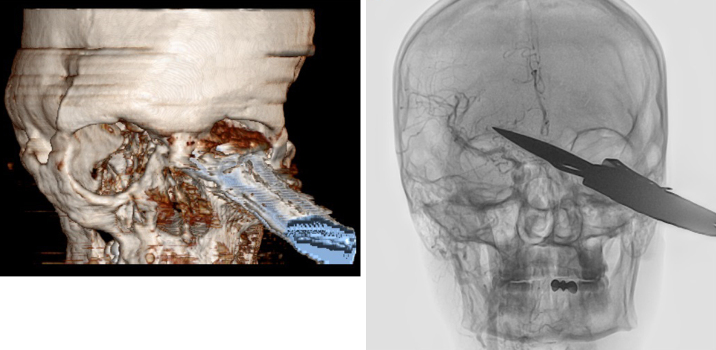
Observations: A 30-year-old male presented with a PBI in the left eye. A CT scan revealed that a knife had penetrated into the frontal lobe, causing contusions and subarachnoid hemorrhage. Angiography showed that the knife was close to the anterior cerebral artery (A1-A2 junction), which increased the risk of hemorrhage and complications during removal of the knife. A hybrid approach using angiographic guidance and balloon/stent catheters was used. Incremental removal of the knife was performed with real-time angiographic monitoring. The patient underwent successful skull base repair and enucleation, with follow-up showing no complications.
Lessons: Traditional acute management typically involves craniotomy for foreign object removal; however, this case report highlights the successful application of endovascular techniques alongside the classic method for hybrid management of these patients. https://thejns.org/doi/10.3171/CASE24692.





 京公网安备 11010802042870号
京ICP备2023020795号-1
京公网安备 11010802042870号
京ICP备2023020795号-1

 分享
分享

 求助内容:
求助内容: 应助结果提醒方式:
 扫码关注我们
