{"title":"Attentional bias towards smartphone stimuli is associated with decreased interoceptive awareness and increased physiological reactivity.","authors":"Yusuke Haruki, Katsunori Miyahara, Kenji Ogawa, Keisuke Suzuki","doi":"10.1038/s44271-025-00225-6","DOIUrl":null,"url":null,"abstract":"<p><p>Excessive smartphone use has been linked to negative psychological outcomes and may also be associated with cognitive impairments and disruptions in mind-body interaction, though the underlying mechanisms remain unclear. Here, we investigated attentional bias towards marginal smartphone stimuli and its relationship with interoceptive awareness and physiological cue reactivity in healthy young adults. Fifty-eight participants completed a letter detection task with varying perceptual loads, during which task-irrelevant smartphone-related or scrambled images were presented in the background. Cardiac responses were recorded to assess physiological reactivity. Participants also completed two questionnaires for interoceptive awareness and self-report smartphone addiction. Using a designed and automated clustering based on behavioural responses, participants were classified into two groups: one group exhibited distraction from smartphone background only under low perceptual load, while the other showed consistent attentional bias regardless of load. Notably, the latter group reported significantly lower interoceptive awareness and higher smartphone addiction scores. Additionally, they exhibited heart rate acceleration in response to smartphone stimuli, indicating heightened arousal, whereas the former group showed heart rate deceleration. These findings demonstrate that consistent attentional bias towards smartphone stimuli is associated with reduced interoceptive awareness, specifically a decreased tendency to notice and trust internal bodily sensations, and increased physiological reactivity.</p>","PeriodicalId":501698,"journal":{"name":"Communications Psychology","volume":"3 1","pages":"42"},"PeriodicalIF":0.0000,"publicationDate":"2025-03-17","publicationTypes":"Journal Article","fieldsOfStudy":null,"isOpenAccess":false,"openAccessPdf":"https://www.ncbi.nlm.nih.gov/pmc/articles/PMC11914067/pdf/","citationCount":"0","resultStr":null,"platform":"Semanticscholar","paperid":null,"PeriodicalName":"Communications Psychology","FirstCategoryId":"1085","ListUrlMain":"https://doi.org/10.1038/s44271-025-00225-6","RegionNum":0,"RegionCategory":null,"ArticlePicture":[],"TitleCN":null,"AbstractTextCN":null,"PMCID":null,"EPubDate":"","PubModel":"","JCR":"","JCRName":"","Score":null,"Total":0}
引用次数: 0
Abstract
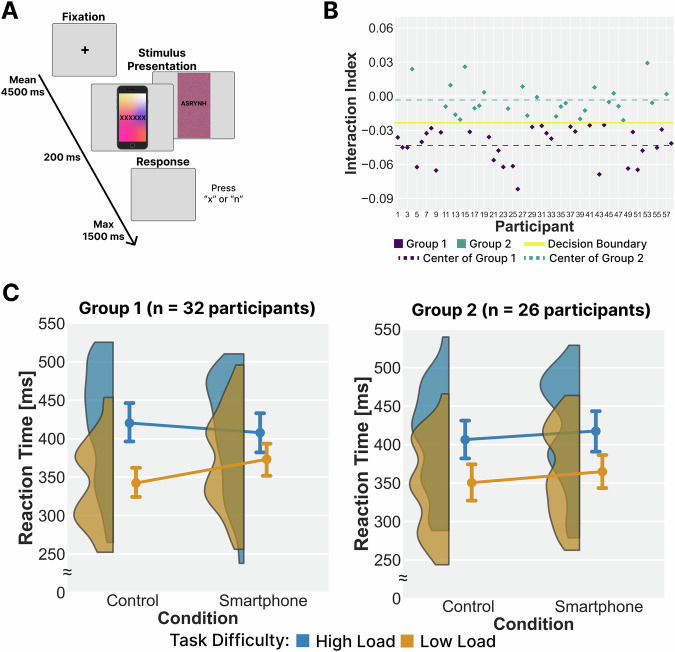
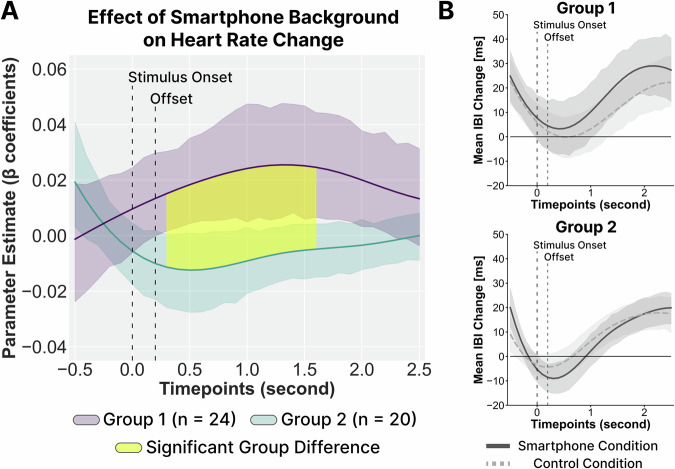
Excessive smartphone use has been linked to negative psychological outcomes and may also be associated with cognitive impairments and disruptions in mind-body interaction, though the underlying mechanisms remain unclear. Here, we investigated attentional bias towards marginal smartphone stimuli and its relationship with interoceptive awareness and physiological cue reactivity in healthy young adults. Fifty-eight participants completed a letter detection task with varying perceptual loads, during which task-irrelevant smartphone-related or scrambled images were presented in the background. Cardiac responses were recorded to assess physiological reactivity. Participants also completed two questionnaires for interoceptive awareness and self-report smartphone addiction. Using a designed and automated clustering based on behavioural responses, participants were classified into two groups: one group exhibited distraction from smartphone background only under low perceptual load, while the other showed consistent attentional bias regardless of load. Notably, the latter group reported significantly lower interoceptive awareness and higher smartphone addiction scores. Additionally, they exhibited heart rate acceleration in response to smartphone stimuli, indicating heightened arousal, whereas the former group showed heart rate deceleration. These findings demonstrate that consistent attentional bias towards smartphone stimuli is associated with reduced interoceptive awareness, specifically a decreased tendency to notice and trust internal bodily sensations, and increased physiological reactivity.



 京公网安备 11010802042870号
京ICP备2023020795号-1
京公网安备 11010802042870号
京ICP备2023020795号-1

 分享
分享

 求助内容:
求助内容: 应助结果提醒方式:
 扫码关注我们
