Matthew R. Kerr, Nicole Currie, Matthew A. Kosnik, John Alroy
{"title":"Regional databases demonstrate macroecological patterns less clearly than systematically collected field data","authors":"Matthew R. Kerr, Nicole Currie, Matthew A. Kosnik, John Alroy","doi":"10.1111/ecog.07355","DOIUrl":null,"url":null,"abstract":"<p>The analysis of macroecological patterns has necessitated the use of large, composite datasets recording local-scale species occurrences distributed across the globe. These datasets, however, have various spatial and temporal biases, including taxonomic under sampling, range gaps for many species, and geographic uncertainty. They have rarely been compared to data collected in the field across large spatial gradients. In this paper we use two datasets built from online repositories plus standardised field collections of death assemblages to reconstruct macroecological patterns for marine bivalves along the eastern coastline of Australia – spanning over 20° of latitude and the transition between tropical and temperate regions. We test the strength of the latitudinal diversity gradient using four diversity measures and identify a biogeographical boundary. The field collection demonstrates a strong latitudinal gradient, but results from the composite datasets were varied. Adding observation-based records to the composite dataset obscured the latitudinal gradient. The location of the biogeographic boundary was the same in all datasets, and the location mirrored two previously published bioregionalisations. Although broad patterns seen in the field can be uncovered from composite macroecological datasets, care both in dataset construction and choice of methods is needed to ensure robust results.</p>","PeriodicalId":51026,"journal":{"name":"Ecography","volume":"2025 6","pages":""},"PeriodicalIF":4.7000,"publicationDate":"2025-03-19","publicationTypes":"Journal Article","fieldsOfStudy":null,"isOpenAccess":false,"openAccessPdf":"https://onlinelibrary.wiley.com/doi/epdf/10.1111/ecog.07355","citationCount":"0","resultStr":null,"platform":"Semanticscholar","paperid":null,"PeriodicalName":"Ecography","FirstCategoryId":"93","ListUrlMain":"https://nsojournals.onlinelibrary.wiley.com/doi/10.1111/ecog.07355","RegionNum":1,"RegionCategory":"环境科学与生态学","ArticlePicture":[],"TitleCN":null,"AbstractTextCN":null,"PMCID":null,"EPubDate":"","PubModel":"","JCR":"Q1","JCRName":"BIODIVERSITY CONSERVATION","Score":null,"Total":0}
引用次数: 0
Abstract
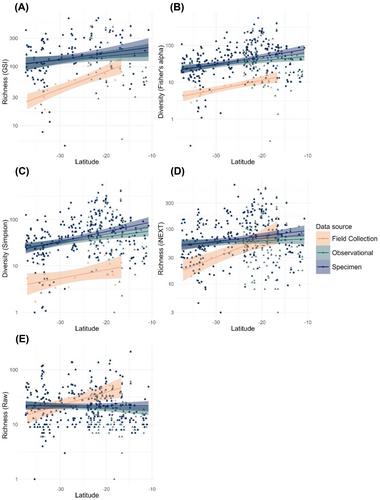
The analysis of macroecological patterns has necessitated the use of large, composite datasets recording local-scale species occurrences distributed across the globe. These datasets, however, have various spatial and temporal biases, including taxonomic under sampling, range gaps for many species, and geographic uncertainty. They have rarely been compared to data collected in the field across large spatial gradients. In this paper we use two datasets built from online repositories plus standardised field collections of death assemblages to reconstruct macroecological patterns for marine bivalves along the eastern coastline of Australia – spanning over 20° of latitude and the transition between tropical and temperate regions. We test the strength of the latitudinal diversity gradient using four diversity measures and identify a biogeographical boundary. The field collection demonstrates a strong latitudinal gradient, but results from the composite datasets were varied. Adding observation-based records to the composite dataset obscured the latitudinal gradient. The location of the biogeographic boundary was the same in all datasets, and the location mirrored two previously published bioregionalisations. Although broad patterns seen in the field can be uncovered from composite macroecological datasets, care both in dataset construction and choice of methods is needed to ensure robust results.
期刊介绍:
ECOGRAPHY publishes exciting, novel, and important articles that significantly advance understanding of ecological or biodiversity patterns in space or time. Papers focusing on conservation or restoration are welcomed, provided they are anchored in ecological theory and convey a general message that goes beyond a single case study. We encourage papers that seek advancing the field through the development and testing of theory or methodology, or by proposing new tools for analysis or interpretation of ecological phenomena. Manuscripts are expected to address general principles in ecology, though they may do so using a specific model system if they adequately frame the problem relative to a generalized ecological question or problem.
Purely descriptive papers are considered only if breaking new ground and/or describing patterns seldom explored. Studies focused on a single species or single location are generally discouraged unless they make a significant contribution to advancing general theory or understanding of biodiversity patterns and processes. Manuscripts merely confirming or marginally extending results of previous work are unlikely to be considered in Ecography.
Papers are judged by virtue of their originality, appeal to general interest, and their contribution to new developments in studies of spatial and temporal ecological patterns. There are no biases with regard to taxon, biome, or biogeographical area.





 京公网安备 11010802042870号
京ICP备2023020795号-1
京公网安备 11010802042870号
京ICP备2023020795号-1

 分享
分享
 求助内容:
求助内容: 应助结果提醒方式:
 扫码关注我们
