Damith Chandrasenage, William Johnson, Paula L Griffiths
{"title":"Stunting and inequality in Sri Lanka compared with other low- and middle-income South Asian countries.","authors":"Damith Chandrasenage, William Johnson, Paula L Griffiths","doi":"10.1017/S1368980025000205","DOIUrl":null,"url":null,"abstract":"<p><strong>Objective: </strong>This study investigates and measures whether the association of childhood stunting with household socio-economic position (SEP) differs in Sri Lanka compared with other South Asian countries.</p><p><strong>Design: </strong>Secondary analysis of data of children from the latest available Demographic and Health Surveys data (survey years, 2016-2018). The exposures (SEP) were maternal education and wealth. The outcome was stunting. Binary logistic regression models incorporated SEP, country and SEP-by-country interaction terms.</p><p><strong>Setting: </strong>A nationally representative sample of children from Bangladesh, India, Nepal, Pakistan and Sri Lanka.</p><p><strong>Participants: </strong>Mothers/caregivers of children under 36 months (133 491).</p><p><strong>Results: </strong>The prevalence of stunting in Sri Lanka of 19 % was much lower than that observed for all the other low- to low-middle income South Asian countries (37 % in Bangladesh, 36 % in India, 31 % in Nepal and 30 % in Pakistan). The association of SEP with odds of stunting was similar in Sri Lanka compared with other South Asian countries. The only exception was weaker associations of wealth with stunting in Sri Lanka compared with Bangladesh. For example, in Sri Lanka, the poorest group had 2·75 (2·06, 3·67) times higher odds of stunting compared with the richest group, but in Bangladesh, this estimate was 4·20 (3·24, 5·44); the difference between these two estimates being 0·65 (0·44, 0·96) on the OR scale.</p><p><strong>Conclusions: </strong>The lower prevalence of stunting in Sri Lanka is unlikely to be due to less inequality. It is more likely that the lower prevalence of stunting in Sri Lanka is related to there being fewer mothers belonging to the lowest SEP groups.</p>","PeriodicalId":20951,"journal":{"name":"Public Health Nutrition","volume":" ","pages":"e63"},"PeriodicalIF":3.0000,"publicationDate":"2025-03-19","publicationTypes":"Journal Article","fieldsOfStudy":null,"isOpenAccess":false,"openAccessPdf":"https://www.ncbi.nlm.nih.gov/pmc/articles/PMC12086723/pdf/","citationCount":"0","resultStr":null,"platform":"Semanticscholar","paperid":null,"PeriodicalName":"Public Health Nutrition","FirstCategoryId":"3","ListUrlMain":"https://doi.org/10.1017/S1368980025000205","RegionNum":3,"RegionCategory":"医学","ArticlePicture":[],"TitleCN":null,"AbstractTextCN":null,"PMCID":null,"EPubDate":"","PubModel":"","JCR":"Q2","JCRName":"NUTRITION & DIETETICS","Score":null,"Total":0}
引用次数: 0
Abstract
Objective: This study investigates and measures whether the association of childhood stunting with household socio-economic position (SEP) differs in Sri Lanka compared with other South Asian countries.
Design: Secondary analysis of data of children from the latest available Demographic and Health Surveys data (survey years, 2016-2018). The exposures (SEP) were maternal education and wealth. The outcome was stunting. Binary logistic regression models incorporated SEP, country and SEP-by-country interaction terms.
Setting: A nationally representative sample of children from Bangladesh, India, Nepal, Pakistan and Sri Lanka.
Participants: Mothers/caregivers of children under 36 months (133 491).
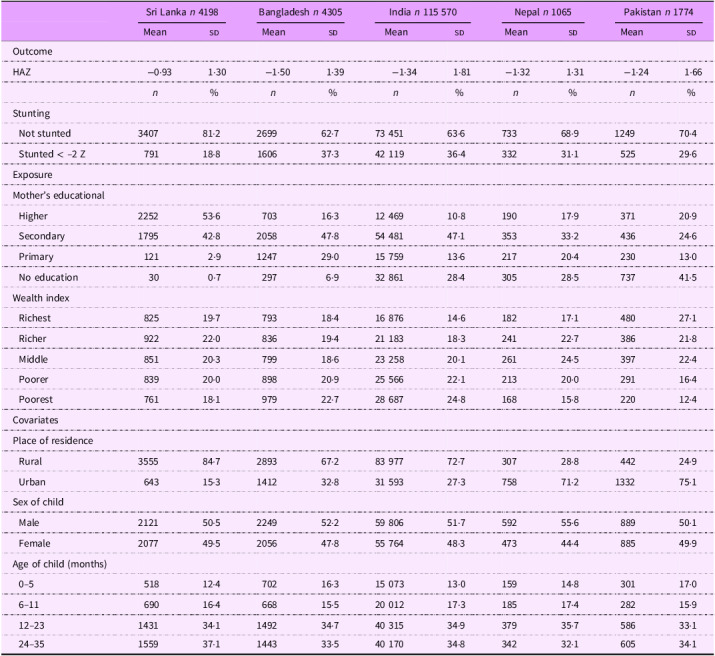
Results: The prevalence of stunting in Sri Lanka of 19 % was much lower than that observed for all the other low- to low-middle income South Asian countries (37 % in Bangladesh, 36 % in India, 31 % in Nepal and 30 % in Pakistan). The association of SEP with odds of stunting was similar in Sri Lanka compared with other South Asian countries. The only exception was weaker associations of wealth with stunting in Sri Lanka compared with Bangladesh. For example, in Sri Lanka, the poorest group had 2·75 (2·06, 3·67) times higher odds of stunting compared with the richest group, but in Bangladesh, this estimate was 4·20 (3·24, 5·44); the difference between these two estimates being 0·65 (0·44, 0·96) on the OR scale.
Conclusions: The lower prevalence of stunting in Sri Lanka is unlikely to be due to less inequality. It is more likely that the lower prevalence of stunting in Sri Lanka is related to there being fewer mothers belonging to the lowest SEP groups.
期刊介绍:
Public Health Nutrition provides an international peer-reviewed forum for the publication and dissemination of research and scholarship aimed at understanding the causes of, and approaches and solutions to nutrition-related public health achievements, situations and problems around the world. The journal publishes original and commissioned articles, commentaries and discussion papers for debate. The journal is of interest to epidemiologists and health promotion specialists interested in the role of nutrition in disease prevention; academics and those involved in fieldwork and the application of research to identify practical solutions to important public health problems.





 京公网安备 11010802042870号
京ICP备2023020795号-1
京公网安备 11010802042870号
京ICP备2023020795号-1

 分享
分享
 求助内容:
求助内容: 应助结果提醒方式:
 扫码关注我们
