Simone D Herzberg, Nelly-Estefanie Garduno-Rapp, Henry H Ong, Srushti Gangireddy, Anoop S Chandrashekar, Wei-Qi Wei, Lance E LeClere, Wanqing Wen, Katherine E Hartmann, Nitin B Jain, Ayush Giri
{"title":"Standardizing phenotypic algorithms for the classification of degenerative rotator cuff tear from electronic health record systems.","authors":"Simone D Herzberg, Nelly-Estefanie Garduno-Rapp, Henry H Ong, Srushti Gangireddy, Anoop S Chandrashekar, Wei-Qi Wei, Lance E LeClere, Wanqing Wen, Katherine E Hartmann, Nitin B Jain, Ayush Giri","doi":"10.1093/jamiaopen/ooaf014","DOIUrl":null,"url":null,"abstract":"<p><strong>Objectives: </strong>Degenerative rotator cuff tears (DCTs) are the leading cause of shoulder pain, affecting 30%-50% of individuals over 50. Current phenotyping strategies for DCT use heterogeneous combinations of procedural and diagnostic codes and are concerning for misclassification. The objective of this study was to create standardized phenotypic algorithms to classify DCT status across electronic health record (EHR) systems.</p><p><strong>Materials and methods: </strong>Using a de-identified EHR system, containing chart level data for ∼3.5 million individuals from January 1998 to December 2023, we developed and validated 2 types of algorithms-one requiring and one without imaging verification-to identify DCT cases and controls. The algorithms used combinations of International Classification of Diseases (ICD) / Current Procedural Terminology (CPT) codes and natural language processing (NLP) to increase diagnostic certainty. These hand-crafted algorithms underwent iterative refinement with manual chart review by trained personnel blinded to case-control determinations to compute positive predictive value (PPV) and negative predictive value (NPV).</p><p><strong>Results: </strong>The algorithm development process resulted in 5 algorithms to identify patients with or without DCT with an overall predictive value of 94.5%: (1) code only cases that required imaging confirmation (PPV = 89%), (2) code only cases that did not require imaging verification (PPV = 92%), (3) NLP-based cases that did not require imaging verification (PPV = 89%), (4) code-based controls that required imaging confirmation (NPV = 90%), and (5) code and NLP-based controls that did not require imaging verification (NPV = 100%). External validation demonstrated 94% sensitivity and 75% specificity for the code-only algorithms.</p><p><strong>Discussion: </strong>This work highlights the inaccuracy of previous approaches to phenotypic assessment of DCT reliant solely on ICD and CPT codes and demonstrate that integrating temporal and frequency requirements, as well as NLP, substantially increases predictive value. However, while the inclusion of imaging verification enhances diagnostic confidence, it also reduces sample size without necessarily improving predictive value, underscoring the need for a balance between precision and scalability in phenotypic definitions for large-scale genetic and clinical research.</p><p><strong>Conclusions: </strong>These algorithms represent an improvement over prior DCT phenotyping strategies and can be useful in large-scale EHR studies.</p>","PeriodicalId":36278,"journal":{"name":"JAMIA Open","volume":"8 2","pages":"ooaf014"},"PeriodicalIF":3.4000,"publicationDate":"2025-03-18","publicationTypes":"Journal Article","fieldsOfStudy":null,"isOpenAccess":false,"openAccessPdf":"https://www.ncbi.nlm.nih.gov/pmc/articles/PMC11917214/pdf/","citationCount":"0","resultStr":null,"platform":"Semanticscholar","paperid":null,"PeriodicalName":"JAMIA Open","FirstCategoryId":"1085","ListUrlMain":"https://doi.org/10.1093/jamiaopen/ooaf014","RegionNum":0,"RegionCategory":null,"ArticlePicture":[],"TitleCN":null,"AbstractTextCN":null,"PMCID":null,"EPubDate":"2025/4/1 0:00:00","PubModel":"eCollection","JCR":"Q2","JCRName":"HEALTH CARE SCIENCES & SERVICES","Score":null,"Total":0}
引用次数: 0
Abstract
Objectives: Degenerative rotator cuff tears (DCTs) are the leading cause of shoulder pain, affecting 30%-50% of individuals over 50. Current phenotyping strategies for DCT use heterogeneous combinations of procedural and diagnostic codes and are concerning for misclassification. The objective of this study was to create standardized phenotypic algorithms to classify DCT status across electronic health record (EHR) systems.
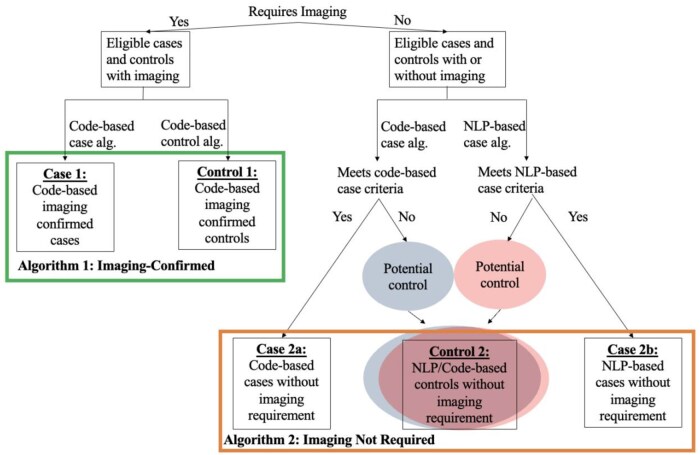
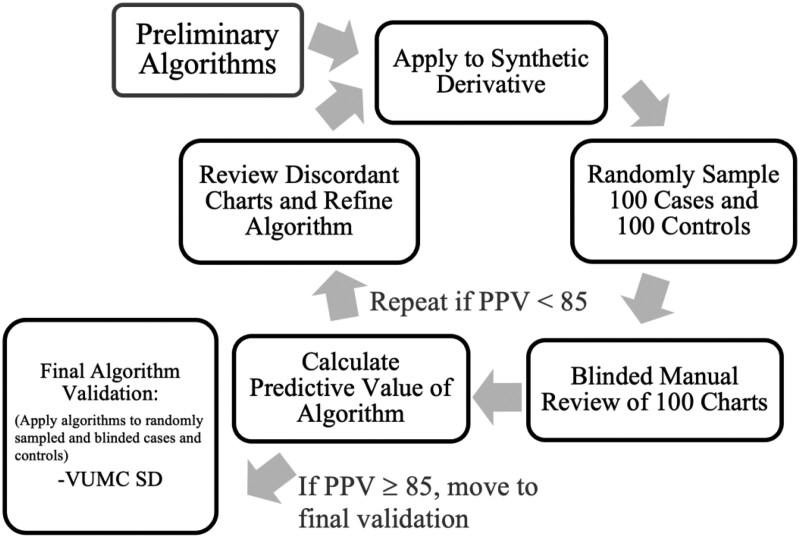
Materials and methods: Using a de-identified EHR system, containing chart level data for ∼3.5 million individuals from January 1998 to December 2023, we developed and validated 2 types of algorithms-one requiring and one without imaging verification-to identify DCT cases and controls. The algorithms used combinations of International Classification of Diseases (ICD) / Current Procedural Terminology (CPT) codes and natural language processing (NLP) to increase diagnostic certainty. These hand-crafted algorithms underwent iterative refinement with manual chart review by trained personnel blinded to case-control determinations to compute positive predictive value (PPV) and negative predictive value (NPV).
Results: The algorithm development process resulted in 5 algorithms to identify patients with or without DCT with an overall predictive value of 94.5%: (1) code only cases that required imaging confirmation (PPV = 89%), (2) code only cases that did not require imaging verification (PPV = 92%), (3) NLP-based cases that did not require imaging verification (PPV = 89%), (4) code-based controls that required imaging confirmation (NPV = 90%), and (5) code and NLP-based controls that did not require imaging verification (NPV = 100%). External validation demonstrated 94% sensitivity and 75% specificity for the code-only algorithms.
Discussion: This work highlights the inaccuracy of previous approaches to phenotypic assessment of DCT reliant solely on ICD and CPT codes and demonstrate that integrating temporal and frequency requirements, as well as NLP, substantially increases predictive value. However, while the inclusion of imaging verification enhances diagnostic confidence, it also reduces sample size without necessarily improving predictive value, underscoring the need for a balance between precision and scalability in phenotypic definitions for large-scale genetic and clinical research.
Conclusions: These algorithms represent an improvement over prior DCT phenotyping strategies and can be useful in large-scale EHR studies.




 京公网安备 11010802042870号
京ICP备2023020795号-1
京公网安备 11010802042870号
京ICP备2023020795号-1

 分享
分享
 求助内容:
求助内容: 应助结果提醒方式:
 扫码关注我们
