{"title":"Development of nutrient-rich complementary foods using locally sourced ingredients for low-income households in Eastern Ethiopia.","authors":"Anbesse Girma Shewa, Shewangizawe Teketele Anamoo, Solomon Abera, Mikiyas Kebede Ali, Jalene Gelan","doi":"10.3389/fnut.2025.1537357","DOIUrl":null,"url":null,"abstract":"<p><strong>Background: </strong>The prevalence of malnutrition among infants continues to be a significant issue in Ethiopia. Although commercial complementary foods are accessible in the market, their prohibitive costs render them unaffordable for low-income households. Consequently, this study was undertaken to formulate complementary foods utilizing locally available, nutrient-rich ingredients tailored for low-income households.</p><p><strong>Method: </strong>The effect of various processing techniques-such as boiling, germination, and roasting-on the physicochemical properties of maize and groundnut flours, including proximate composition, mineral content, phytochemicals, and β-carotene levels, was evaluated using standard methodologies. A complementary food product was developed by varying the blending ratios of maize flour, groundnuts, spinach leaves, and sweet potatoes. Subsequently, the physicochemical and sensory characteristics of the product were assessed.</p><p><strong>Results: </strong>The processes of germination and roasting (applied to maize and groundnut) demonstrated minimal impact on the proximate composition, mineral content, and β-carotene levels while also decreasing the amounts of specific phytochemicals (such as tannins, phenols, and phytic acid) found in the raw materials. Consequently, these processed ingredients were used to formulate eight complementary food products. The results of the proximate composition analysis for the eight developed food formulas indicated that the protein content ranged from 15.35 to 16.39%. Additionally, the fat, carbohydrate, and energy values were observed to range from 8.1 to 11.9%, 59.12 to 63.07%, and 383.82 to 412.87 kcal, respectively, indicating a nutritional profile consistent with locally available commercial complementary foods. Similarly, the levels of calcium, zinc, iron, magnesium, and β-carotene were measured to range from 66.75 mg to 102.48 mg, 1.33 mg to 2.48 mg, 6.64 mg to 10.36 mg, 122.60 mg to 181.73 mg, and 113.40 mg to 197.53 mg per 100 g, respectively, alongside notably low levels of anti-nutritional factors.</p><p><strong>Conclusion: </strong>Including supplementary food is crucial when breastfeeding alone does not adequately meet an infant's nutritional requirements. As a result, the complementary food developed can provide 5 to 50% of the daily recommended nutrient allowance for infants.</p>","PeriodicalId":12473,"journal":{"name":"Frontiers in Nutrition","volume":"12 ","pages":"1537357"},"PeriodicalIF":5.5000,"publicationDate":"2025-03-05","publicationTypes":"Journal Article","fieldsOfStudy":null,"isOpenAccess":false,"openAccessPdf":"https://www.ncbi.nlm.nih.gov/pmc/articles/PMC11919676/pdf/","citationCount":"0","resultStr":null,"platform":"Semanticscholar","paperid":null,"PeriodicalName":"Frontiers in Nutrition","FirstCategoryId":"97","ListUrlMain":"https://doi.org/10.3389/fnut.2025.1537357","RegionNum":2,"RegionCategory":"农林科学","ArticlePicture":[],"TitleCN":null,"AbstractTextCN":null,"PMCID":null,"EPubDate":"2025/1/1 0:00:00","PubModel":"eCollection","JCR":"Q2","JCRName":"NUTRITION & DIETETICS","Score":null,"Total":0}
引用次数: 0
Abstract
Background: The prevalence of malnutrition among infants continues to be a significant issue in Ethiopia. Although commercial complementary foods are accessible in the market, their prohibitive costs render them unaffordable for low-income households. Consequently, this study was undertaken to formulate complementary foods utilizing locally available, nutrient-rich ingredients tailored for low-income households.
Method: The effect of various processing techniques-such as boiling, germination, and roasting-on the physicochemical properties of maize and groundnut flours, including proximate composition, mineral content, phytochemicals, and β-carotene levels, was evaluated using standard methodologies. A complementary food product was developed by varying the blending ratios of maize flour, groundnuts, spinach leaves, and sweet potatoes. Subsequently, the physicochemical and sensory characteristics of the product were assessed.
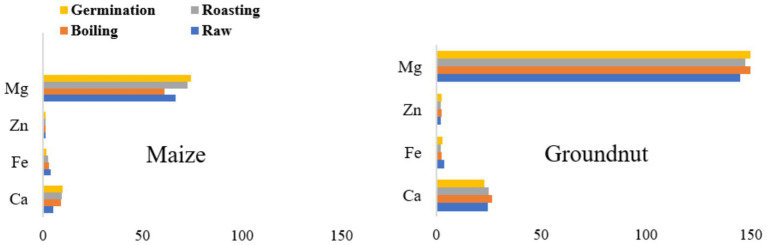
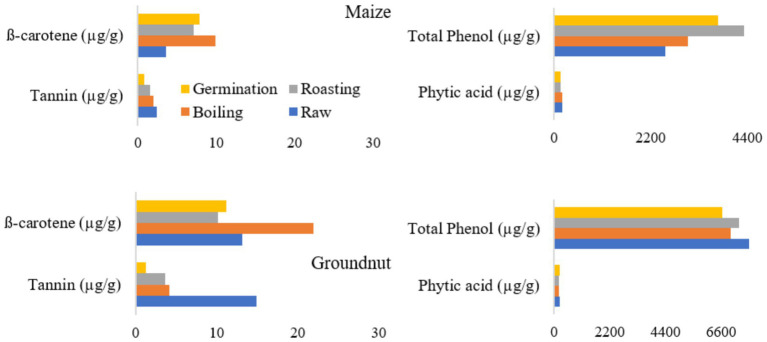
Results: The processes of germination and roasting (applied to maize and groundnut) demonstrated minimal impact on the proximate composition, mineral content, and β-carotene levels while also decreasing the amounts of specific phytochemicals (such as tannins, phenols, and phytic acid) found in the raw materials. Consequently, these processed ingredients were used to formulate eight complementary food products. The results of the proximate composition analysis for the eight developed food formulas indicated that the protein content ranged from 15.35 to 16.39%. Additionally, the fat, carbohydrate, and energy values were observed to range from 8.1 to 11.9%, 59.12 to 63.07%, and 383.82 to 412.87 kcal, respectively, indicating a nutritional profile consistent with locally available commercial complementary foods. Similarly, the levels of calcium, zinc, iron, magnesium, and β-carotene were measured to range from 66.75 mg to 102.48 mg, 1.33 mg to 2.48 mg, 6.64 mg to 10.36 mg, 122.60 mg to 181.73 mg, and 113.40 mg to 197.53 mg per 100 g, respectively, alongside notably low levels of anti-nutritional factors.
Conclusion: Including supplementary food is crucial when breastfeeding alone does not adequately meet an infant's nutritional requirements. As a result, the complementary food developed can provide 5 to 50% of the daily recommended nutrient allowance for infants.
期刊介绍:
No subject pertains more to human life than nutrition. The aim of Frontiers in Nutrition is to integrate major scientific disciplines in this vast field in order to address the most relevant and pertinent questions and developments. Our ambition is to create an integrated podium based on original research, clinical trials, and contemporary reviews to build a reputable knowledge forum in the domains of human health, dietary behaviors, agronomy & 21st century food science. Through the recognized open-access Frontiers platform we welcome manuscripts to our dedicated sections relating to different areas in the field of nutrition with a focus on human health.
Specialty sections in Frontiers in Nutrition include, for example, Clinical Nutrition, Nutrition & Sustainable Diets, Nutrition and Food Science Technology, Nutrition Methodology, Sport & Exercise Nutrition, Food Chemistry, and Nutritional Immunology. Based on the publication of rigorous scientific research, we thrive to achieve a visible impact on the global nutrition agenda addressing the grand challenges of our time, including obesity, malnutrition, hunger, food waste, sustainability and consumer health.





 京公网安备 11010802042870号
京ICP备2023020795号-1
京公网安备 11010802042870号
京ICP备2023020795号-1

 分享
分享
 求助内容:
求助内容: 应助结果提醒方式:
 扫码关注我们
