Francesco Costa, Rob Barringer, Ioannis Riziotis, Antonina Andreeva, Alex Bateman
{"title":"Isopeptor: a tool for detecting intramolecular isopeptide bonds in protein structures.","authors":"Francesco Costa, Rob Barringer, Ioannis Riziotis, Antonina Andreeva, Alex Bateman","doi":"10.1093/bioadv/vbaf049","DOIUrl":null,"url":null,"abstract":"<p><strong>Motivation: </strong>Intramolecular isopeptide bonds contribute to the structural stability of proteins, and have primarily been identified in domains of bacterial fibrillar adhesins and pili. At present, there is no systematic method available to detect them in newly determined molecular structures. This can result in mis-annotations and incorrect modeling.</p><p><strong>Results: </strong>Here, we present Isopeptor, a computational tool designed to predict the presence of intramolecular isopeptide bonds in experimentally determined structures. Isopeptor utilizes structure-guided template matching via the Jess software, combined with a logistic regression classifier that incorporates root mean square deviation and relative solvent accessible area as key features. The tool demonstrates a precision of 1.0 and a recall of 0.947 when tested on a Protein Data Bank subset of domains known to contain intramolecular isopeptide bonds that have been deposited with incorrectly modeled geometries.</p><p><strong>Availability and implementation: </strong>Isopeptor's Python-based implementation supports integration into bioinformatics workflows and can be accessed via the command line, through a Python API or via a Google Colaboratory implementation (https://colab.research.google.com/github/FranceCosta/Isopeptor_development/blob/main/notebooks/Isopeptide_finder.ipynb). Source code is hosted on GitHub (https://github.com/FranceCosta/isopeptor) and can be installed via the Python package installation manager PIP.</p>","PeriodicalId":72368,"journal":{"name":"Bioinformatics advances","volume":"5 1","pages":"vbaf049"},"PeriodicalIF":2.8000,"publicationDate":"2025-03-11","publicationTypes":"Journal Article","fieldsOfStudy":null,"isOpenAccess":false,"openAccessPdf":"https://www.ncbi.nlm.nih.gov/pmc/articles/PMC11919812/pdf/","citationCount":"0","resultStr":null,"platform":"Semanticscholar","paperid":null,"PeriodicalName":"Bioinformatics advances","FirstCategoryId":"1085","ListUrlMain":"https://doi.org/10.1093/bioadv/vbaf049","RegionNum":0,"RegionCategory":null,"ArticlePicture":[],"TitleCN":null,"AbstractTextCN":null,"PMCID":null,"EPubDate":"2025/1/1 0:00:00","PubModel":"eCollection","JCR":"Q2","JCRName":"MATHEMATICAL & COMPUTATIONAL BIOLOGY","Score":null,"Total":0}
引用次数: 0
Abstract
Motivation: Intramolecular isopeptide bonds contribute to the structural stability of proteins, and have primarily been identified in domains of bacterial fibrillar adhesins and pili. At present, there is no systematic method available to detect them in newly determined molecular structures. This can result in mis-annotations and incorrect modeling.
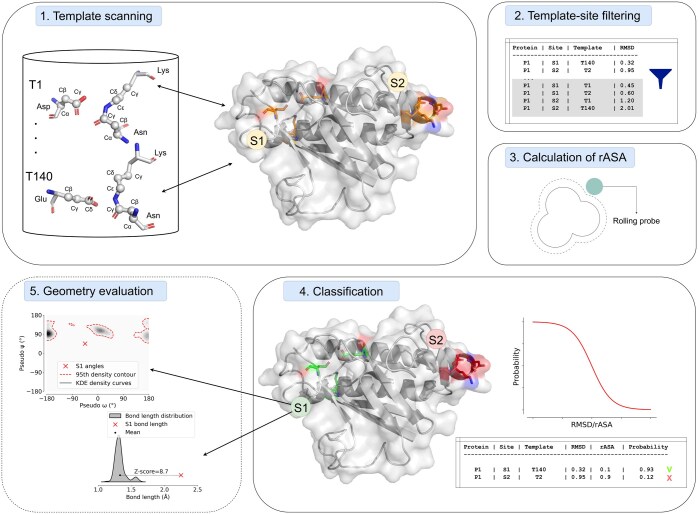
Results: Here, we present Isopeptor, a computational tool designed to predict the presence of intramolecular isopeptide bonds in experimentally determined structures. Isopeptor utilizes structure-guided template matching via the Jess software, combined with a logistic regression classifier that incorporates root mean square deviation and relative solvent accessible area as key features. The tool demonstrates a precision of 1.0 and a recall of 0.947 when tested on a Protein Data Bank subset of domains known to contain intramolecular isopeptide bonds that have been deposited with incorrectly modeled geometries.
Availability and implementation: Isopeptor's Python-based implementation supports integration into bioinformatics workflows and can be accessed via the command line, through a Python API or via a Google Colaboratory implementation (https://colab.research.google.com/github/FranceCosta/Isopeptor_development/blob/main/notebooks/Isopeptide_finder.ipynb). Source code is hosted on GitHub (https://github.com/FranceCosta/isopeptor) and can be installed via the Python package installation manager PIP.




 京公网安备 11010802042870号
京ICP备2023020795号-1
京公网安备 11010802042870号
京ICP备2023020795号-1

 分享
分享

 求助内容:
求助内容: 应助结果提醒方式:
 扫码关注我们
