{"title":"LipidSigR: a R-based solution for integrated lipidomics data analysis and visualization.","authors":"Chia-Hsin Liu, Pei-Chun Shen, Meng-Hsin Tsai, Hsiu-Cheng Liu, Wen-Jen Lin, Yo-Liang Lai, Yu-De Wang, Mien-Chie Hung, Wei-Chung Cheng","doi":"10.1093/bioadv/vbaf047","DOIUrl":null,"url":null,"abstract":"<p><strong>Motivation: </strong>Lipidomics is a rapidly expanding field focused on studying lipid species and classes within biological systems. As the field evolves, there is an increasing demand for user-friendly, open-source software tools capable of handling large and complex datasets while keeping pace with technological advancements. LipidSig, a widely used web-based platform, has been instrumental in data analysis and visualization of lipidomics. However, its limitations become evident when users want to build customized workflows. To address the limitation, we developed a companion R package, LipidSigR, based on the R code of the LipidSig web platform.</p><p><strong>Results: </strong>LipidSigR offers greater flexibility, allowing researchers with basic R programming skills to modify and adapt workflows according to their needs. It has been rigorously tested following CRAN guidelines to ensure compatibility and reproducibility. In demonstrating its functionality, we analyze the case with commonly used experimental design, case versus control, in lipidomics studies. Researchers can follow the use case to explore the key capabilities and build customized lipidomics data analysis workflows using LipidSigR.</p><p><strong>Availability and implementation: </strong>LipidSigR is freely available from https://lipidsig.bioinfomics.org/lipidsigr/index.html and https://github.com/BioinfOMICS/LipidSigR.</p>","PeriodicalId":72368,"journal":{"name":"Bioinformatics advances","volume":"5 1","pages":"vbaf047"},"PeriodicalIF":2.8000,"publicationDate":"2025-03-10","publicationTypes":"Journal Article","fieldsOfStudy":null,"isOpenAccess":false,"openAccessPdf":"https://www.ncbi.nlm.nih.gov/pmc/articles/PMC11919814/pdf/","citationCount":"0","resultStr":null,"platform":"Semanticscholar","paperid":null,"PeriodicalName":"Bioinformatics advances","FirstCategoryId":"1085","ListUrlMain":"https://doi.org/10.1093/bioadv/vbaf047","RegionNum":0,"RegionCategory":null,"ArticlePicture":[],"TitleCN":null,"AbstractTextCN":null,"PMCID":null,"EPubDate":"2025/1/1 0:00:00","PubModel":"eCollection","JCR":"Q2","JCRName":"MATHEMATICAL & COMPUTATIONAL BIOLOGY","Score":null,"Total":0}
引用次数: 0
Abstract
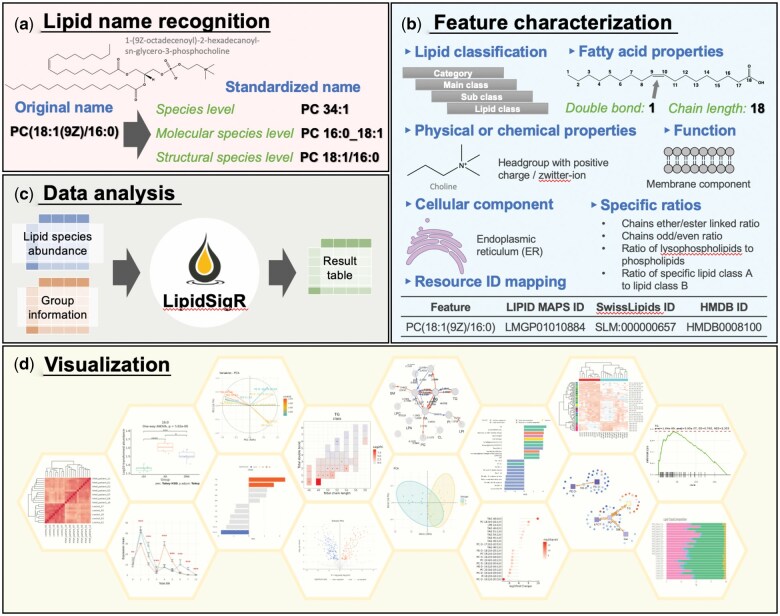
Motivation: Lipidomics is a rapidly expanding field focused on studying lipid species and classes within biological systems. As the field evolves, there is an increasing demand for user-friendly, open-source software tools capable of handling large and complex datasets while keeping pace with technological advancements. LipidSig, a widely used web-based platform, has been instrumental in data analysis and visualization of lipidomics. However, its limitations become evident when users want to build customized workflows. To address the limitation, we developed a companion R package, LipidSigR, based on the R code of the LipidSig web platform.
Results: LipidSigR offers greater flexibility, allowing researchers with basic R programming skills to modify and adapt workflows according to their needs. It has been rigorously tested following CRAN guidelines to ensure compatibility and reproducibility. In demonstrating its functionality, we analyze the case with commonly used experimental design, case versus control, in lipidomics studies. Researchers can follow the use case to explore the key capabilities and build customized lipidomics data analysis workflows using LipidSigR.
Availability and implementation: LipidSigR is freely available from https://lipidsig.bioinfomics.org/lipidsigr/index.html and https://github.com/BioinfOMICS/LipidSigR.




 京公网安备 11010802042870号
京ICP备2023020795号-1
京公网安备 11010802042870号
京ICP备2023020795号-1

 分享
分享

 求助内容:
求助内容: 应助结果提醒方式:
 扫码关注我们
