Demeng Sun, Xiang Li, Qingning Yuan, Yuanxia Wang, Pan Shi, Huanhuan Zhang, Tao Wang, Wenjing Sun, Shenglong Ling, Yuanchun Liu, Jinglin Lai, Wenqin Xie, Wanchao Yin, Lei Liu, H. Eric Xu, Changlin Tian
{"title":"Molecular mechanism of the arrestin-biased agonism of neurotensin receptor 1 by an intracellular allosteric modulator","authors":"Demeng Sun, Xiang Li, Qingning Yuan, Yuanxia Wang, Pan Shi, Huanhuan Zhang, Tao Wang, Wenjing Sun, Shenglong Ling, Yuanchun Liu, Jinglin Lai, Wenqin Xie, Wanchao Yin, Lei Liu, H. Eric Xu, Changlin Tian","doi":"10.1038/s41422-025-01095-7","DOIUrl":null,"url":null,"abstract":"Biased allosteric modulators (BAMs) of G protein-coupled receptors (GPCRs) have been at the forefront of drug discovery owing to their potential to selectively stimulate therapeutically relevant signaling and avoid on-target side effects. Although structures of GPCRs in complex with G protein or GRK in a BAM-bound state have recently been resolved, revealing that BAM can induce biased signaling by directly modulating interactions between GPCRs and these two transducers, no BAM-bound GPCR–arrestin complex structure has yet been determined, limiting our understanding of the full pharmacological profile of BAMs. Herein, we developed a chemical protein synthesis strategy to generate neurotensin receptor 1 (NTSR1) with defined hexa-phosphorylation at its C-terminus and resolved high-resolution cryo-EM structures (2.65–2.88 Å) of NTSR1 in complex with both β-arrestin1 and the BAM SBI-553. These structures revealed a unique “loop engagement” configuration of β-arrestin1 coupling to NTSR1 in the presence of SBI-553, markedly different from the typical “core engagement” configuration observed in the absence of BAMs. This configuration is characterized by the engagement of the intracellular loop 3 of NTSR1 with a cavity in the central crest of β-arrestin1, representing a previously unobserved, arrestin-selective conformation of GPCR. Our findings fill the critical knowledge gap regarding the regulation of GPCR–arrestin interactions and biased signaling by BAMs, which would advance the development of safer and more efficacious GPCR-targeted therapeutics.","PeriodicalId":9926,"journal":{"name":"Cell Research","volume":"35 4","pages":"284-295"},"PeriodicalIF":25.9000,"publicationDate":"2025-03-21","publicationTypes":"Journal Article","fieldsOfStudy":null,"isOpenAccess":false,"openAccessPdf":"https://www.nature.com/articles/s41422-025-01095-7.pdf","citationCount":"0","resultStr":null,"platform":"Semanticscholar","paperid":null,"PeriodicalName":"Cell Research","FirstCategoryId":"99","ListUrlMain":"https://www.nature.com/articles/s41422-025-01095-7","RegionNum":1,"RegionCategory":"生物学","ArticlePicture":[],"TitleCN":null,"AbstractTextCN":null,"PMCID":null,"EPubDate":"","PubModel":"","JCR":"Q1","JCRName":"CELL BIOLOGY","Score":null,"Total":0}
引用次数: 0
Abstract
Biased allosteric modulators (BAMs) of G protein-coupled receptors (GPCRs) have been at the forefront of drug discovery owing to their potential to selectively stimulate therapeutically relevant signaling and avoid on-target side effects. Although structures of GPCRs in complex with G protein or GRK in a BAM-bound state have recently been resolved, revealing that BAM can induce biased signaling by directly modulating interactions between GPCRs and these two transducers, no BAM-bound GPCR–arrestin complex structure has yet been determined, limiting our understanding of the full pharmacological profile of BAMs. Herein, we developed a chemical protein synthesis strategy to generate neurotensin receptor 1 (NTSR1) with defined hexa-phosphorylation at its C-terminus and resolved high-resolution cryo-EM structures (2.65–2.88 Å) of NTSR1 in complex with both β-arrestin1 and the BAM SBI-553. These structures revealed a unique “loop engagement” configuration of β-arrestin1 coupling to NTSR1 in the presence of SBI-553, markedly different from the typical “core engagement” configuration observed in the absence of BAMs. This configuration is characterized by the engagement of the intracellular loop 3 of NTSR1 with a cavity in the central crest of β-arrestin1, representing a previously unobserved, arrestin-selective conformation of GPCR. Our findings fill the critical knowledge gap regarding the regulation of GPCR–arrestin interactions and biased signaling by BAMs, which would advance the development of safer and more efficacious GPCR-targeted therapeutics.
期刊介绍:
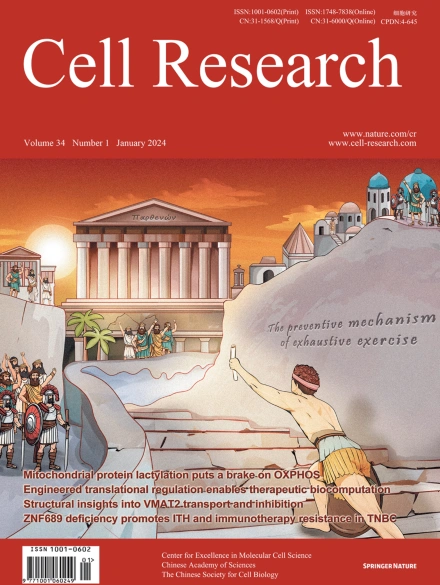
Cell Research (CR) is an international journal published by Springer Nature in partnership with the Center for Excellence in Molecular Cell Science, Chinese Academy of Sciences (CAS). It focuses on publishing original research articles and reviews in various areas of life sciences, particularly those related to molecular and cell biology. The journal covers a broad range of topics including cell growth, differentiation, and apoptosis; signal transduction; stem cell biology and development; chromatin, epigenetics, and transcription; RNA biology; structural and molecular biology; cancer biology and metabolism; immunity and molecular pathogenesis; molecular and cellular neuroscience; plant molecular and cell biology; and omics, system biology, and synthetic biology. CR is recognized as China's best international journal in life sciences and is part of Springer Nature's prestigious family of Molecular Cell Biology journals.





 京公网安备 11010802042870号
京ICP备2023020795号-1
京公网安备 11010802042870号
京ICP备2023020795号-1

 分享
分享
 求助内容:
求助内容: 应助结果提醒方式:
 扫码关注我们
