Silvia Sonzini , Richard M. England , Alexander N. Kapustin , Jennifer I. Moss , Daniel Sutton , Aaron Smith , Soumya Sharma , Elise Siouve , Mariarosa Mazza , Peter Ravn , Sanya Puri , Marianne Ashford
{"title":"HER2-targeted star polymer conjugates for improved tumor distribution and efficacy","authors":"Silvia Sonzini , Richard M. England , Alexander N. Kapustin , Jennifer I. Moss , Daniel Sutton , Aaron Smith , Soumya Sharma , Elise Siouve , Mariarosa Mazza , Peter Ravn , Sanya Puri , Marianne Ashford","doi":"10.1016/j.jconrel.2025.113654","DOIUrl":null,"url":null,"abstract":"<div><div>Actively targeted nanoparticle systems have the potential to improve delivery to tumors over untargeted systems however the design rules to achieve this have not been fully elucidated. A HER2-targeted polymer drug delivery system composed of a 32-arm star polymer (SD) conjugated with the TOP1 inhibitor molecule SN-38, with a trastuzumab antigen binding fragment (HER2-Fab), has been used to target cancer cells overexpressing this receptor. The HER2-Fab was attached to the SD at two different densities (average of 1 or 3 Fabs per star polymer) and compared to the native star polymer without Fab. <em>In vitro</em> experimentation showed that both the targeted star polymers (HER2-SDs) had better binding and uptake in HER2-positive cell lines (SK-BR3 and HEK293) compared to the non-targeted SD. <em>In vivo</em> biodistribution studies showed enhanced accumulation of HER2-targeted SDs in tumors, but not normal tissues, particularly at the later (96 h post-dose) timepoint. The HER2-SDs demonstrated increased localization with tumor cells rather than in stromal regions, greater penetration into the tumor core and a more homogenous distribution in the tumor section than the untargeted SD. The targeted star polymer conjugated to SN-38 was tested for anti-tumor activity in a HER2-positive gastric cancer xenograft in mice and showed significantly greater efficacy compared to untargeted SDs.</div></div>","PeriodicalId":15450,"journal":{"name":"Journal of Controlled Release","volume":"382 ","pages":"Article 113654"},"PeriodicalIF":11.5000,"publicationDate":"2025-03-21","publicationTypes":"Journal Article","fieldsOfStudy":null,"isOpenAccess":false,"openAccessPdf":"","citationCount":"0","resultStr":null,"platform":"Semanticscholar","paperid":null,"PeriodicalName":"Journal of Controlled Release","FirstCategoryId":"3","ListUrlMain":"https://www.sciencedirect.com/science/article/pii/S0168365925002743","RegionNum":1,"RegionCategory":"医学","ArticlePicture":[],"TitleCN":null,"AbstractTextCN":null,"PMCID":null,"EPubDate":"","PubModel":"","JCR":"Q1","JCRName":"CHEMISTRY, MULTIDISCIPLINARY","Score":null,"Total":0}
引用次数: 0
Abstract
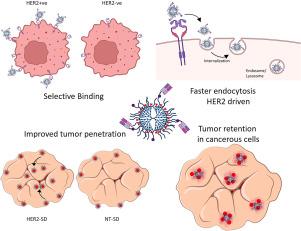
Actively targeted nanoparticle systems have the potential to improve delivery to tumors over untargeted systems however the design rules to achieve this have not been fully elucidated. A HER2-targeted polymer drug delivery system composed of a 32-arm star polymer (SD) conjugated with the TOP1 inhibitor molecule SN-38, with a trastuzumab antigen binding fragment (HER2-Fab), has been used to target cancer cells overexpressing this receptor. The HER2-Fab was attached to the SD at two different densities (average of 1 or 3 Fabs per star polymer) and compared to the native star polymer without Fab. In vitro experimentation showed that both the targeted star polymers (HER2-SDs) had better binding and uptake in HER2-positive cell lines (SK-BR3 and HEK293) compared to the non-targeted SD. In vivo biodistribution studies showed enhanced accumulation of HER2-targeted SDs in tumors, but not normal tissues, particularly at the later (96 h post-dose) timepoint. The HER2-SDs demonstrated increased localization with tumor cells rather than in stromal regions, greater penetration into the tumor core and a more homogenous distribution in the tumor section than the untargeted SD. The targeted star polymer conjugated to SN-38 was tested for anti-tumor activity in a HER2-positive gastric cancer xenograft in mice and showed significantly greater efficacy compared to untargeted SDs.
期刊介绍:
The Journal of Controlled Release (JCR) proudly serves as the Official Journal of the Controlled Release Society and the Japan Society of Drug Delivery System.
Dedicated to the broad field of delivery science and technology, JCR publishes high-quality research articles covering drug delivery systems and all facets of formulations. This includes the physicochemical and biological properties of drugs, design and characterization of dosage forms, release mechanisms, in vivo testing, and formulation research and development across pharmaceutical, diagnostic, agricultural, environmental, cosmetic, and food industries.
Priority is given to manuscripts that contribute to the fundamental understanding of principles or demonstrate the advantages of novel technologies in terms of safety and efficacy over current clinical standards. JCR strives to be a leading platform for advancements in delivery science and technology.




 京公网安备 11010802042870号
京ICP备2023020795号-1
京公网安备 11010802042870号
京ICP备2023020795号-1

 分享
分享
 求助内容:
求助内容: 应助结果提醒方式:
 扫码关注我们
