Maria Gil-Vives , Marta Hernández , Álvaro Hernáez , Salvador Borrós , Cristina Fornaguera
{"title":"Safety of nanoparticle therapies during pregnancy: A systematic review and meta-analysis","authors":"Maria Gil-Vives , Marta Hernández , Álvaro Hernáez , Salvador Borrós , Cristina Fornaguera","doi":"10.1016/j.jconrel.2025.113655","DOIUrl":null,"url":null,"abstract":"<div><div>The exclusion of pregnant women from clinical trials has led to insufficient safety data for many treatments, making it necessary to evaluate their potential benefits and risks during preclinical stages. Nanomedicines show potential for reduced toxicity but there is limited evidence about their safety for pregnant women and their fetuses. We conducted the first systematic review and meta-analysis of the effect of nanoparticles (NPs) on a key outcome of fetal toxicity (low birth weight) in murine models. In the meta-analysis of mouse models, negatively charged NPs tended to decrease birth weight (−69.8 mg, 95 % CI: −196 to 56.5), as did small (−191 mg, 95 % CI: −369 to −13.3) and plain inorganic nanosystems (−249 mg, 95 % CI: −535 to 37.4). In contrast, positively charged NPs resulted in increased birth weight (+29.3 mg, 95 % CI: 23.4 to 35.2). All findings were validated in studies with low heterogeneity and low risk of publication bias. Neither large NPs (+4.37 mg; 95 % CI: −45.3 to 54.0) nor polymer-coated NPs (+16.5 mg; 95 % CI: −44.7 to 77.6) had any clear association with birth weight. Similar results were observed in other models and experimental designs from articles not included in the meta-analysis, although no conclusions were drawn for other parameters due to high variability. Our findings pave the way for future research and the rational development of safer nanomedicines for use during pregnancy.</div></div>","PeriodicalId":15450,"journal":{"name":"Journal of Controlled Release","volume":"382 ","pages":"Article 113655"},"PeriodicalIF":11.5000,"publicationDate":"2025-03-21","publicationTypes":"Journal Article","fieldsOfStudy":null,"isOpenAccess":false,"openAccessPdf":"","citationCount":"0","resultStr":null,"platform":"Semanticscholar","paperid":null,"PeriodicalName":"Journal of Controlled Release","FirstCategoryId":"3","ListUrlMain":"https://www.sciencedirect.com/science/article/pii/S0168365925002755","RegionNum":1,"RegionCategory":"医学","ArticlePicture":[],"TitleCN":null,"AbstractTextCN":null,"PMCID":null,"EPubDate":"","PubModel":"","JCR":"Q1","JCRName":"CHEMISTRY, MULTIDISCIPLINARY","Score":null,"Total":0}
引用次数: 0
Abstract
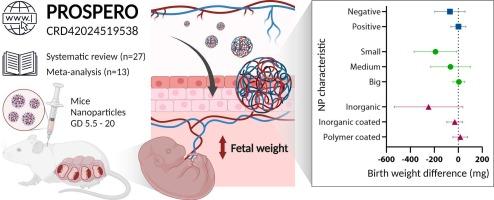
The exclusion of pregnant women from clinical trials has led to insufficient safety data for many treatments, making it necessary to evaluate their potential benefits and risks during preclinical stages. Nanomedicines show potential for reduced toxicity but there is limited evidence about their safety for pregnant women and their fetuses. We conducted the first systematic review and meta-analysis of the effect of nanoparticles (NPs) on a key outcome of fetal toxicity (low birth weight) in murine models. In the meta-analysis of mouse models, negatively charged NPs tended to decrease birth weight (−69.8 mg, 95 % CI: −196 to 56.5), as did small (−191 mg, 95 % CI: −369 to −13.3) and plain inorganic nanosystems (−249 mg, 95 % CI: −535 to 37.4). In contrast, positively charged NPs resulted in increased birth weight (+29.3 mg, 95 % CI: 23.4 to 35.2). All findings were validated in studies with low heterogeneity and low risk of publication bias. Neither large NPs (+4.37 mg; 95 % CI: −45.3 to 54.0) nor polymer-coated NPs (+16.5 mg; 95 % CI: −44.7 to 77.6) had any clear association with birth weight. Similar results were observed in other models and experimental designs from articles not included in the meta-analysis, although no conclusions were drawn for other parameters due to high variability. Our findings pave the way for future research and the rational development of safer nanomedicines for use during pregnancy.
期刊介绍:
The Journal of Controlled Release (JCR) proudly serves as the Official Journal of the Controlled Release Society and the Japan Society of Drug Delivery System.
Dedicated to the broad field of delivery science and technology, JCR publishes high-quality research articles covering drug delivery systems and all facets of formulations. This includes the physicochemical and biological properties of drugs, design and characterization of dosage forms, release mechanisms, in vivo testing, and formulation research and development across pharmaceutical, diagnostic, agricultural, environmental, cosmetic, and food industries.
Priority is given to manuscripts that contribute to the fundamental understanding of principles or demonstrate the advantages of novel technologies in terms of safety and efficacy over current clinical standards. JCR strives to be a leading platform for advancements in delivery science and technology.




 京公网安备 11010802042870号
京ICP备2023020795号-1
京公网安备 11010802042870号
京ICP备2023020795号-1

 分享
分享
 求助内容:
求助内容: 应助结果提醒方式:
 扫码关注我们
