Zeina Abdallah, James W. Pomeroy, Nicolas Blasakis, Athanasios Baltopoulos, Martin Kuball
{"title":"Simultaneous Measurement of Thermal Conductivity and Volumetric Heat Capacity of Thermal Interface Materials Using Thermoreflectance","authors":"Zeina Abdallah, James W. Pomeroy, Nicolas Blasakis, Athanasios Baltopoulos, Martin Kuball","doi":"10.1021/acsaelm.4c00691","DOIUrl":null,"url":null,"abstract":"Thermal interface materials are crucial to minimize the thermal resistance between a semiconductor device and a heat sink, especially for high-power electronic devices, which are susceptible to self-heating-induced failures. The effectiveness of these interface materials depends on their low thermal contact resistance coupled with high thermal conductivity. Various characterization techniques are used to determine the thermal properties of the thermal interface materials. However, their bulk or free-standing thermal properties are typically assessed rather than their thermal performance when applied as a thin layer in real application. In this study, we introduce a low-frequency range frequency domain thermoreflectance method that can measure the effective thermal conductivity and volumetric heat capacity of thermal interface materials simultaneously in situ, illustrated on silver-filled thermal interface material samples, offering a distinct advantage over traditional techniques such as ASTM D5470. Monte Carlo fitting is used to quantify the thermal conductivities and heat capacities and their uncertainties, which are compared to a more efficient least-squares method.","PeriodicalId":3,"journal":{"name":"ACS Applied Electronic Materials","volume":"30 20 1","pages":""},"PeriodicalIF":4.7000,"publicationDate":"2024-06-27","publicationTypes":"Journal Article","fieldsOfStudy":null,"isOpenAccess":false,"openAccessPdf":"","citationCount":"0","resultStr":null,"platform":"Semanticscholar","paperid":null,"PeriodicalName":"ACS Applied Electronic Materials","FirstCategoryId":"88","ListUrlMain":"https://doi.org/10.1021/acsaelm.4c00691","RegionNum":3,"RegionCategory":"材料科学","ArticlePicture":[],"TitleCN":null,"AbstractTextCN":null,"PMCID":null,"EPubDate":"","PubModel":"","JCR":"Q1","JCRName":"ENGINEERING, ELECTRICAL & ELECTRONIC","Score":null,"Total":0}
引用次数: 0
Abstract
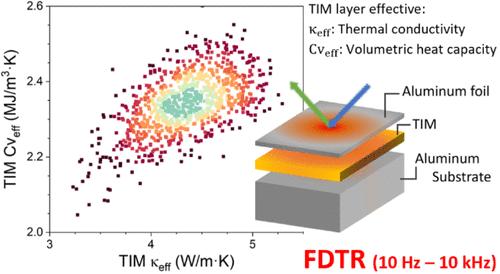
Thermal interface materials are crucial to minimize the thermal resistance between a semiconductor device and a heat sink, especially for high-power electronic devices, which are susceptible to self-heating-induced failures. The effectiveness of these interface materials depends on their low thermal contact resistance coupled with high thermal conductivity. Various characterization techniques are used to determine the thermal properties of the thermal interface materials. However, their bulk or free-standing thermal properties are typically assessed rather than their thermal performance when applied as a thin layer in real application. In this study, we introduce a low-frequency range frequency domain thermoreflectance method that can measure the effective thermal conductivity and volumetric heat capacity of thermal interface materials simultaneously in situ, illustrated on silver-filled thermal interface material samples, offering a distinct advantage over traditional techniques such as ASTM D5470. Monte Carlo fitting is used to quantify the thermal conductivities and heat capacities and their uncertainties, which are compared to a more efficient least-squares method.
期刊介绍:
ACS Applied Electronic Materials is an interdisciplinary journal publishing original research covering all aspects of electronic materials. The journal is devoted to reports of new and original experimental and theoretical research of an applied nature that integrate knowledge in the areas of materials science, engineering, optics, physics, and chemistry into important applications of electronic materials. Sample research topics that span the journal's scope are inorganic, organic, ionic and polymeric materials with properties that include conducting, semiconducting, superconducting, insulating, dielectric, magnetic, optoelectronic, piezoelectric, ferroelectric and thermoelectric.
Indexed/Abstracted:
Web of Science SCIE
Scopus
CAS
INSPEC
Portico




 京公网安备 11010802042870号
京ICP备2023020795号-1
京公网安备 11010802042870号
京ICP备2023020795号-1

 分享
分享
 求助内容:
求助内容: 应助结果提醒方式:
 扫码关注我们
