Ziyi Qin, Zhenlin Jiang, Lan Zhou, Wenjun Wang, Min Zhu, Jiapeng Chen, Baoxiu Wang, Chaosheng Wang
{"title":"Construction and Properties of Ultralow Thermal Conductivity and High Strength Zirconia Aerogel Composites by Freeze-Drying","authors":"Ziyi Qin, Zhenlin Jiang, Lan Zhou, Wenjun Wang, Min Zhu, Jiapeng Chen, Baoxiu Wang, Chaosheng Wang","doi":"10.1021/acsami.4c13860","DOIUrl":null,"url":null,"abstract":"Zirconia aerogels possess significant applications, including their use catalyst carriers, thermal insulation materials, and thermal barrier coatings. This is due to their ultrahigh temperature resistance, high porosity, and low thermal conductivity. Nonetheless, the inherent challenges associated with ZrO<sub>2</sub> aerogels, such as high brittleness, low compressive strength, and inadequate formability, restrict their potential applications. In this paper, with ultralow thermal conductivity and high strength zirconia aerogel composites with inorganic zirconium salt zirconium carbonate as the raw material, acetic acid as the solvent, polyvinylpyrrolidone (PVP) as the viscosity builder to stabilize the structure of the aerogel during the freeze-drying process. Additionally, yttrium nitrate hexahydrate (Y(NO<sub>3</sub>)<sub>3</sub>·6H<sub>2</sub>O) is employed as a phase stabilizer. The sol–gel method, in conjunction with the freeze-drying process, is utilized to fabricate ZrO<sub>2</sub> aerogel composites with an optimized microstructure. The findings indicate that optimal process parameters are achieved with a PVP solution concentration of 2.0 wt % and a zirconium carbonate concentration of 20 wt %. The mechanical properties of the resulting composites reach up to 550 kPa, while the thermal insulation performance exhibits a temperature difference of 207 °C/cm and a thermal conductivity of 0.0504 W/(m·K). This advancement addresses the mechanical stability issues commonly associated with traditional ceramic aerogels and widely used elastic insulating materials, thereby enhancing their applicability as thermal insulation and heat preservation materials.","PeriodicalId":5,"journal":{"name":"ACS Applied Materials & Interfaces","volume":"125 1","pages":""},"PeriodicalIF":8.2000,"publicationDate":"2024-10-22","publicationTypes":"Journal Article","fieldsOfStudy":null,"isOpenAccess":false,"openAccessPdf":"","citationCount":"0","resultStr":null,"platform":"Semanticscholar","paperid":null,"PeriodicalName":"ACS Applied Materials & Interfaces","FirstCategoryId":"88","ListUrlMain":"https://doi.org/10.1021/acsami.4c13860","RegionNum":2,"RegionCategory":"材料科学","ArticlePicture":[],"TitleCN":null,"AbstractTextCN":null,"PMCID":null,"EPubDate":"","PubModel":"","JCR":"Q1","JCRName":"MATERIALS SCIENCE, MULTIDISCIPLINARY","Score":null,"Total":0}
引用次数: 0
Abstract
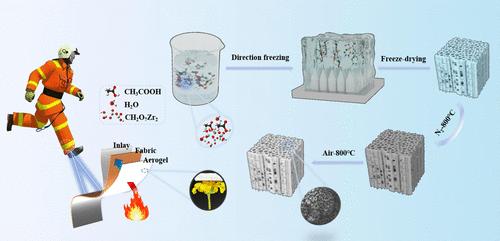
Zirconia aerogels possess significant applications, including their use catalyst carriers, thermal insulation materials, and thermal barrier coatings. This is due to their ultrahigh temperature resistance, high porosity, and low thermal conductivity. Nonetheless, the inherent challenges associated with ZrO2 aerogels, such as high brittleness, low compressive strength, and inadequate formability, restrict their potential applications. In this paper, with ultralow thermal conductivity and high strength zirconia aerogel composites with inorganic zirconium salt zirconium carbonate as the raw material, acetic acid as the solvent, polyvinylpyrrolidone (PVP) as the viscosity builder to stabilize the structure of the aerogel during the freeze-drying process. Additionally, yttrium nitrate hexahydrate (Y(NO3)3·6H2O) is employed as a phase stabilizer. The sol–gel method, in conjunction with the freeze-drying process, is utilized to fabricate ZrO2 aerogel composites with an optimized microstructure. The findings indicate that optimal process parameters are achieved with a PVP solution concentration of 2.0 wt % and a zirconium carbonate concentration of 20 wt %. The mechanical properties of the resulting composites reach up to 550 kPa, while the thermal insulation performance exhibits a temperature difference of 207 °C/cm and a thermal conductivity of 0.0504 W/(m·K). This advancement addresses the mechanical stability issues commonly associated with traditional ceramic aerogels and widely used elastic insulating materials, thereby enhancing their applicability as thermal insulation and heat preservation materials.
期刊介绍:
ACS Applied Materials & Interfaces is a leading interdisciplinary journal that brings together chemists, engineers, physicists, and biologists to explore the development and utilization of newly-discovered materials and interfacial processes for specific applications. Our journal has experienced remarkable growth since its establishment in 2009, both in terms of the number of articles published and the impact of the research showcased. We are proud to foster a truly global community, with the majority of published articles originating from outside the United States, reflecting the rapid growth of applied research worldwide.



 京公网安备 11010802042870号
京ICP备2023020795号-1
京公网安备 11010802042870号
京ICP备2023020795号-1

 分享
分享
 求助内容:
求助内容: 应助结果提醒方式:
 扫码关注我们
