{"title":"High-Efficiency Microwave Wireless Power Transmission via Reflective Phase Gradient Metasurfaces and Surface Wave Aggregation","authors":"Han Xiong, Qiang Yang, Yi-Zhe Huang, Jia-Hao Deng, Ben-Xin Wang, Huai-Qing Zhang","doi":"10.1021/acsami.4c11720","DOIUrl":null,"url":null,"abstract":"Microwave Wireless Power Transfer (MWPT) technology is crucial for emergency power supply during natural disasters and powering off-grid equipment. Traditional antenna arrays, however, suffer from low energy capture efficiency, difficult impedance matching, complex synthetic networks, and intricate manufacturing processes. This paper introduces a microwave energy receiver design utilizing Reflective Phase Gradient Metasurfaces (R-PGMs) and surface wave energy convergence technology. The design leverages the effective plane wave-to-surface wave conversion capability of R-PGMs to transform incident microwave energy into a surface wave mode, which is then efficiently harvested using a circular energy convergence array before being output to a coupling port. By optimizing R-PGM parameters, an ideal 60° phase gradient distribution is achieved, facilitating the focus of surface wave energy via dispersion characteristics. These components are integrated into a hybrid antenna array, complemented by a matched energy output port structure. Numerical simulations show that this array can efficiently convert microwave energy from plane waves to surface waves, achieving a conversion efficiency of 85.32% and a collection efficiency of 68.26%. Experimental results corroborate these findings, with peak energy collection efficiency reaching 64.68% at 5.8 GHz and an RF-DC conversion efficiency of 42%, confirming the design’s efficacy. Compared to conventional methods, this design simplifies the system by avoiding complex combining networks and significantly enhances the efficiency of microwave MWPT.","PeriodicalId":5,"journal":{"name":"ACS Applied Materials & Interfaces","volume":"12 1","pages":""},"PeriodicalIF":8.2000,"publicationDate":"2024-10-23","publicationTypes":"Journal Article","fieldsOfStudy":null,"isOpenAccess":false,"openAccessPdf":"","citationCount":"0","resultStr":null,"platform":"Semanticscholar","paperid":null,"PeriodicalName":"ACS Applied Materials & Interfaces","FirstCategoryId":"88","ListUrlMain":"https://doi.org/10.1021/acsami.4c11720","RegionNum":2,"RegionCategory":"材料科学","ArticlePicture":[],"TitleCN":null,"AbstractTextCN":null,"PMCID":null,"EPubDate":"","PubModel":"","JCR":"Q1","JCRName":"MATERIALS SCIENCE, MULTIDISCIPLINARY","Score":null,"Total":0}
引用次数: 0
Abstract
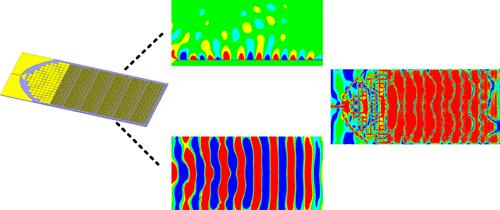
Microwave Wireless Power Transfer (MWPT) technology is crucial for emergency power supply during natural disasters and powering off-grid equipment. Traditional antenna arrays, however, suffer from low energy capture efficiency, difficult impedance matching, complex synthetic networks, and intricate manufacturing processes. This paper introduces a microwave energy receiver design utilizing Reflective Phase Gradient Metasurfaces (R-PGMs) and surface wave energy convergence technology. The design leverages the effective plane wave-to-surface wave conversion capability of R-PGMs to transform incident microwave energy into a surface wave mode, which is then efficiently harvested using a circular energy convergence array before being output to a coupling port. By optimizing R-PGM parameters, an ideal 60° phase gradient distribution is achieved, facilitating the focus of surface wave energy via dispersion characteristics. These components are integrated into a hybrid antenna array, complemented by a matched energy output port structure. Numerical simulations show that this array can efficiently convert microwave energy from plane waves to surface waves, achieving a conversion efficiency of 85.32% and a collection efficiency of 68.26%. Experimental results corroborate these findings, with peak energy collection efficiency reaching 64.68% at 5.8 GHz and an RF-DC conversion efficiency of 42%, confirming the design’s efficacy. Compared to conventional methods, this design simplifies the system by avoiding complex combining networks and significantly enhances the efficiency of microwave MWPT.
期刊介绍:
ACS Applied Materials & Interfaces is a leading interdisciplinary journal that brings together chemists, engineers, physicists, and biologists to explore the development and utilization of newly-discovered materials and interfacial processes for specific applications. Our journal has experienced remarkable growth since its establishment in 2009, both in terms of the number of articles published and the impact of the research showcased. We are proud to foster a truly global community, with the majority of published articles originating from outside the United States, reflecting the rapid growth of applied research worldwide.



 京公网安备 11010802042870号
京ICP备2023020795号-1
京公网安备 11010802042870号
京ICP备2023020795号-1

 分享
分享
 求助内容:
求助内容: 应助结果提醒方式:
 扫码关注我们
