Utilization of municipal solid waste incineration fly ash with different pretreatments with gold tailings and coal fly ash for environmentally friendly geopolymers
Ke Li , Jie Deng , Ying Zhu , Weiyi Zhang , Tao Zhang , Chao Tian , Jinwei Ma , Yingying Shao , Yanfeng Yang , Yanqiu Shao
{"title":"Utilization of municipal solid waste incineration fly ash with different pretreatments with gold tailings and coal fly ash for environmentally friendly geopolymers","authors":"Ke Li , Jie Deng , Ying Zhu , Weiyi Zhang , Tao Zhang , Chao Tian , Jinwei Ma , Yingying Shao , Yanfeng Yang , Yanqiu Shao","doi":"10.1016/j.wasman.2025.01.014","DOIUrl":null,"url":null,"abstract":"<div><div>Municipal solid waste incineration fly ash (MSWIFA) is considered a hazardous solid waste, traditionally disposed by solidified landfill methods. However, solidified landfills present challenges with leaching heavy metals, polychlorinated dibenzo-p-dioxins and dibenzofurans (PCDD/Fs). To address this issue, this study examined two pretreatment methods for MSWIFA: sintering at 850℃ for 30 min and washing with three water baths (20 min each) at a 3:1 liquid–solid ratio. Then, the pretreated MSWIFA was employed in geopolymer synthesis, along with gold tailings (GT) and coal fly ash (CFA). The optimal raw material ratio was GT:CFA:MSWIFA = 5:4:1 after pretreatment, which resulted in maximum compressive strengths of 20.95 and 25.87 MPa for the sintered and washed samples, respectively. Washing removed 87.3 % of soluble chlorides from MSWIFA, enhancing the compressive strength of the geopolymer. High-temperature treatment effectively reduced the leaching concentrations of heavy metals and the toxic equivalent quantity (TEQ) of PCDD/Fs. The leaching concentrations of heavy metals (Cu, Zn, Cd, Pb) and the TEQ of PCDD/Fs were all below the limits established by Chinese standards GB 5085.3–2007 and HJ 1134–2020. X-ray Diffraction, Fourier transform infrared spectrometry, scanning electron microscopy, and energy dispersive spectroscopy analyses revealed that the primary hydration products of the geopolymer are C–(A)–S–H gels. Washing treatment facilitated the formation of ettringite and Ca(OH)<sub>2</sub>, which enhanced the pore structure and optimized the performance of the geopolymer. Thermogravimetric analysis revealed the good thermal stability of the geopolymer, indicating that the high-temperature and washing pretreatments minimally impacted its thermal stability.</div></div>","PeriodicalId":23969,"journal":{"name":"Waste management","volume":"194 ","pages":"Pages 342-352"},"PeriodicalIF":7.1000,"publicationDate":"2025-02-15","publicationTypes":"Journal Article","fieldsOfStudy":null,"isOpenAccess":false,"openAccessPdf":"","citationCount":"0","resultStr":null,"platform":"Semanticscholar","paperid":null,"PeriodicalName":"Waste management","FirstCategoryId":"93","ListUrlMain":"https://www.sciencedirect.com/science/article/pii/S0956053X25000145","RegionNum":2,"RegionCategory":"环境科学与生态学","ArticlePicture":[],"TitleCN":null,"AbstractTextCN":null,"PMCID":null,"EPubDate":"2025/1/24 0:00:00","PubModel":"Epub","JCR":"Q1","JCRName":"ENGINEERING, ENVIRONMENTAL","Score":null,"Total":0}
引用次数: 0
Abstract
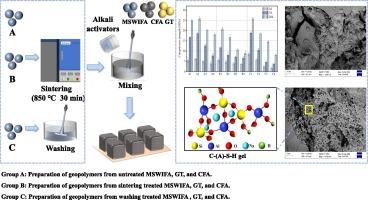
Municipal solid waste incineration fly ash (MSWIFA) is considered a hazardous solid waste, traditionally disposed by solidified landfill methods. However, solidified landfills present challenges with leaching heavy metals, polychlorinated dibenzo-p-dioxins and dibenzofurans (PCDD/Fs). To address this issue, this study examined two pretreatment methods for MSWIFA: sintering at 850℃ for 30 min and washing with three water baths (20 min each) at a 3:1 liquid–solid ratio. Then, the pretreated MSWIFA was employed in geopolymer synthesis, along with gold tailings (GT) and coal fly ash (CFA). The optimal raw material ratio was GT:CFA:MSWIFA = 5:4:1 after pretreatment, which resulted in maximum compressive strengths of 20.95 and 25.87 MPa for the sintered and washed samples, respectively. Washing removed 87.3 % of soluble chlorides from MSWIFA, enhancing the compressive strength of the geopolymer. High-temperature treatment effectively reduced the leaching concentrations of heavy metals and the toxic equivalent quantity (TEQ) of PCDD/Fs. The leaching concentrations of heavy metals (Cu, Zn, Cd, Pb) and the TEQ of PCDD/Fs were all below the limits established by Chinese standards GB 5085.3–2007 and HJ 1134–2020. X-ray Diffraction, Fourier transform infrared spectrometry, scanning electron microscopy, and energy dispersive spectroscopy analyses revealed that the primary hydration products of the geopolymer are C–(A)–S–H gels. Washing treatment facilitated the formation of ettringite and Ca(OH)2, which enhanced the pore structure and optimized the performance of the geopolymer. Thermogravimetric analysis revealed the good thermal stability of the geopolymer, indicating that the high-temperature and washing pretreatments minimally impacted its thermal stability.
期刊介绍:
Waste Management is devoted to the presentation and discussion of information on solid wastes,it covers the entire lifecycle of solid. wastes.
Scope:
Addresses solid wastes in both industrialized and economically developing countries
Covers various types of solid wastes, including:
Municipal (e.g., residential, institutional, commercial, light industrial)
Agricultural
Special (e.g., C and D, healthcare, household hazardous wastes, sewage sludge)



 京公网安备 11010802042870号
京ICP备2023020795号-1
京公网安备 11010802042870号
京ICP备2023020795号-1

 分享
分享
 求助内容:
求助内容: 应助结果提醒方式:
 扫码关注我们
