David-Samuel Burkhardt, Claire Leyden, Carina Thomas, Christian Brysch, Florian Alexander Dehmelt, Aristides B. Arrenberg
{"title":"Behavioral and neurophysiological effects of electrical stunning on zebrafish larvae","authors":"David-Samuel Burkhardt, Claire Leyden, Carina Thomas, Christian Brysch, Florian Alexander Dehmelt, Aristides B. Arrenberg","doi":"10.1038/s41684-024-01505-0","DOIUrl":null,"url":null,"abstract":"Two methods dominate the way that zebrafish larvae are euthanized after experimental procedures: anesthetic overdose and rapid cooling. Although MS-222 is easy to apply, this anesthetic takes about a minute to act and fish show aversive reactions and interindividual differences, limiting its reliability. Rapid cooling kills larvae after several hours and is not listed as an approved method in the relevant European Union directive. Electrical stunning is a promising alternative euthanasia method for zebrafish but has not yet been fully established. Here we characterize both behavioral and neurophysiological effects of electrical stunning in 4-day-old zebrafish larvae. We identified the electric field characteristics and stimulus duration (50 V/cm alternating current for 32 s) that reliably euthanizes free-swimming larvae and agarose-embedded larvae with an easy-to-implement protocol. Behavioral analysis and calcium neurophysiology show that larvae lose consciousness and stop responding to touch and visual stimuli very quickly (<1 s). Electrically stunned larvae no longer show coordinated brain activity. Their brains instead undergo a series of concerted whole-brain calcium waves over the course of many minutes before the cessation of all brain signals. Consistent with the need to implement the 3R at all stages of animal experimentation, the rapid and reliable euthanasia achieved by electrical stunning has potential for refinement of the welfare of more than 5 million zebrafish used annually in biomedical research worldwide. This study explores the use of electrical stunning as a viable alternative to anesthetic overdose and rapid cooling for euthanizing zebrafish larvae, potentially improving the welfare of over 5 million zebrafish in biomedical research.","PeriodicalId":17936,"journal":{"name":"Lab Animal","volume":"54 2","pages":"50-58"},"PeriodicalIF":3.9000,"publicationDate":"2025-01-27","publicationTypes":"Journal Article","fieldsOfStudy":null,"isOpenAccess":false,"openAccessPdf":"https://www.nature.com/articles/s41684-024-01505-0.pdf","citationCount":"0","resultStr":null,"platform":"Semanticscholar","paperid":null,"PeriodicalName":"Lab Animal","FirstCategoryId":"97","ListUrlMain":"https://www.nature.com/articles/s41684-024-01505-0","RegionNum":3,"RegionCategory":"农林科学","ArticlePicture":[],"TitleCN":null,"AbstractTextCN":null,"PMCID":null,"EPubDate":"","PubModel":"","JCR":"Q1","JCRName":"VETERINARY SCIENCES","Score":null,"Total":0}
引用次数: 0
Abstract
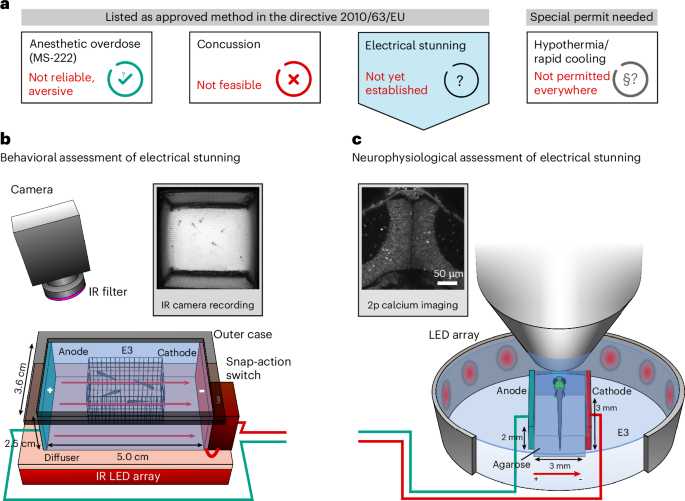
Two methods dominate the way that zebrafish larvae are euthanized after experimental procedures: anesthetic overdose and rapid cooling. Although MS-222 is easy to apply, this anesthetic takes about a minute to act and fish show aversive reactions and interindividual differences, limiting its reliability. Rapid cooling kills larvae after several hours and is not listed as an approved method in the relevant European Union directive. Electrical stunning is a promising alternative euthanasia method for zebrafish but has not yet been fully established. Here we characterize both behavioral and neurophysiological effects of electrical stunning in 4-day-old zebrafish larvae. We identified the electric field characteristics and stimulus duration (50 V/cm alternating current for 32 s) that reliably euthanizes free-swimming larvae and agarose-embedded larvae with an easy-to-implement protocol. Behavioral analysis and calcium neurophysiology show that larvae lose consciousness and stop responding to touch and visual stimuli very quickly (<1 s). Electrically stunned larvae no longer show coordinated brain activity. Their brains instead undergo a series of concerted whole-brain calcium waves over the course of many minutes before the cessation of all brain signals. Consistent with the need to implement the 3R at all stages of animal experimentation, the rapid and reliable euthanasia achieved by electrical stunning has potential for refinement of the welfare of more than 5 million zebrafish used annually in biomedical research worldwide. This study explores the use of electrical stunning as a viable alternative to anesthetic overdose and rapid cooling for euthanizing zebrafish larvae, potentially improving the welfare of over 5 million zebrafish in biomedical research.
期刊介绍:
LabAnimal is a Nature Research journal dedicated to in vivo science and technology that improves our basic understanding and use of model organisms of human health and disease. In addition to basic research, methods and technologies, LabAnimal also covers important news, business and regulatory matters that impact the development and application of model organisms for preclinical research.
LabAnimal's focus is on innovative in vivo methods, research and technology covering a wide range of model organisms. Our broad scope ensures that the work we publish reaches the widest possible audience. LabAnimal provides a rigorous and fair peer review of manuscripts, high standards for copyediting and production, and efficient publication.




 京公网安备 11010802042870号
京ICP备2023020795号-1
京公网安备 11010802042870号
京ICP备2023020795号-1

 分享
分享
 求助内容:
求助内容: 应助结果提醒方式:
 扫码关注我们
