Xinran Qiu, Maodian Liu, Yuanzheng Zhang, Qianru Zhang, Huiming Lin, Xingrui Cai, Jin Li, Rong Dai, Shuxiu Zheng, Jinghang Wang, Yaqi Zhu, Huizhong Shen, Guofeng Shen, Xuejun Wang, Shu Tao
{"title":"Declines in anthropogenic mercury emissions in the Global North and China offset by the Global South","authors":"Xinran Qiu, Maodian Liu, Yuanzheng Zhang, Qianru Zhang, Huiming Lin, Xingrui Cai, Jin Li, Rong Dai, Shuxiu Zheng, Jinghang Wang, Yaqi Zhu, Huizhong Shen, Guofeng Shen, Xuejun Wang, Shu Tao","doi":"10.1038/s41467-025-56274-2","DOIUrl":null,"url":null,"abstract":"<p>Human activities have emitted substantial mercury into the atmosphere, significantly impacting ecosystems and human health worldwide. Currently, consistent methodologies to evaluate long-term mercury emissions across countries and industries are scant, hindering efforts to prioritize emission controls. Here, we develop a high-spatiotemporal-resolution dataset to comprehensively analyze global anthropogenic mercury emission patterns. We show that global emissions increased 330% during 1960–2021, with declines in developed Global North countries since the 1990s and China since the 2010s completely offset by rapid growth in Global South countries (excluding China). Consequently, global emissions have continued to rise slightly since the 2013 Minamata Convention. In 2021, Global South countries produced two-thirds of global emissions, despite comprising only one-fifth of the global economy. We predict that, although large uncertainties exist, continued emission growth in Global South countries under a business-as-usual scenario could increase 10%-50% global mercury emissions by 2030. Our findings demonstrate that global control of anthropogenic mercury emissions has reached a critical juncture, highlighting the urgent need to target reductions in Global South countries to prevent worsening health and environmental impacts.</p>","PeriodicalId":19066,"journal":{"name":"Nature Communications","volume":"36 1","pages":""},"PeriodicalIF":15.7000,"publicationDate":"2025-01-30","publicationTypes":"Journal Article","fieldsOfStudy":null,"isOpenAccess":false,"openAccessPdf":"","citationCount":"0","resultStr":null,"platform":"Semanticscholar","paperid":null,"PeriodicalName":"Nature Communications","FirstCategoryId":"103","ListUrlMain":"https://doi.org/10.1038/s41467-025-56274-2","RegionNum":1,"RegionCategory":"综合性期刊","ArticlePicture":[],"TitleCN":null,"AbstractTextCN":null,"PMCID":null,"EPubDate":"","PubModel":"","JCR":"Q1","JCRName":"MULTIDISCIPLINARY SCIENCES","Score":null,"Total":0}
引用次数: 0
Abstract
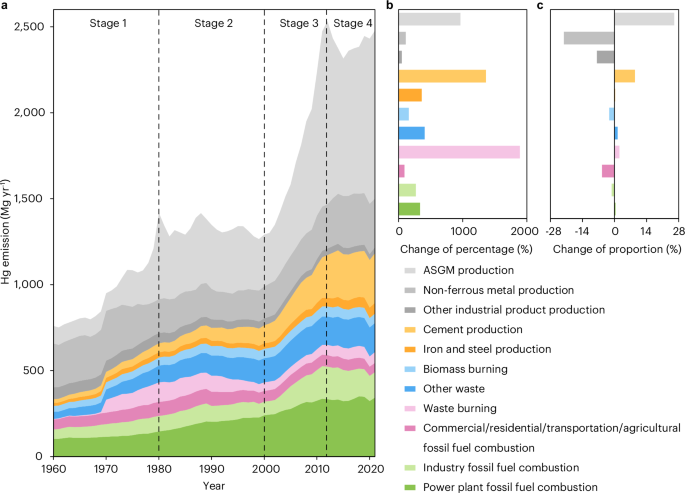
Human activities have emitted substantial mercury into the atmosphere, significantly impacting ecosystems and human health worldwide. Currently, consistent methodologies to evaluate long-term mercury emissions across countries and industries are scant, hindering efforts to prioritize emission controls. Here, we develop a high-spatiotemporal-resolution dataset to comprehensively analyze global anthropogenic mercury emission patterns. We show that global emissions increased 330% during 1960–2021, with declines in developed Global North countries since the 1990s and China since the 2010s completely offset by rapid growth in Global South countries (excluding China). Consequently, global emissions have continued to rise slightly since the 2013 Minamata Convention. In 2021, Global South countries produced two-thirds of global emissions, despite comprising only one-fifth of the global economy. We predict that, although large uncertainties exist, continued emission growth in Global South countries under a business-as-usual scenario could increase 10%-50% global mercury emissions by 2030. Our findings demonstrate that global control of anthropogenic mercury emissions has reached a critical juncture, highlighting the urgent need to target reductions in Global South countries to prevent worsening health and environmental impacts.
期刊介绍:
Nature Communications, an open-access journal, publishes high-quality research spanning all areas of the natural sciences. Papers featured in the journal showcase significant advances relevant to specialists in each respective field. With a 2-year impact factor of 16.6 (2022) and a median time of 8 days from submission to the first editorial decision, Nature Communications is committed to rapid dissemination of research findings. As a multidisciplinary journal, it welcomes contributions from biological, health, physical, chemical, Earth, social, mathematical, applied, and engineering sciences, aiming to highlight important breakthroughs within each domain.



 京公网安备 11010802042870号
京ICP备2023020795号-1
京公网安备 11010802042870号
京ICP备2023020795号-1

 分享
分享
 求助内容:
求助内容: 应助结果提醒方式:
 扫码关注我们
