Management of acute calculous cholecystitis in the emergency department: Evaluating the role of laboratory and radiological findings in a retrospective study.
Omer Faruk Turan, Emine Sarcan, Seyda Gedikaslan, Aybuke Soylu, Fatih Mehmet Aksoy, Abdullah Dodurga, Gul Sila Mutlu, Yusuf Yavuz, Jacek Smereka
{"title":"Management of acute calculous cholecystitis in the emergency department: Evaluating the role of laboratory and radiological findings in a retrospective study.","authors":"Omer Faruk Turan, Emine Sarcan, Seyda Gedikaslan, Aybuke Soylu, Fatih Mehmet Aksoy, Abdullah Dodurga, Gul Sila Mutlu, Yusuf Yavuz, Jacek Smereka","doi":"10.14744/tjtes.2025.62703","DOIUrl":null,"url":null,"abstract":"<p><strong>Background: </strong>Acute calculous cholecystitis (ACC) is a significant cause of acute abdominal pain, accounting for 90-95% of gallbladder inflammations caused by gallstones. Its clinical presentation ranges from nonspecific abdominal pain to septic conditions associated with an acute abdomen. Timely and accurate diagnosis is critical in patient management, as delayed diagnosis or inadequate treatment can result in increased morbidity and life-threatening complications such as perforation or biliary peritonitis. This study aims to identify factors influencing the severity of ACC by analyzing the relationship between laboratory findings, radiological imaging, and pathology results in cases managed in the emergency department.</p><p><strong>Methods: </strong>This retrospective study was conducted at the emergency department of Etlik City Hospital, a tertiary care center. Patients diagnosed with acute cholecystitis were included in the study, while those under 18 years of age and those with choledocholithiasis were excluded. Patients' radiological findings, laboratory parameters, and pathological results were analyzed.</p><p><strong>Results: </strong>A total of 230 patients were included in the study. Patients with pericholecystic fluid exhibited significantly thicker gallbladder walls (p=0.002). A significant association was found between elevated white blood cell (WBC) counts and gallbladder wall thickness (p=0.035). However, no significant relationship was observed between liver function test results and gallbladder wall thickness.</p><p><strong>Conclusion: </strong>This study evaluated the diagnostic and management parameters utilized by clinicians in cases of acute calculous cholecystitis. The association between increased gallbladder wall thickness and pericholecystic fluid was highlighted as a key factor in diagnosis and follow-up. Although laboratory and imaging modalities provide supportive roles in diagnosis, their necessity may vary depending on the individual case. The study emphasizes the importance of a holistic approach that integrates clinical, laboratory, and radiological findings to optimize patient outcomes in the emergency department, avoid unnecessary interventions, and prevent delays in surgical treatment.</p>","PeriodicalId":94263,"journal":{"name":"Ulusal travma ve acil cerrahi dergisi = Turkish journal of trauma & emergency surgery : TJTES","volume":"31 2","pages":"161-166"},"PeriodicalIF":1.0000,"publicationDate":"2025-02-01","publicationTypes":"Journal Article","fieldsOfStudy":null,"isOpenAccess":false,"openAccessPdf":"https://www.ncbi.nlm.nih.gov/pmc/articles/PMC11843415/pdf/","citationCount":"0","resultStr":null,"platform":"Semanticscholar","paperid":null,"PeriodicalName":"Ulusal travma ve acil cerrahi dergisi = Turkish journal of trauma & emergency surgery : TJTES","FirstCategoryId":"1085","ListUrlMain":"https://doi.org/10.14744/tjtes.2025.62703","RegionNum":0,"RegionCategory":null,"ArticlePicture":[],"TitleCN":null,"AbstractTextCN":null,"PMCID":null,"EPubDate":"","PubModel":"","JCR":"","JCRName":"","Score":null,"Total":0}
引用次数: 0
Abstract
Background: Acute calculous cholecystitis (ACC) is a significant cause of acute abdominal pain, accounting for 90-95% of gallbladder inflammations caused by gallstones. Its clinical presentation ranges from nonspecific abdominal pain to septic conditions associated with an acute abdomen. Timely and accurate diagnosis is critical in patient management, as delayed diagnosis or inadequate treatment can result in increased morbidity and life-threatening complications such as perforation or biliary peritonitis. This study aims to identify factors influencing the severity of ACC by analyzing the relationship between laboratory findings, radiological imaging, and pathology results in cases managed in the emergency department.
Methods: This retrospective study was conducted at the emergency department of Etlik City Hospital, a tertiary care center. Patients diagnosed with acute cholecystitis were included in the study, while those under 18 years of age and those with choledocholithiasis were excluded. Patients' radiological findings, laboratory parameters, and pathological results were analyzed.
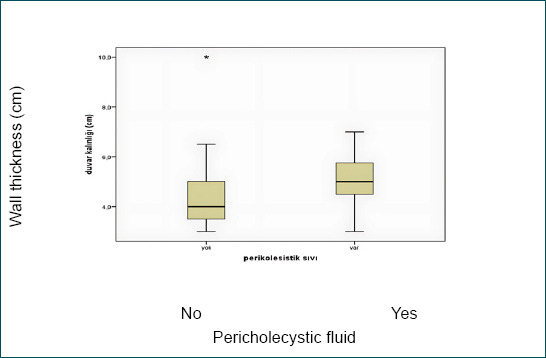
Results: A total of 230 patients were included in the study. Patients with pericholecystic fluid exhibited significantly thicker gallbladder walls (p=0.002). A significant association was found between elevated white blood cell (WBC) counts and gallbladder wall thickness (p=0.035). However, no significant relationship was observed between liver function test results and gallbladder wall thickness.
Conclusion: This study evaluated the diagnostic and management parameters utilized by clinicians in cases of acute calculous cholecystitis. The association between increased gallbladder wall thickness and pericholecystic fluid was highlighted as a key factor in diagnosis and follow-up. Although laboratory and imaging modalities provide supportive roles in diagnosis, their necessity may vary depending on the individual case. The study emphasizes the importance of a holistic approach that integrates clinical, laboratory, and radiological findings to optimize patient outcomes in the emergency department, avoid unnecessary interventions, and prevent delays in surgical treatment.





 京公网安备 11010802042870号
京ICP备2023020795号-1
京公网安备 11010802042870号
京ICP备2023020795号-1

 分享
分享

 求助内容:
求助内容: 应助结果提醒方式:
 扫码关注我们
