The sources of bioavailable toxic metals in sediments regulated their aggregated form, environmental responses and health risk-a case study in Liujiang River Basin, China
{"title":"The sources of bioavailable toxic metals in sediments regulated their aggregated form, environmental responses and health risk-a case study in Liujiang River Basin, China","authors":"Miao Xiongyi , Wei Xueqin , Hao Yupei , Zhao Xiqian , Zhou Xiaohua","doi":"10.1016/j.watres.2025.123369","DOIUrl":null,"url":null,"abstract":"<div><div>Bioavailable toxic metals (BTMs) predominantly stem from anthropogenic emissions, but their emission inventory remain unspecified. Considering the regulation of toxic metals (TMs) forms, variations in BTMs input linked to sources likely result from specific TM forms. To test this, we identified BTMs sources in Liujiang River Basin sediments, focusing on their aggregation and risk based on varying TMs forms. The findings indicated BTMs ratios decreased in the order as follows: Cd > Pb > Zn > Cu > As > Cr > Hg. PMF identified BTMs sourced from industrial, agricultural, and mining emissions with ratio of 43.2 %, 36.7 % and 20.2 %, respectively. The correspondences between the correlation coefficients of TMs forms and the sources proportions suggested reducible forms were predominantly present in industrial BTMs, whereas residual and carbonate-bound forms were less abundant in mining and agricultural BTMs, respectively. Additionally, the correspondence between correlations of environmental parameters and the sources proportions confirmed different responses of industrial, agricultural and mining BTMs for Eh, for OM and Mz and for pH, TDS and EC, respectively. HI values, generally within 1, suggested the absence of non-carcinogenic risks. Conversely, TCR values, frequently exceeded 10<sup>−6</sup>, highlighted a significant carcinogenic risk, particularly for children. Considering industrial BTMs contributed most to both HI and TCR values, frequent aeration in sediments, particularly for industrial zones, will effectively alleviate the aggregation of BTMs in Liujiang River Basin. This study confirmed TMs forms in discharged wastewater are tightly related to BTMs aggregations, therefore, strengthening their monitoring is essential.</div></div>","PeriodicalId":443,"journal":{"name":"Water Research","volume":"278 ","pages":"Article 123369"},"PeriodicalIF":12.4000,"publicationDate":"2025-06-15","publicationTypes":"Journal Article","fieldsOfStudy":null,"isOpenAccess":false,"openAccessPdf":"","citationCount":"0","resultStr":null,"platform":"Semanticscholar","paperid":null,"PeriodicalName":"Water Research","FirstCategoryId":"93","ListUrlMain":"https://www.sciencedirect.com/science/article/pii/S0043135425002829","RegionNum":1,"RegionCategory":"环境科学与生态学","ArticlePicture":[],"TitleCN":null,"AbstractTextCN":null,"PMCID":null,"EPubDate":"2025/2/23 0:00:00","PubModel":"Epub","JCR":"Q1","JCRName":"ENGINEERING, ENVIRONMENTAL","Score":null,"Total":0}
引用次数: 0
Abstract
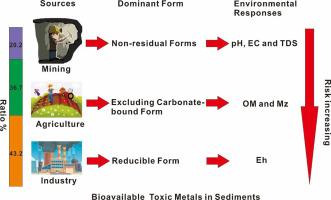
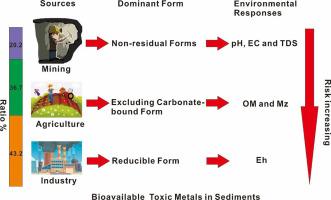
Bioavailable toxic metals (BTMs) predominantly stem from anthropogenic emissions, but their emission inventory remain unspecified. Considering the regulation of toxic metals (TMs) forms, variations in BTMs input linked to sources likely result from specific TM forms. To test this, we identified BTMs sources in Liujiang River Basin sediments, focusing on their aggregation and risk based on varying TMs forms. The findings indicated BTMs ratios decreased in the order as follows: Cd > Pb > Zn > Cu > As > Cr > Hg. PMF identified BTMs sourced from industrial, agricultural, and mining emissions with ratio of 43.2 %, 36.7 % and 20.2 %, respectively. The correspondences between the correlation coefficients of TMs forms and the sources proportions suggested reducible forms were predominantly present in industrial BTMs, whereas residual and carbonate-bound forms were less abundant in mining and agricultural BTMs, respectively. Additionally, the correspondence between correlations of environmental parameters and the sources proportions confirmed different responses of industrial, agricultural and mining BTMs for Eh, for OM and Mz and for pH, TDS and EC, respectively. HI values, generally within 1, suggested the absence of non-carcinogenic risks. Conversely, TCR values, frequently exceeded 10−6, highlighted a significant carcinogenic risk, particularly for children. Considering industrial BTMs contributed most to both HI and TCR values, frequent aeration in sediments, particularly for industrial zones, will effectively alleviate the aggregation of BTMs in Liujiang River Basin. This study confirmed TMs forms in discharged wastewater are tightly related to BTMs aggregations, therefore, strengthening their monitoring is essential.
期刊介绍:
Water Research, along with its open access companion journal Water Research X, serves as a platform for publishing original research papers covering various aspects of the science and technology related to the anthropogenic water cycle, water quality, and its management worldwide. The audience targeted by the journal comprises biologists, chemical engineers, chemists, civil engineers, environmental engineers, limnologists, and microbiologists. The scope of the journal include:
•Treatment processes for water and wastewaters (municipal, agricultural, industrial, and on-site treatment), including resource recovery and residuals management;
•Urban hydrology including sewer systems, stormwater management, and green infrastructure;
•Drinking water treatment and distribution;
•Potable and non-potable water reuse;
•Sanitation, public health, and risk assessment;
•Anaerobic digestion, solid and hazardous waste management, including source characterization and the effects and control of leachates and gaseous emissions;
•Contaminants (chemical, microbial, anthropogenic particles such as nanoparticles or microplastics) and related water quality sensing, monitoring, fate, and assessment;
•Anthropogenic impacts on inland, tidal, coastal and urban waters, focusing on surface and ground waters, and point and non-point sources of pollution;
•Environmental restoration, linked to surface water, groundwater and groundwater remediation;
•Analysis of the interfaces between sediments and water, and between water and atmosphere, focusing specifically on anthropogenic impacts;
•Mathematical modelling, systems analysis, machine learning, and beneficial use of big data related to the anthropogenic water cycle;
•Socio-economic, policy, and regulations studies.



 京公网安备 11010802042870号
京ICP备2023020795号-1
京公网安备 11010802042870号
京ICP备2023020795号-1

 分享
分享
 求助内容:
求助内容: 应助结果提醒方式:
 扫码关注我们
