{"title":"Generation of Orthogonal Gradients of the Matrix Stiffness and Chemotactic Cues in a Suspended Array of Hydrogel to Study hMSCs Migration","authors":"Zhen Xu, Anna Ponek, Jordan Thomas, Yibing Qyang","doi":"10.1021/acssensors.4c02793","DOIUrl":null,"url":null,"abstract":"Stem cell migration is a tightly regulated process in vivo, orchestrated by a collection of mechanical and chemotactic cues via concentration gradients. A variety of in vitro assays have been developed to facilitate cell migration studies; however, very few assays allow the investigation of both matrix stiffness and chemotactic cues on cell migration within a single device, especially in a three-dimensional (3D) environment. Here, we develop a microfluidic device that can produce 3D orthogonal gradients of matrix stiffness and chemotactic cues with varied steepness in a suspended array of hydrogel cylinders. The device’s working principle is the formation of diffusion-driven concentration gradients within a suspended array of hydrogel cylinders between a source and a sink. Device fabrication is based on poly(dimethylsiloxane) (PDMS) replica molding, followed by assembly on a glass substrate. To validate this device, we study the migration of human mesenchymal stem cells (hMSCs) in response to orthogonal gradients of matrix stiffness and stromal cell-derived factor 1 alpha (SDF-1α). This technology has the potential to be applied to various cell types, facilitating exploration in different cellular contexts.","PeriodicalId":24,"journal":{"name":"ACS Sensors","volume":"24 1 1","pages":""},"PeriodicalIF":9.1000,"publicationDate":"2025-02-28","publicationTypes":"Journal Article","fieldsOfStudy":null,"isOpenAccess":false,"openAccessPdf":"","citationCount":"0","resultStr":null,"platform":"Semanticscholar","paperid":null,"PeriodicalName":"ACS Sensors","FirstCategoryId":"92","ListUrlMain":"https://doi.org/10.1021/acssensors.4c02793","RegionNum":1,"RegionCategory":"化学","ArticlePicture":[],"TitleCN":null,"AbstractTextCN":null,"PMCID":null,"EPubDate":"","PubModel":"","JCR":"Q1","JCRName":"CHEMISTRY, ANALYTICAL","Score":null,"Total":0}
引用次数: 0
Abstract
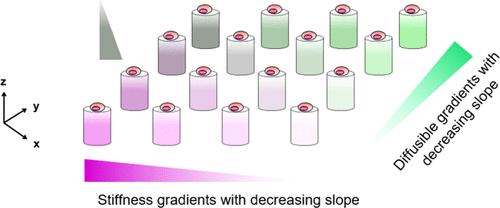
Stem cell migration is a tightly regulated process in vivo, orchestrated by a collection of mechanical and chemotactic cues via concentration gradients. A variety of in vitro assays have been developed to facilitate cell migration studies; however, very few assays allow the investigation of both matrix stiffness and chemotactic cues on cell migration within a single device, especially in a three-dimensional (3D) environment. Here, we develop a microfluidic device that can produce 3D orthogonal gradients of matrix stiffness and chemotactic cues with varied steepness in a suspended array of hydrogel cylinders. The device’s working principle is the formation of diffusion-driven concentration gradients within a suspended array of hydrogel cylinders between a source and a sink. Device fabrication is based on poly(dimethylsiloxane) (PDMS) replica molding, followed by assembly on a glass substrate. To validate this device, we study the migration of human mesenchymal stem cells (hMSCs) in response to orthogonal gradients of matrix stiffness and stromal cell-derived factor 1 alpha (SDF-1α). This technology has the potential to be applied to various cell types, facilitating exploration in different cellular contexts.
期刊介绍:
ACS Sensors is a peer-reviewed research journal that focuses on the dissemination of new and original knowledge in the field of sensor science, particularly those that selectively sense chemical or biological species or processes. The journal covers a broad range of topics, including but not limited to biosensors, chemical sensors, gas sensors, intracellular sensors, single molecule sensors, cell chips, and microfluidic devices. It aims to publish articles that address conceptual advances in sensing technology applicable to various types of analytes or application papers that report on the use of existing sensing concepts in new ways or for new analytes.



 京公网安备 11010802042870号
京ICP备2023020795号-1
京公网安备 11010802042870号
京ICP备2023020795号-1

 分享
分享
 求助内容:
求助内容: 应助结果提醒方式:
 扫码关注我们
