Bichitra Nanda Sahoo, Peter James Thomas, Paul Thomas, Martin Møller Greve
{"title":"Antibiofouling Coatings For Marine Sensors: Progress and Perspectives on Materials, Methods, Impacts, and Field Trial Studies","authors":"Bichitra Nanda Sahoo, Peter James Thomas, Paul Thomas, Martin Møller Greve","doi":"10.1021/acssensors.4c02670","DOIUrl":null,"url":null,"abstract":"The attachment of marine organisms, for example, bacteria, proteins, inorganic molecules, and more on a sea-submerged surface is a global concern for marine industries as it controls the surface for further marine growth. Applications requiring the estimation of real-time information from oceanographic sensors conveyed for long-term deployment are vulnerable to biofouling. Therefore, an effective approach to controlling the biofouling that accumulates on marine sensors is paramount. To date, many technologies have been explored to impede biofouling; however, several factors constrain many strategies, including their reliance on environmentally toxic materials, high fabrication costs, poor coatings, and nontransparency. These challenges have motivated work to develop numerous advanced and innovative strategies based on mechanical methods, irradiation, and design of polymeric/nonpolymeric coatings with fouling resistance, fouling release, and fouling degrading coatings to protect marine sensors and housing materials from biofouling. This Review presents recent progress in the developed biofouling control strategies that have been applied to commercially available sensors and sensor housing materials. Moreover, recent findings in the literature are highlighted while considering the wettability principles for air and water environments, antifouling performance, practical feasibility, environmental and economic impact of coatings, and field trial studies. Here, we emphasize how these features can play major roles synergistically to affect antifouling coatings against nano- to microlevel organisms. This review will not only allow researchers to understand the design principles but also contribute to the development of new cost-effective strategies.","PeriodicalId":24,"journal":{"name":"ACS Sensors","volume":"3 1","pages":""},"PeriodicalIF":9.1000,"publicationDate":"2025-03-05","publicationTypes":"Journal Article","fieldsOfStudy":null,"isOpenAccess":false,"openAccessPdf":"","citationCount":"0","resultStr":null,"platform":"Semanticscholar","paperid":null,"PeriodicalName":"ACS Sensors","FirstCategoryId":"92","ListUrlMain":"https://doi.org/10.1021/acssensors.4c02670","RegionNum":1,"RegionCategory":"化学","ArticlePicture":[],"TitleCN":null,"AbstractTextCN":null,"PMCID":null,"EPubDate":"","PubModel":"","JCR":"Q1","JCRName":"CHEMISTRY, ANALYTICAL","Score":null,"Total":0}
引用次数: 0
Abstract
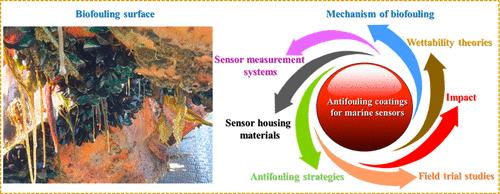
The attachment of marine organisms, for example, bacteria, proteins, inorganic molecules, and more on a sea-submerged surface is a global concern for marine industries as it controls the surface for further marine growth. Applications requiring the estimation of real-time information from oceanographic sensors conveyed for long-term deployment are vulnerable to biofouling. Therefore, an effective approach to controlling the biofouling that accumulates on marine sensors is paramount. To date, many technologies have been explored to impede biofouling; however, several factors constrain many strategies, including their reliance on environmentally toxic materials, high fabrication costs, poor coatings, and nontransparency. These challenges have motivated work to develop numerous advanced and innovative strategies based on mechanical methods, irradiation, and design of polymeric/nonpolymeric coatings with fouling resistance, fouling release, and fouling degrading coatings to protect marine sensors and housing materials from biofouling. This Review presents recent progress in the developed biofouling control strategies that have been applied to commercially available sensors and sensor housing materials. Moreover, recent findings in the literature are highlighted while considering the wettability principles for air and water environments, antifouling performance, practical feasibility, environmental and economic impact of coatings, and field trial studies. Here, we emphasize how these features can play major roles synergistically to affect antifouling coatings against nano- to microlevel organisms. This review will not only allow researchers to understand the design principles but also contribute to the development of new cost-effective strategies.
期刊介绍:
ACS Sensors is a peer-reviewed research journal that focuses on the dissemination of new and original knowledge in the field of sensor science, particularly those that selectively sense chemical or biological species or processes. The journal covers a broad range of topics, including but not limited to biosensors, chemical sensors, gas sensors, intracellular sensors, single molecule sensors, cell chips, and microfluidic devices. It aims to publish articles that address conceptual advances in sensing technology applicable to various types of analytes or application papers that report on the use of existing sensing concepts in new ways or for new analytes.




 京公网安备 11010802042870号
京ICP备2023020795号-1
京公网安备 11010802042870号
京ICP备2023020795号-1

 分享
分享
 求助内容:
求助内容: 应助结果提醒方式:
 扫码关注我们
