{"title":"Association between drinking water disinfection byproducts exposure and human bladder cancer: A time-updated meta-analysis of trihalomethanes","authors":"Bingyue Xie , Jingsi Chen , Jiayan Kai, Jiafu Li","doi":"10.1016/j.jhazmat.2025.137833","DOIUrl":null,"url":null,"abstract":"<div><div>Drinking water disinfection byproducts (DBPs) have received widespread attention due to their high concentrations and toxicity. However, the correlation between exposure to disinfection byproducts and bladder cancer in published papers is inconsistent. In this study, a time-updated meta-analysis was conducted, which aimed to elucidate the relationship between the historical exposure time and exposure levels of trihalomethanes (THMs) in drinking water and the associated risk of bladder cancer. A total of 433 relative publications was obtained from databases, however only 16 publications satisfied the inclusive criteria, including 13 case-control studies and 3 cohort studies. The case-control studies encompassed 8126 bladder cancer cases and 13,843 controls, while the cohort studies included 112,654 cases and 955 bladder cancer patients. In comparison to individuals who have never been exposed to or have only experienced brief exposure to THMs, the odds ratio (OR) for medium-term and long-term exposure of THMs was 1.30 (95 % CI = (1.11, 1.53)), and 1.59 (95 % CI = (1.40, 1.81)), respectively. This suggests a statistically significant positive correlation between long-term exposure to chlorinated drinking water and an increased risk of bladder cancer. The pooled OR for low and high exposure group was 1.28 (95 % CI = (1.06, 1.55)) and 1.45 (95 % CI = (1.14, 1.85)), respectively, indicating an increased risk of bladder cancer occurrence compared to the unexposed group. Interestingly, subgroup analysis revealed that high levels of THM exposures of males caused an increased risk of bladder cancer (OR= 1.59, 95 % CI = (1.11, 1.53)), while this association was not significant for females (OR = 1.05, 95 % CI = (0.61, 1.80)). More importantly, although the case-control studies were consistent with the overall findings, the cohort studies suggest that there is insufficient evidence to establish a definitive causal link between THMs exposure levels and bladder cancer. In general, long-term consumption of chlorinated drinking water was associated with the occurrence of bladder cancer of male rather than female.</div></div>","PeriodicalId":361,"journal":{"name":"Journal of Hazardous Materials","volume":"490 ","pages":"Article 137833"},"PeriodicalIF":11.3000,"publicationDate":"2025-06-15","publicationTypes":"Journal Article","fieldsOfStudy":null,"isOpenAccess":false,"openAccessPdf":"","citationCount":"0","resultStr":null,"platform":"Semanticscholar","paperid":null,"PeriodicalName":"Journal of Hazardous Materials","FirstCategoryId":"93","ListUrlMain":"https://www.sciencedirect.com/science/article/pii/S0304389425007472","RegionNum":1,"RegionCategory":"环境科学与生态学","ArticlePicture":[],"TitleCN":null,"AbstractTextCN":null,"PMCID":null,"EPubDate":"2025/3/3 0:00:00","PubModel":"Epub","JCR":"Q1","JCRName":"ENGINEERING, ENVIRONMENTAL","Score":null,"Total":0}
引用次数: 0
Abstract
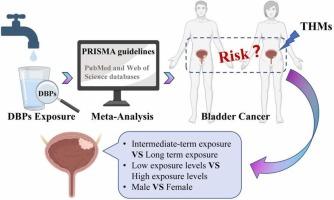
Drinking water disinfection byproducts (DBPs) have received widespread attention due to their high concentrations and toxicity. However, the correlation between exposure to disinfection byproducts and bladder cancer in published papers is inconsistent. In this study, a time-updated meta-analysis was conducted, which aimed to elucidate the relationship between the historical exposure time and exposure levels of trihalomethanes (THMs) in drinking water and the associated risk of bladder cancer. A total of 433 relative publications was obtained from databases, however only 16 publications satisfied the inclusive criteria, including 13 case-control studies and 3 cohort studies. The case-control studies encompassed 8126 bladder cancer cases and 13,843 controls, while the cohort studies included 112,654 cases and 955 bladder cancer patients. In comparison to individuals who have never been exposed to or have only experienced brief exposure to THMs, the odds ratio (OR) for medium-term and long-term exposure of THMs was 1.30 (95 % CI = (1.11, 1.53)), and 1.59 (95 % CI = (1.40, 1.81)), respectively. This suggests a statistically significant positive correlation between long-term exposure to chlorinated drinking water and an increased risk of bladder cancer. The pooled OR for low and high exposure group was 1.28 (95 % CI = (1.06, 1.55)) and 1.45 (95 % CI = (1.14, 1.85)), respectively, indicating an increased risk of bladder cancer occurrence compared to the unexposed group. Interestingly, subgroup analysis revealed that high levels of THM exposures of males caused an increased risk of bladder cancer (OR= 1.59, 95 % CI = (1.11, 1.53)), while this association was not significant for females (OR = 1.05, 95 % CI = (0.61, 1.80)). More importantly, although the case-control studies were consistent with the overall findings, the cohort studies suggest that there is insufficient evidence to establish a definitive causal link between THMs exposure levels and bladder cancer. In general, long-term consumption of chlorinated drinking water was associated with the occurrence of bladder cancer of male rather than female.
饮用水消毒副产物(DBPs)因其浓度高、毒性大而受到广泛关注。然而,在已发表的论文中,接触消毒副产物与膀胱癌之间的相关性并不一致。本研究通过时间更新的荟萃分析,旨在阐明饮用水中三卤甲烷(THMs)的历史暴露时间和暴露水平与膀胱癌相关风险的关系。从数据库中共获得433篇相关文献,但只有16篇文献符合纳入标准,包括13篇病例对照研究和3篇队列研究。病例对照研究包括8126例膀胱癌病例和13843例对照,而队列研究包括112654例膀胱癌病例和955例膀胱癌患者。与从未暴露于THMs或仅短暂暴露于THMs的个体相比,中期和长期暴露于THMs的优势比(or)分别为1.30 (95% CI =(1.11, 1.53))和1.59 (95% CI =(1.40, 1.81))。这表明,长期饮用含氯饮用水与膀胱癌风险增加之间存在统计学上显著的正相关。低暴露组和高暴露组的合并OR分别为1.28 (95% CI =(1.06, 1.55))和1.45 (95% CI =(1.14, 1.85)),表明与未暴露组相比,膀胱癌发生的风险增加。有趣的是,亚组分析显示,男性高水平的THM暴露导致膀胱癌的风险增加(OR= 1.59, 95% CI =(1.11, 1.53)),而这种关联对女性不显著(OR= 1.05, 95% CI =(0.61, 1.80))。更重要的是,尽管病例对照研究与总体结果一致,但队列研究表明,没有足够的证据证明THMs暴露水平与膀胱癌之间存在明确的因果关系。总体而言,长期饮用含氯饮用水与男性膀胱癌的发生有关,而非女性。
期刊介绍:
The Journal of Hazardous Materials serves as a global platform for promoting cutting-edge research in the field of Environmental Science and Engineering. Our publication features a wide range of articles, including full-length research papers, review articles, and perspectives, with the aim of enhancing our understanding of the dangers and risks associated with various materials concerning public health and the environment. It is important to note that the term "environmental contaminants" refers specifically to substances that pose hazardous effects through contamination, while excluding those that do not have such impacts on the environment or human health. Moreover, we emphasize the distinction between wastes and hazardous materials in order to provide further clarity on the scope of the journal. We have a keen interest in exploring specific compounds and microbial agents that have adverse effects on the environment.



 京公网安备 11010802042870号
京ICP备2023020795号-1
京公网安备 11010802042870号
京ICP备2023020795号-1

 分享
分享
 求助内容:
求助内容: 应助结果提醒方式:
 扫码关注我们
