Polypropylene Covalent Adaptable Networks with Full Cross-Link Density Recovery after Reprocessing: Development by Free-Radical Reactive Processing with Resonance-Stabilized, Aromatic Disulfide Cross-Linkers
Yen-Wen Huang, Mathew J. Suazo, Stephanie M. Barbon, Hayley A. Brown, Evelyn Auyeung, Colin Li Pi Shan, John M. Torkelson
{"title":"Polypropylene Covalent Adaptable Networks with Full Cross-Link Density Recovery after Reprocessing: Development by Free-Radical Reactive Processing with Resonance-Stabilized, Aromatic Disulfide Cross-Linkers","authors":"Yen-Wen Huang, Mathew J. Suazo, Stephanie M. Barbon, Hayley A. Brown, Evelyn Auyeung, Colin Li Pi Shan, John M. Torkelson","doi":"10.1021/acsmacrolett.5c00061","DOIUrl":null,"url":null,"abstract":"A single-step method that produces percolated, dynamic covalent cross-links integrated into the PP homopolymer has not been previously demonstrated. Here, we synthesized covalent adaptable networks (CANs) from polypropylene (PP) homopolymers using 180 °C, radical-based, reactive processing with a free-radical initiator, dicumyl peroxide (DCP), and resonance-stabilized, aromatic disulfide cross-linkers, one methacrylate-based and another phenyl acrylate-based. Both cross-linkers yielded networks when reactively processed at 4 wt % with relatively high molecular weight (MW) PP (melt flow index (MFI) = 12) and 4 wt % DCP. The phenyl acrylate-based cross-linker also yielded PP networks at other studied DCP/cross-linker concentrations and with relatively low MW PP (MFI = 35). Notably, our highest cross-link density PP CAN exhibited full recovery of cross-link density after three reprocessing steps by compression molding; that PP CAN also exhibited full cross-link density recovery within experimental uncertainty after reprocessing by melt extrusion.","PeriodicalId":18,"journal":{"name":"ACS Macro Letters","volume":"11 1","pages":""},"PeriodicalIF":5.2000,"publicationDate":"2025-03-05","publicationTypes":"Journal Article","fieldsOfStudy":null,"isOpenAccess":false,"openAccessPdf":"","citationCount":"0","resultStr":null,"platform":"Semanticscholar","paperid":null,"PeriodicalName":"ACS Macro Letters","FirstCategoryId":"92","ListUrlMain":"https://doi.org/10.1021/acsmacrolett.5c00061","RegionNum":0,"RegionCategory":null,"ArticlePicture":[],"TitleCN":null,"AbstractTextCN":null,"PMCID":null,"EPubDate":"","PubModel":"","JCR":"Q1","JCRName":"POLYMER SCIENCE","Score":null,"Total":0}
引用次数: 0
Abstract
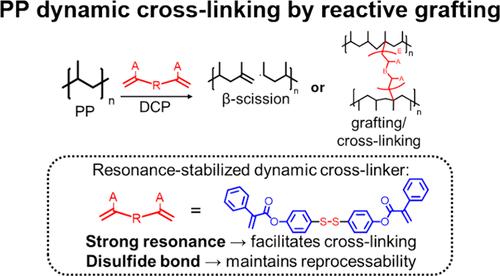
A single-step method that produces percolated, dynamic covalent cross-links integrated into the PP homopolymer has not been previously demonstrated. Here, we synthesized covalent adaptable networks (CANs) from polypropylene (PP) homopolymers using 180 °C, radical-based, reactive processing with a free-radical initiator, dicumyl peroxide (DCP), and resonance-stabilized, aromatic disulfide cross-linkers, one methacrylate-based and another phenyl acrylate-based. Both cross-linkers yielded networks when reactively processed at 4 wt % with relatively high molecular weight (MW) PP (melt flow index (MFI) = 12) and 4 wt % DCP. The phenyl acrylate-based cross-linker also yielded PP networks at other studied DCP/cross-linker concentrations and with relatively low MW PP (MFI = 35). Notably, our highest cross-link density PP CAN exhibited full recovery of cross-link density after three reprocessing steps by compression molding; that PP CAN also exhibited full cross-link density recovery within experimental uncertainty after reprocessing by melt extrusion.
期刊介绍:
ACS Macro Letters publishes research in all areas of contemporary soft matter science in which macromolecules play a key role, including nanotechnology, self-assembly, supramolecular chemistry, biomaterials, energy generation and storage, and renewable/sustainable materials. Submissions to ACS Macro Letters should justify clearly the rapid disclosure of the key elements of the study. The scope of the journal includes high-impact research of broad interest in all areas of polymer science and engineering, including cross-disciplinary research that interfaces with polymer science.
With the launch of ACS Macro Letters, all Communications that were formerly published in Macromolecules and Biomacromolecules will be published as Letters in ACS Macro Letters.



 京公网安备 11010802042870号
京ICP备2023020795号-1
京公网安备 11010802042870号
京ICP备2023020795号-1

 分享
分享
 求助内容:
求助内容: 应助结果提醒方式:
 扫码关注我们
