Direct recovery of high-purity uranium from fluoride-containing nuclear wastewater via extraction materials with ensemble Lewis sites and a tandem electrochemical device
Guo Li , Yan Liu , Chi Jiao , Zhengyu Jiang , Juan Zhang , Tao Chen , Tao Lin , Rong He , Wenkun Zhu , Xiangke Wang
{"title":"Direct recovery of high-purity uranium from fluoride-containing nuclear wastewater via extraction materials with ensemble Lewis sites and a tandem electrochemical device","authors":"Guo Li , Yan Liu , Chi Jiao , Zhengyu Jiang , Juan Zhang , Tao Chen , Tao Lin , Rong He , Wenkun Zhu , Xiangke Wang","doi":"10.1016/j.watres.2025.123467","DOIUrl":null,"url":null,"abstract":"<div><div>Electrochemical uranium extraction from real nuclear wastewater with a high concentration of fluoride ions (F-) represents a promising strategy for the efficient treatment of radioactive wastewater and the recovery of the valuable uranium resource. However, the current progress suffers from the interference of extremely high concentration of F- and undesired purity of the final uranium product. Herein, we constructed the neighboring ensemble Lewis acid-base pair sites (ensemble Lewis sites) in bismuth oxides as the extraction material, which was integrated into a designed tandem electrochemical device for efficient recovery of high-purity uranium from real nuclear wastewater. The mechanistic study revealed that the ensemble Lewis sites dramatically enhance the binding of all dominant uranyl fluoride (UO2Fx) species through the simultaneous strengthened chemical bonds with U, O, and F atoms. Besides, the tandem electrochemical device rationally controlled the reaction period to U3O8, avoiding the undesired crystalline transformation to K2U2O7. Through 3 h electrolysis in 1 L of real nuclear wastewater, the extraction efficiency of uranium reached 99.9 % with only 2.2 % impurities of alkali metals in extracted uranium product, outperforming the previous work. This study offers an effective method for the recovery of uranium resources in real nuclear wastewater.</div></div>","PeriodicalId":443,"journal":{"name":"Water Research","volume":"279 ","pages":"Article 123467"},"PeriodicalIF":12.4000,"publicationDate":"2025-03-09","publicationTypes":"Journal Article","fieldsOfStudy":null,"isOpenAccess":false,"openAccessPdf":"","citationCount":"0","resultStr":null,"platform":"Semanticscholar","paperid":null,"PeriodicalName":"Water Research","FirstCategoryId":"93","ListUrlMain":"https://www.sciencedirect.com/science/article/pii/S004313542500380X","RegionNum":1,"RegionCategory":"环境科学与生态学","ArticlePicture":[],"TitleCN":null,"AbstractTextCN":null,"PMCID":null,"EPubDate":"","PubModel":"","JCR":"Q1","JCRName":"ENGINEERING, ENVIRONMENTAL","Score":null,"Total":0}
引用次数: 0
Abstract
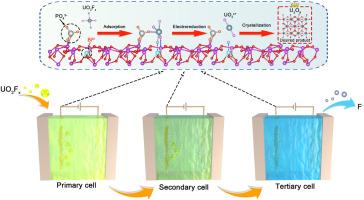
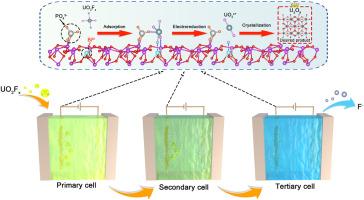
Electrochemical uranium extraction from real nuclear wastewater with a high concentration of fluoride ions (F-) represents a promising strategy for the efficient treatment of radioactive wastewater and the recovery of the valuable uranium resource. However, the current progress suffers from the interference of extremely high concentration of F- and undesired purity of the final uranium product. Herein, we constructed the neighboring ensemble Lewis acid-base pair sites (ensemble Lewis sites) in bismuth oxides as the extraction material, which was integrated into a designed tandem electrochemical device for efficient recovery of high-purity uranium from real nuclear wastewater. The mechanistic study revealed that the ensemble Lewis sites dramatically enhance the binding of all dominant uranyl fluoride (UO2Fx) species through the simultaneous strengthened chemical bonds with U, O, and F atoms. Besides, the tandem electrochemical device rationally controlled the reaction period to U3O8, avoiding the undesired crystalline transformation to K2U2O7. Through 3 h electrolysis in 1 L of real nuclear wastewater, the extraction efficiency of uranium reached 99.9 % with only 2.2 % impurities of alkali metals in extracted uranium product, outperforming the previous work. This study offers an effective method for the recovery of uranium resources in real nuclear wastewater.
期刊介绍:
Water Research, along with its open access companion journal Water Research X, serves as a platform for publishing original research papers covering various aspects of the science and technology related to the anthropogenic water cycle, water quality, and its management worldwide. The audience targeted by the journal comprises biologists, chemical engineers, chemists, civil engineers, environmental engineers, limnologists, and microbiologists. The scope of the journal include:
•Treatment processes for water and wastewaters (municipal, agricultural, industrial, and on-site treatment), including resource recovery and residuals management;
•Urban hydrology including sewer systems, stormwater management, and green infrastructure;
•Drinking water treatment and distribution;
•Potable and non-potable water reuse;
•Sanitation, public health, and risk assessment;
•Anaerobic digestion, solid and hazardous waste management, including source characterization and the effects and control of leachates and gaseous emissions;
•Contaminants (chemical, microbial, anthropogenic particles such as nanoparticles or microplastics) and related water quality sensing, monitoring, fate, and assessment;
•Anthropogenic impacts on inland, tidal, coastal and urban waters, focusing on surface and ground waters, and point and non-point sources of pollution;
•Environmental restoration, linked to surface water, groundwater and groundwater remediation;
•Analysis of the interfaces between sediments and water, and between water and atmosphere, focusing specifically on anthropogenic impacts;
•Mathematical modelling, systems analysis, machine learning, and beneficial use of big data related to the anthropogenic water cycle;
•Socio-economic, policy, and regulations studies.



 京公网安备 11010802042870号
京ICP备2023020795号-1
京公网安备 11010802042870号
京ICP备2023020795号-1

 分享
分享
 求助内容:
求助内容: 应助结果提醒方式:
 扫码关注我们
