{"title":"Rapid and reliable POCT blood typing based on a laser identified RBC agglutination method†","authors":"Bing Xu, Yange Huang, Shuqiang Min, Xianchang Wu, Tonghuan Zhan, Jiahao Liu, Fuzhou Niu and Hui Niu","doi":"10.1039/D4AN01504E","DOIUrl":null,"url":null,"abstract":"<p >Blood typing is a critical element of medical diagnostics and health assessment. Nevertheless, prevailing point-of-care testing (POCT) assays, including the slide method, tube method, column agglutination method, and gel test method, often necessitate costly equipment such as centrifuges, cumbersome procedures, and skilled personnel for operation. Furthermore, the testing time is relatively long (∼30 min), which is not applicable in emergency cases/point-of-care testing. Thus, a low-cost, simple, low blood consumption and rapid blood typing method is urgently required, especially in resource limited areas for point-of-care applications. Herein, we present a novel method of laser-based identification of red blood cell (RBC) agglutination for accurate and reliable blood typing. Specifically, the RBC agglutination reaction (a bio-signal) is initially converted into a laser signal. Subsequently, a photoresistor converts the laser signal into an electrical signal (with high or low resistance). Finally, the electrical signal is converted into an optical signal through a detection circuit (if the resistance is lower than 600 Ω, the LED light is on; otherwise, the LED light is off). By merely interpreting the light signals, even non-professionals can precisely determine the blood types without the risk of misinterpretation. This laser-based blood typing method can effectively avoid human errors caused by naked-eye observations or environmental interference and can provide new insights for developing accurate and reliable hemagglutination identification methods for point-of-care blood typing.</p>","PeriodicalId":63,"journal":{"name":"Analyst","volume":" 9","pages":" 1862-1871"},"PeriodicalIF":3.3000,"publicationDate":"2025-03-11","publicationTypes":"Journal Article","fieldsOfStudy":null,"isOpenAccess":false,"openAccessPdf":"","citationCount":"0","resultStr":null,"platform":"Semanticscholar","paperid":null,"PeriodicalName":"Analyst","FirstCategoryId":"92","ListUrlMain":"https://pubs.rsc.org/en/content/articlelanding/2025/an/d4an01504e","RegionNum":3,"RegionCategory":"化学","ArticlePicture":[],"TitleCN":null,"AbstractTextCN":null,"PMCID":null,"EPubDate":"","PubModel":"","JCR":"Q2","JCRName":"CHEMISTRY, ANALYTICAL","Score":null,"Total":0}
引用次数: 0
Abstract
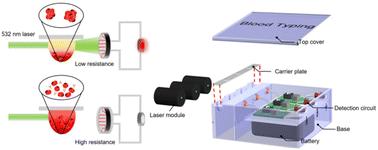
Blood typing is a critical element of medical diagnostics and health assessment. Nevertheless, prevailing point-of-care testing (POCT) assays, including the slide method, tube method, column agglutination method, and gel test method, often necessitate costly equipment such as centrifuges, cumbersome procedures, and skilled personnel for operation. Furthermore, the testing time is relatively long (∼30 min), which is not applicable in emergency cases/point-of-care testing. Thus, a low-cost, simple, low blood consumption and rapid blood typing method is urgently required, especially in resource limited areas for point-of-care applications. Herein, we present a novel method of laser-based identification of red blood cell (RBC) agglutination for accurate and reliable blood typing. Specifically, the RBC agglutination reaction (a bio-signal) is initially converted into a laser signal. Subsequently, a photoresistor converts the laser signal into an electrical signal (with high or low resistance). Finally, the electrical signal is converted into an optical signal through a detection circuit (if the resistance is lower than 600 Ω, the LED light is on; otherwise, the LED light is off). By merely interpreting the light signals, even non-professionals can precisely determine the blood types without the risk of misinterpretation. This laser-based blood typing method can effectively avoid human errors caused by naked-eye observations or environmental interference and can provide new insights for developing accurate and reliable hemagglutination identification methods for point-of-care blood typing.



 京公网安备 11010802042870号
京ICP备2023020795号-1
京公网安备 11010802042870号
京ICP备2023020795号-1

 分享
分享
 求助内容:
求助内容: 应助结果提醒方式:
 扫码关注我们
