{"title":"Ultrasensitive electrochemical sensor for lipopolysaccharide detection catalyzed by 3,4,9,10-perylenetetracarboxylic diimide","authors":"Wenjie Yu , Shuaibing Yu , Fenghong Zhang , Qinyuan Xu , Xueji Zhang , Jinming Kong","doi":"10.1016/j.aca.2025.343926","DOIUrl":null,"url":null,"abstract":"<div><h3>Background</h3><div>Lipopolysaccharide (LPS), a bacterial endotoxin prevalent in Gram-negative pathogens (e.g., <em>Escherichia coli</em>), induces severe immune responses linked to endotoxemia and hepatitis. Despite its clinical significance, conventional LPS detection methods (e.g., limulus amebocyte lysate assays) face challenges including operational complexity, high cost, and limited sensitivity. Addressing these limitations necessitates the development of innovative strategies for ultrasensitive LPS quantification.</div></div><div><h3>Results</h3><div>We present an electrochemical biosensor integrating dual-signal amplification: (1) affinity amplification via phenylboronic acid-cis-diol covalent binding on LPS polysaccharide chains, and (2) photocatalytic amplification using perylene diimide (PDI)-mediated atom transfer radical polymerization (Photo-ATRP) under red light (615–650 nm). Thiol-functionalized DNA aptamers enable specific LPS capture, while PDI catalyzes rapid ferrocene monomer polymerization, achieving exponential signal enhancement. The sensor demonstrates exceptional performance: (1) Ultrahigh sensitivity: Detection limit of 0.25 fg/mL. (2) Wide dynamic range: Linear response from 1.0 fg/mL to 0.1 pg/mL. (3) Robust specificity: Minimal interference in human serum matrices.</div></div><div><h3>Significance</h3><div>This work establishes a paradigm for LPS detection through three key advances: (1) Operational simplicity: Eliminates enzymatic/nanomaterial dependencies via metal-free PDI photocatalysis. (2) Translational utility: Serum compatibility supports clinical diagnostics and point-of-care applications. (3) Catalytic innovation: Validates PDI as a high-efficiency photocatalyst for controlled polymer synthesis. The sensor's low-cost fabrication, rapid response (<4.5 h), and femtomolar sensitivity position it as a transformative tool for sepsis monitoring and biomedical research.</div></div>","PeriodicalId":240,"journal":{"name":"Analytica Chimica Acta","volume":"1352 ","pages":"Article 343926"},"PeriodicalIF":6.0000,"publicationDate":"2025-05-22","publicationTypes":"Journal Article","fieldsOfStudy":null,"isOpenAccess":false,"openAccessPdf":"","citationCount":"0","resultStr":null,"platform":"Semanticscholar","paperid":null,"PeriodicalName":"Analytica Chimica Acta","FirstCategoryId":"92","ListUrlMain":"https://www.sciencedirect.com/science/article/pii/S0003267025003204","RegionNum":2,"RegionCategory":"化学","ArticlePicture":[],"TitleCN":null,"AbstractTextCN":null,"PMCID":null,"EPubDate":"2025/3/10 0:00:00","PubModel":"Epub","JCR":"Q1","JCRName":"CHEMISTRY, ANALYTICAL","Score":null,"Total":0}
引用次数: 0
Abstract
Background
Lipopolysaccharide (LPS), a bacterial endotoxin prevalent in Gram-negative pathogens (e.g., Escherichia coli), induces severe immune responses linked to endotoxemia and hepatitis. Despite its clinical significance, conventional LPS detection methods (e.g., limulus amebocyte lysate assays) face challenges including operational complexity, high cost, and limited sensitivity. Addressing these limitations necessitates the development of innovative strategies for ultrasensitive LPS quantification.
Results
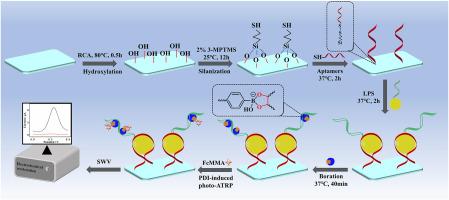
We present an electrochemical biosensor integrating dual-signal amplification: (1) affinity amplification via phenylboronic acid-cis-diol covalent binding on LPS polysaccharide chains, and (2) photocatalytic amplification using perylene diimide (PDI)-mediated atom transfer radical polymerization (Photo-ATRP) under red light (615–650 nm). Thiol-functionalized DNA aptamers enable specific LPS capture, while PDI catalyzes rapid ferrocene monomer polymerization, achieving exponential signal enhancement. The sensor demonstrates exceptional performance: (1) Ultrahigh sensitivity: Detection limit of 0.25 fg/mL. (2) Wide dynamic range: Linear response from 1.0 fg/mL to 0.1 pg/mL. (3) Robust specificity: Minimal interference in human serum matrices.
Significance
This work establishes a paradigm for LPS detection through three key advances: (1) Operational simplicity: Eliminates enzymatic/nanomaterial dependencies via metal-free PDI photocatalysis. (2) Translational utility: Serum compatibility supports clinical diagnostics and point-of-care applications. (3) Catalytic innovation: Validates PDI as a high-efficiency photocatalyst for controlled polymer synthesis. The sensor's low-cost fabrication, rapid response (<4.5 h), and femtomolar sensitivity position it as a transformative tool for sepsis monitoring and biomedical research.
期刊介绍:
Analytica Chimica Acta has an open access mirror journal Analytica Chimica Acta: X, sharing the same aims and scope, editorial team, submission system and rigorous peer review.
Analytica Chimica Acta provides a forum for the rapid publication of original research, and critical, comprehensive reviews dealing with all aspects of fundamental and applied modern analytical chemistry. The journal welcomes the submission of research papers which report studies concerning the development of new and significant analytical methodologies. In determining the suitability of submitted articles for publication, particular scrutiny will be placed on the degree of novelty and impact of the research and the extent to which it adds to the existing body of knowledge in analytical chemistry.




 京公网安备 11010802042870号
京ICP备2023020795号-1
京公网安备 11010802042870号
京ICP备2023020795号-1

 分享
分享
 求助内容:
求助内容: 应助结果提醒方式:
 扫码关注我们
