Katarzyna Dziopa, Nishi Chaturvedi, Folkert W Asselbergs, Amand F Schmidt
{"title":"Identifying and ranking non-traditional risk factors for cardiovascular disease prediction in people with type 2 diabetes.","authors":"Katarzyna Dziopa, Nishi Chaturvedi, Folkert W Asselbergs, Amand F Schmidt","doi":"10.1038/s43856-025-00785-y","DOIUrl":null,"url":null,"abstract":"<p><strong>Background: </strong>Cardiovascular disease (CVD) prediction models perform poorly in people with type 2 diabetes (T2DM). We aimed to identify potentially non-traditional CVD predictors for six facets of CVD (including coronary heart disease, ischemic stroke, heart failure, and atrial fibrillation) in people with T2DM.</p><p><strong>Methods: </strong>We analysed data on 600+ features from the UK Biobank, stratified by history of CVD and T2DM: 459,142 participants without diabetes or CVD, 14,610 with diabetes but without CVD, and 4432 with diabetes and CVD. A penalised generalized linear model with a binomial distribution was used to identify CVD-related features. Subsequently, a 20% hold-out set was used to replicate identified features and provide an importance based ranking.</p><p><strong>Results: </strong>Here we show that non-traditional risk factors are of particular importance in people with diabetes. Classical CVD risk factors (e.g. family history, high blood pressure) rank highly in people without diabetes. For individuals with T2DM but no CVD, top predictors include cystatin C, self-reported health satisfaction, biochemical measures of ill health. In people with diabetes and CVD, key predictors are self-reported ill health and blood cell counts. Unique diabetes-related risk factors include dietary patterns, mental health and biochemistry measures (e.g. oestradiol, rheumatoid factor). Adding these features improves risk stratification; per 1000 people with diabetes, 133 CVD and 165 HF cases receive a higher risk.</p><p><strong>Conclusions: </strong>This study identifies numerous replicated non-traditional CVD risk factors for people with T2DM, providing insight to improve guideline recommended risk prediction models which currently overlook these features.</p>","PeriodicalId":72646,"journal":{"name":"Communications medicine","volume":"5 1","pages":"77"},"PeriodicalIF":5.4000,"publicationDate":"2025-03-14","publicationTypes":"Journal Article","fieldsOfStudy":null,"isOpenAccess":false,"openAccessPdf":"https://www.ncbi.nlm.nih.gov/pmc/articles/PMC11906859/pdf/","citationCount":"0","resultStr":null,"platform":"Semanticscholar","paperid":null,"PeriodicalName":"Communications medicine","FirstCategoryId":"1085","ListUrlMain":"https://doi.org/10.1038/s43856-025-00785-y","RegionNum":0,"RegionCategory":null,"ArticlePicture":[],"TitleCN":null,"AbstractTextCN":null,"PMCID":null,"EPubDate":"","PubModel":"","JCR":"Q1","JCRName":"MEDICINE, RESEARCH & EXPERIMENTAL","Score":null,"Total":0}
引用次数: 0
Abstract
Background: Cardiovascular disease (CVD) prediction models perform poorly in people with type 2 diabetes (T2DM). We aimed to identify potentially non-traditional CVD predictors for six facets of CVD (including coronary heart disease, ischemic stroke, heart failure, and atrial fibrillation) in people with T2DM.
Methods: We analysed data on 600+ features from the UK Biobank, stratified by history of CVD and T2DM: 459,142 participants without diabetes or CVD, 14,610 with diabetes but without CVD, and 4432 with diabetes and CVD. A penalised generalized linear model with a binomial distribution was used to identify CVD-related features. Subsequently, a 20% hold-out set was used to replicate identified features and provide an importance based ranking.
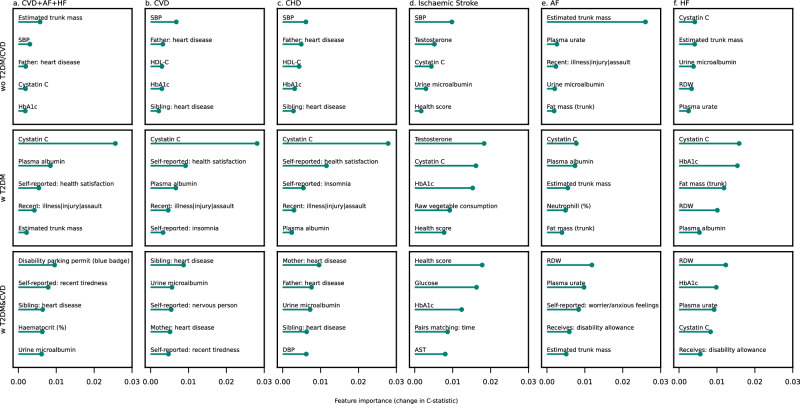
Results: Here we show that non-traditional risk factors are of particular importance in people with diabetes. Classical CVD risk factors (e.g. family history, high blood pressure) rank highly in people without diabetes. For individuals with T2DM but no CVD, top predictors include cystatin C, self-reported health satisfaction, biochemical measures of ill health. In people with diabetes and CVD, key predictors are self-reported ill health and blood cell counts. Unique diabetes-related risk factors include dietary patterns, mental health and biochemistry measures (e.g. oestradiol, rheumatoid factor). Adding these features improves risk stratification; per 1000 people with diabetes, 133 CVD and 165 HF cases receive a higher risk.
Conclusions: This study identifies numerous replicated non-traditional CVD risk factors for people with T2DM, providing insight to improve guideline recommended risk prediction models which currently overlook these features.





 京公网安备 11010802042870号
京ICP备2023020795号-1
京公网安备 11010802042870号
京ICP备2023020795号-1

 分享
分享

 求助内容:
求助内容: 应助结果提醒方式:
 扫码关注我们
