Viktor Hartung, Philipp Gruschwitz, Anne Marie Augustin, Jan-Peter Grunz, Florian Kleefeldt, Dominik Peter, Süleyman Ergün, Johanna Günther, Teresa Reichl, Thomas Kampf, Martin Andreas Rückert, Stefan Herz, Volker Christian Behr, Thorsten Alexander Bley, Patrick Vogel
{"title":"Magnetic particle imaging angiography of the femoral artery in a human cadaveric perfusion model.","authors":"Viktor Hartung, Philipp Gruschwitz, Anne Marie Augustin, Jan-Peter Grunz, Florian Kleefeldt, Dominik Peter, Süleyman Ergün, Johanna Günther, Teresa Reichl, Thomas Kampf, Martin Andreas Rückert, Stefan Herz, Volker Christian Behr, Thorsten Alexander Bley, Patrick Vogel","doi":"10.1038/s43856-025-00794-x","DOIUrl":null,"url":null,"abstract":"<p><strong>Background: </strong>Magnetic particle imaging (MPI) allows for radiation-free visualization of tracers without background signal. With the first human-sized interventional MPI scanner being recently developed, the aim of the present study was to test its performance for guiding of endovascular procedures in a realistic perfusion model.</p><p><strong>Methods: </strong>Three fresh-frozen cadaveric legs were prepared to establish continuous circulation in the superficial femoral artery via introducer sheaths in the inguinal and infragenicular region. To facilitate vessel visualization, a mixture of a MPI tracer (Resotran® or Perimag®) and X-ray contrast agent was injected under continuous extracorporeal perfusion and imaged simultaneously with MPI angiography and digital subtraction angiography (DSA) as reference.</p><p><strong>Results: </strong>The MPI scanner integrates seamlessly into the standard operating procedures in the angiography suite and simultaneous imaging with DSA and MPI is feasible. The MPI scanner detects a tracer bolus of 2 ml Perimag® or 1.5 ml Resotran®. Imaging results are consistent and reproducible in three cadaveric leg phantoms.</p><p><strong>Conclusion: </strong>This study demonstrates, that the recently developed human-sized MPI scanner facilitates reliable radiation-free image guidance for peripheral vascular interventions in the superficial femoral artery with a tracer approved for use in humans.</p>","PeriodicalId":72646,"journal":{"name":"Communications medicine","volume":"5 1","pages":"75"},"PeriodicalIF":5.4000,"publicationDate":"2025-03-13","publicationTypes":"Journal Article","fieldsOfStudy":null,"isOpenAccess":false,"openAccessPdf":"https://www.ncbi.nlm.nih.gov/pmc/articles/PMC11906881/pdf/","citationCount":"0","resultStr":null,"platform":"Semanticscholar","paperid":null,"PeriodicalName":"Communications medicine","FirstCategoryId":"1085","ListUrlMain":"https://doi.org/10.1038/s43856-025-00794-x","RegionNum":0,"RegionCategory":null,"ArticlePicture":[],"TitleCN":null,"AbstractTextCN":null,"PMCID":null,"EPubDate":"","PubModel":"","JCR":"Q1","JCRName":"MEDICINE, RESEARCH & EXPERIMENTAL","Score":null,"Total":0}
引用次数: 0
Abstract
Background: Magnetic particle imaging (MPI) allows for radiation-free visualization of tracers without background signal. With the first human-sized interventional MPI scanner being recently developed, the aim of the present study was to test its performance for guiding of endovascular procedures in a realistic perfusion model.
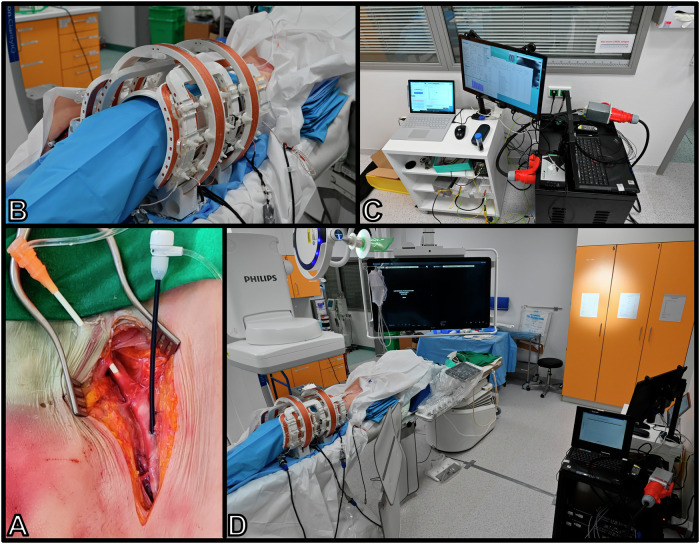
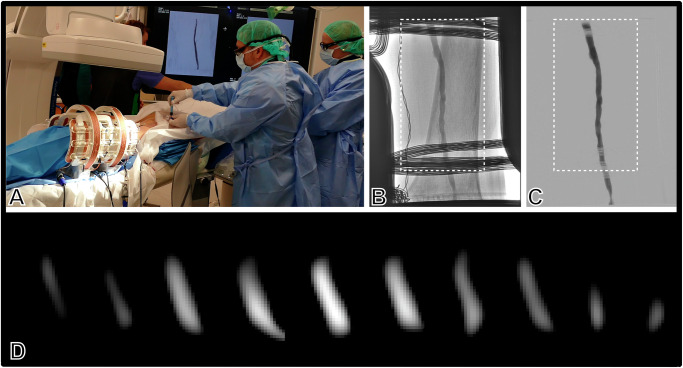
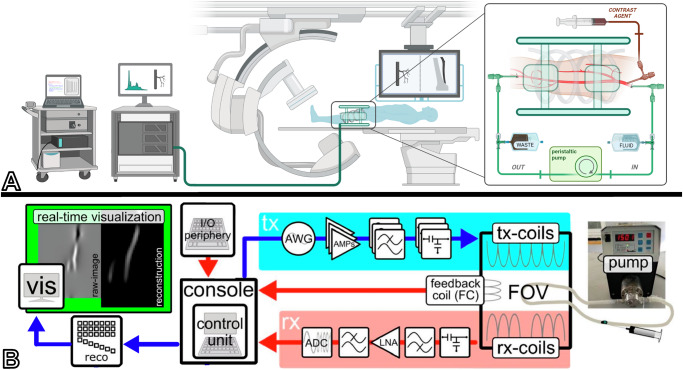
Methods: Three fresh-frozen cadaveric legs were prepared to establish continuous circulation in the superficial femoral artery via introducer sheaths in the inguinal and infragenicular region. To facilitate vessel visualization, a mixture of a MPI tracer (Resotran® or Perimag®) and X-ray contrast agent was injected under continuous extracorporeal perfusion and imaged simultaneously with MPI angiography and digital subtraction angiography (DSA) as reference.
Results: The MPI scanner integrates seamlessly into the standard operating procedures in the angiography suite and simultaneous imaging with DSA and MPI is feasible. The MPI scanner detects a tracer bolus of 2 ml Perimag® or 1.5 ml Resotran®. Imaging results are consistent and reproducible in three cadaveric leg phantoms.
Conclusion: This study demonstrates, that the recently developed human-sized MPI scanner facilitates reliable radiation-free image guidance for peripheral vascular interventions in the superficial femoral artery with a tracer approved for use in humans.
背景:磁颗粒成像(MPI)允许无背景信号的示踪剂无辐射可视化。随着第一台人体大小的介入性MPI扫描仪最近被开发出来,本研究的目的是测试其在现实灌注模型中指导血管内手术的性能。方法:制备3条新鲜冷冻的尸体腿,通过腹股沟和细骨下区的引入鞘在股浅动脉内建立连续循环。为了方便血管可视化,在连续体外灌注下注射MPI示踪剂(Resotran®或Perimag®)和x射线造影剂的混合物,同时与MPI血管造影和数字减影血管造影(DSA)作为参考进行成像。结果:MPI扫描仪无缝集成到血管造影套件的标准操作程序中,与DSA和MPI同时成像是可行的。MPI扫描仪检测2ml Perimag®或1.5 ml Resotran®示踪剂。影像结果一致,可重复的三具尸体的腿幻影。结论:本研究表明,最近开发的人体大小的MPI扫描仪可以通过批准用于人类的示踪剂,为股浅动脉周围血管干预提供可靠的无辐射图像引导。



 京公网安备 11010802042870号
京ICP备2023020795号-1
京公网安备 11010802042870号
京ICP备2023020795号-1

 分享
分享

 求助内容:
求助内容: 应助结果提醒方式:
 扫码关注我们
