Self-supported cathode based microbial electro-Fenton for water disinfection: The synergistic inactivation mechanism of biological and electrochemical oxidation
{"title":"Self-supported cathode based microbial electro-Fenton for water disinfection: The synergistic inactivation mechanism of biological and electrochemical oxidation","authors":"Jiao Xu, Tongcai Liu, Ruicheng Ji, Zewei Hao, Jiabin Chen, Yalei Zhang, Xuefei Zhou","doi":"10.1016/j.seppur.2025.132544","DOIUrl":null,"url":null,"abstract":"<div><div>The microbial electro-Fenton (MEF) system integrates bioelectrochemistry with Fenton oxidation for wastewater treatment. In this system, microbial oxidation of organic matter at the anode generates electrons that are transferred to the cathode, promoting the in-situ production of H<sub>2</sub>O<sub>2</sub>. The reactive species formed during the cathodic electrochemical reactions effectively degrade refractory organic pollutants in wastewater. However, research on the disinfection capabilities of this system is notably lacking with challenges including low H<sub>2</sub>O<sub>2</sub> yield and ineffective cycling of Fe<sup>2+</sup> and Fe<sup>3+</sup>. To address these limitations, a self-supported embedded composite electrode was designed as the MEF cathode, which enhanced electron transfer throughout the system. At an applied voltage of 0.4 V, a 4.0-Log reduction of <em>E</em>. coli was achieved within 2 h, with an energy consumption of 0.06 kWh/m<sup>3</sup>, significantly lower than traditional electrochemical disinfection. The stable adsorption sites on the composite electrode promoted the sustained production of H<sub>2</sub>O<sub>2</sub> through oxygen reduction. Results demonstrated that elevated levels of ·OH induced the leakage of intracellular substances, which ultimately triggered bacterial inactivation. Furthermore, the anodic microbial community revealed that the growth of <em>Firmicutes</em> phylum accelerated electron transfer and cathodic oxidation, boosting the disinfection efficacy of MEF system. Thus, this technology shows great potential for simultaneous organic contaminants treatment at the anode and disinfection at the cathode, offering a low energy consumption, high-efficiency method for reducing pollution risks.</div></div>","PeriodicalId":427,"journal":{"name":"Separation and Purification Technology","volume":"365 ","pages":"Article 132544"},"PeriodicalIF":9.0000,"publicationDate":"2025-09-11","publicationTypes":"Journal Article","fieldsOfStudy":null,"isOpenAccess":false,"openAccessPdf":"","citationCount":"0","resultStr":null,"platform":"Semanticscholar","paperid":null,"PeriodicalName":"Separation and Purification Technology","FirstCategoryId":"5","ListUrlMain":"https://www.sciencedirect.com/science/article/pii/S1383586625011414","RegionNum":1,"RegionCategory":"工程技术","ArticlePicture":[],"TitleCN":null,"AbstractTextCN":null,"PMCID":null,"EPubDate":"2025/3/15 0:00:00","PubModel":"Epub","JCR":"Q1","JCRName":"ENGINEERING, CHEMICAL","Score":null,"Total":0}
引用次数: 0
Abstract
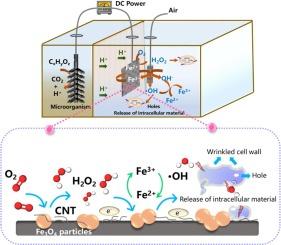
The microbial electro-Fenton (MEF) system integrates bioelectrochemistry with Fenton oxidation for wastewater treatment. In this system, microbial oxidation of organic matter at the anode generates electrons that are transferred to the cathode, promoting the in-situ production of H2O2. The reactive species formed during the cathodic electrochemical reactions effectively degrade refractory organic pollutants in wastewater. However, research on the disinfection capabilities of this system is notably lacking with challenges including low H2O2 yield and ineffective cycling of Fe2+ and Fe3+. To address these limitations, a self-supported embedded composite electrode was designed as the MEF cathode, which enhanced electron transfer throughout the system. At an applied voltage of 0.4 V, a 4.0-Log reduction of E. coli was achieved within 2 h, with an energy consumption of 0.06 kWh/m3, significantly lower than traditional electrochemical disinfection. The stable adsorption sites on the composite electrode promoted the sustained production of H2O2 through oxygen reduction. Results demonstrated that elevated levels of ·OH induced the leakage of intracellular substances, which ultimately triggered bacterial inactivation. Furthermore, the anodic microbial community revealed that the growth of Firmicutes phylum accelerated electron transfer and cathodic oxidation, boosting the disinfection efficacy of MEF system. Thus, this technology shows great potential for simultaneous organic contaminants treatment at the anode and disinfection at the cathode, offering a low energy consumption, high-efficiency method for reducing pollution risks.
期刊介绍:
Separation and Purification Technology is a premier journal committed to sharing innovative methods for separation and purification in chemical and environmental engineering, encompassing both homogeneous solutions and heterogeneous mixtures. Our scope includes the separation and/or purification of liquids, vapors, and gases, as well as carbon capture and separation techniques. However, it's important to note that methods solely intended for analytical purposes are not within the scope of the journal. Additionally, disciplines such as soil science, polymer science, and metallurgy fall outside the purview of Separation and Purification Technology. Join us in advancing the field of separation and purification methods for sustainable solutions in chemical and environmental engineering.





 京公网安备 11010802042870号
京ICP备2023020795号-1
京公网安备 11010802042870号
京ICP备2023020795号-1

 分享
分享
 求助内容:
求助内容: 应助结果提醒方式:
 扫码关注我们
