Lin Yang , Xin Jin , Zhitao Feng , Shihong Xu , Feng Xie , Wei Sun , Wanjia Zhang , Zhiyong Gao
{"title":"Efficient separation of sulfide minerals using a heterocyclic collector by regulating strong and weak interactions","authors":"Lin Yang , Xin Jin , Zhitao Feng , Shihong Xu , Feng Xie , Wei Sun , Wanjia Zhang , Zhiyong Gao","doi":"10.1016/j.seppur.2025.132526","DOIUrl":null,"url":null,"abstract":"<div><div>Galena is the primary source of lead (Pb), and its efficient utilization is hindered by associated minerals such as sphalerite and pyrite. Flotation is the main method used for their separation, requiring the development of efficient flotation reagents, particularly collectors. In this work, a novel galena collector, 5-mercapto-3-phenyl-1,3,4-thiadiazole-2(3H)-thione (YC-2), was designed and synthesized to selectively float galena from sphalerite and pyrite. By regulating both strong (coordination) and weak (hydrogen bonding) interactions between YC-2 molecules and the surfaces of the sulfide minerals, the energy and spatial matching degrees in adsorption were enhanced. The flotation tests indicate that YC-2 can efficiently and greenly separate galena from sphalerite and pyrite under natural pulp pH (∼8), demonstrating strong collecting ability and high selectivity. Zeta potential, XPS analysis, and DFT calculations confirm that YC-2 selectively adsorbs on galena by forming N–Pb–S bonds, rather than on sphalerite or pyrite. As pH increases, the electrostatic repulsion between YC-2 and the sulfide minerals gradually strengthens, attributed to the increased negative charge of the coordination groups in YC-2 and more negative zeta potentials on the sulfide mineral surfaces. At pH 8, electrostatic repulsion reaches its optimal level, maximizing galena selectivity. In terms of energy matching, strong interactions are regulated by incorporating a xanthate skeleton into an azacycle, while YC-2 is constructed with lower molecular polarity, fewer ionic bonds, and higher selectivity. Regarding spatial matching, weak interactions are regulated by increasing spatial hindrance, enhancing YC-2 selectivity due to differences in the hydration layers of sulfide minerals. Water molecules loosely adsorb on galena mainly via S···H hydrogen bonds, but tightly adsorb on sphalerite and pyrite mainly via Zn–O/Fe–O bonds. Due to desolvation, YC-2 preferentially adsorbs on galena over sphalerite and pyrite. In conclusion, YC-2 exhibits enhanced flotation performance, achieving efficient and green separation of galena from complex sulfide ores, with industrial application potential.</div></div>","PeriodicalId":427,"journal":{"name":"Separation and Purification Technology","volume":"364 ","pages":"Article 132526"},"PeriodicalIF":9.0000,"publicationDate":"2025-03-16","publicationTypes":"Journal Article","fieldsOfStudy":null,"isOpenAccess":false,"openAccessPdf":"","citationCount":"0","resultStr":null,"platform":"Semanticscholar","paperid":null,"PeriodicalName":"Separation and Purification Technology","FirstCategoryId":"5","ListUrlMain":"https://www.sciencedirect.com/science/article/pii/S1383586625011232","RegionNum":1,"RegionCategory":"工程技术","ArticlePicture":[],"TitleCN":null,"AbstractTextCN":null,"PMCID":null,"EPubDate":"","PubModel":"","JCR":"Q1","JCRName":"ENGINEERING, CHEMICAL","Score":null,"Total":0}
引用次数: 0
Abstract
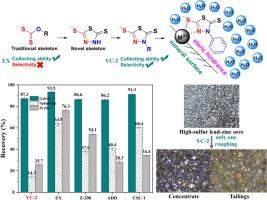
Galena is the primary source of lead (Pb), and its efficient utilization is hindered by associated minerals such as sphalerite and pyrite. Flotation is the main method used for their separation, requiring the development of efficient flotation reagents, particularly collectors. In this work, a novel galena collector, 5-mercapto-3-phenyl-1,3,4-thiadiazole-2(3H)-thione (YC-2), was designed and synthesized to selectively float galena from sphalerite and pyrite. By regulating both strong (coordination) and weak (hydrogen bonding) interactions between YC-2 molecules and the surfaces of the sulfide minerals, the energy and spatial matching degrees in adsorption were enhanced. The flotation tests indicate that YC-2 can efficiently and greenly separate galena from sphalerite and pyrite under natural pulp pH (∼8), demonstrating strong collecting ability and high selectivity. Zeta potential, XPS analysis, and DFT calculations confirm that YC-2 selectively adsorbs on galena by forming N–Pb–S bonds, rather than on sphalerite or pyrite. As pH increases, the electrostatic repulsion between YC-2 and the sulfide minerals gradually strengthens, attributed to the increased negative charge of the coordination groups in YC-2 and more negative zeta potentials on the sulfide mineral surfaces. At pH 8, electrostatic repulsion reaches its optimal level, maximizing galena selectivity. In terms of energy matching, strong interactions are regulated by incorporating a xanthate skeleton into an azacycle, while YC-2 is constructed with lower molecular polarity, fewer ionic bonds, and higher selectivity. Regarding spatial matching, weak interactions are regulated by increasing spatial hindrance, enhancing YC-2 selectivity due to differences in the hydration layers of sulfide minerals. Water molecules loosely adsorb on galena mainly via S···H hydrogen bonds, but tightly adsorb on sphalerite and pyrite mainly via Zn–O/Fe–O bonds. Due to desolvation, YC-2 preferentially adsorbs on galena over sphalerite and pyrite. In conclusion, YC-2 exhibits enhanced flotation performance, achieving efficient and green separation of galena from complex sulfide ores, with industrial application potential.
期刊介绍:
Separation and Purification Technology is a premier journal committed to sharing innovative methods for separation and purification in chemical and environmental engineering, encompassing both homogeneous solutions and heterogeneous mixtures. Our scope includes the separation and/or purification of liquids, vapors, and gases, as well as carbon capture and separation techniques. However, it's important to note that methods solely intended for analytical purposes are not within the scope of the journal. Additionally, disciplines such as soil science, polymer science, and metallurgy fall outside the purview of Separation and Purification Technology. Join us in advancing the field of separation and purification methods for sustainable solutions in chemical and environmental engineering.




 京公网安备 11010802042870号
京ICP备2023020795号-1
京公网安备 11010802042870号
京ICP备2023020795号-1

 分享
分享
 求助内容:
求助内容: 应助结果提醒方式:
 扫码关注我们
