Natasha M Appelman-Dijkstra, Telli Merve Avci, Manuela Schoeb, Elizabeth M Winter, Antoon van Lierop, Socrates E Papapoulos
{"title":"Long-term clinical and bone mineral density changes of adult patients with sclerostin deficiency due to van Buchem disease: a follow-up study.","authors":"Natasha M Appelman-Dijkstra, Telli Merve Avci, Manuela Schoeb, Elizabeth M Winter, Antoon van Lierop, Socrates E Papapoulos","doi":"10.1093/jbmrpl/ziae170","DOIUrl":null,"url":null,"abstract":"<p><p>Van Buchem disease (VBD) is an inherited rare sclerosing bone disorder, due to defective synthesis of sclerostin, a negative regulator of bone formation. Our earlier cross-sectional studies of patients with VBD and the closely related sclerosteosis suggested that the accrual of bone mass does not continue after puberty but longitudinal studies of patients with sclerostin deficiency are not available. The aim, therefore, of the present study was the long-term assessment of adult patients with VBD. Fifteen previously evaluated patients with genetically confirmed VBD were invited to participate in the study and 11 (4 women) consented. Mean follow-up time was 8.9 ± 1.1 yr and median age at follow-up was 47 yr (range 20-60). Seven patients developed permanent facial paresis, 9 had progressing hearing loss, and 2 developed had increased intracranial pressure requiring cranial surgery. Dental problems were common, and 3 patients developed osteoarthritis during follow-up. None experienced a cardiovascular event. BMD did not change at the LS or the left FN; Z-scores were 10.2 ± 1.3 SD vs 9.4 ± 2.3 SD, <i>p</i>=.62, and 8.9 ± 2.2 SD vs 7.7 ± 2.2 SD, <i>p</i>=.15, respectively. The variability of the clinical expression and progression of the disease, despite the stabilization of BMD but with progressive cranial nerve compression, requires continuous monitoring of these patients for whom no disease-specific therapy is currently available.</p>","PeriodicalId":14611,"journal":{"name":"JBMR Plus","volume":"9 4","pages":"ziae170"},"PeriodicalIF":2.4000,"publicationDate":"2025-03-15","publicationTypes":"Journal Article","fieldsOfStudy":null,"isOpenAccess":false,"openAccessPdf":"https://www.ncbi.nlm.nih.gov/pmc/articles/PMC11910894/pdf/","citationCount":"0","resultStr":null,"platform":"Semanticscholar","paperid":null,"PeriodicalName":"JBMR Plus","FirstCategoryId":"1085","ListUrlMain":"https://doi.org/10.1093/jbmrpl/ziae170","RegionNum":0,"RegionCategory":null,"ArticlePicture":[],"TitleCN":null,"AbstractTextCN":null,"PMCID":null,"EPubDate":"2025/4/1 0:00:00","PubModel":"eCollection","JCR":"Q2","JCRName":"ENDOCRINOLOGY & METABOLISM","Score":null,"Total":0}
引用次数: 0
Abstract
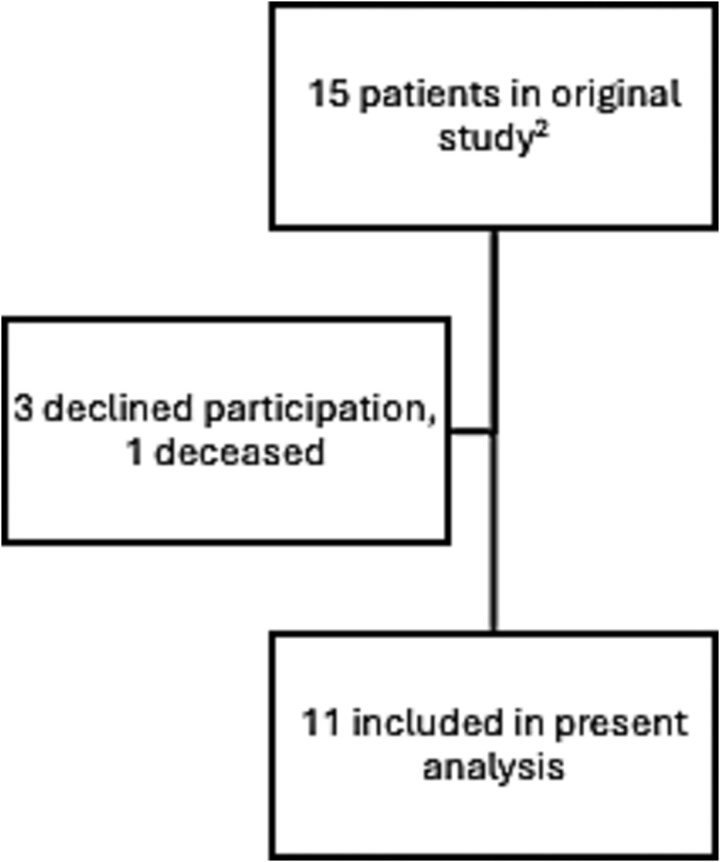
Van Buchem disease (VBD) is an inherited rare sclerosing bone disorder, due to defective synthesis of sclerostin, a negative regulator of bone formation. Our earlier cross-sectional studies of patients with VBD and the closely related sclerosteosis suggested that the accrual of bone mass does not continue after puberty but longitudinal studies of patients with sclerostin deficiency are not available. The aim, therefore, of the present study was the long-term assessment of adult patients with VBD. Fifteen previously evaluated patients with genetically confirmed VBD were invited to participate in the study and 11 (4 women) consented. Mean follow-up time was 8.9 ± 1.1 yr and median age at follow-up was 47 yr (range 20-60). Seven patients developed permanent facial paresis, 9 had progressing hearing loss, and 2 developed had increased intracranial pressure requiring cranial surgery. Dental problems were common, and 3 patients developed osteoarthritis during follow-up. None experienced a cardiovascular event. BMD did not change at the LS or the left FN; Z-scores were 10.2 ± 1.3 SD vs 9.4 ± 2.3 SD, p=.62, and 8.9 ± 2.2 SD vs 7.7 ± 2.2 SD, p=.15, respectively. The variability of the clinical expression and progression of the disease, despite the stabilization of BMD but with progressive cranial nerve compression, requires continuous monitoring of these patients for whom no disease-specific therapy is currently available.
Van Buchem病(VBD)是一种遗传性罕见的硬化性骨疾病,由于骨形成的负调节因子硬化蛋白合成缺陷。我们早期对VBD患者和密切相关的硬化症患者的横断面研究表明,青春期后骨量的积累不会继续,但对硬化蛋白缺乏患者的纵向研究还没有得到。因此,本研究的目的是对成年VBD患者进行长期评估。15名先前被评估的基因证实的VBD患者被邀请参加研究,其中11名(4名女性)同意。平均随访时间8.9±1.1年,中位年龄47岁(20 ~ 60岁)。7名患者出现永久性面部瘫,9名患者出现进行性听力丧失,2名患者出现颅内压升高,需要进行颅内压手术。牙病常见,随访中有3例出现骨关节炎。没有人发生心血管事件。左左FN和左LS的BMD没有变化;z评分为10.2±1.3 SD vs 9.4±2.3 SD, p=。和8.9±2.2 SD vs 7.7±2.2 SD, p=。分别为15。尽管骨密度稳定,但伴有进行性颅神经压迫,但该疾病的临床表现和进展的可变性需要对这些目前没有疾病特异性治疗的患者进行持续监测。





 京公网安备 11010802042870号
京ICP备2023020795号-1
京公网安备 11010802042870号
京ICP备2023020795号-1

 分享
分享
 求助内容:
求助内容: 应助结果提醒方式:
 扫码关注我们
