{"title":"Surfactant-Mediated Interfacial Hydrogen Evolution Reaction","authors":"Boubakar Sanogo, Pratibha Dogra, Kangkana Kalita, Xuehua Zhang","doi":"10.1021/acsami.4c20384","DOIUrl":null,"url":null,"abstract":"Hydrogen is a highly promising clean energy source without greenhouse gas emissions. Liquid organic hydrogen carriers (LOHCs) offer a promising alternative for convenient storage and transportation. This study investigates the interfacial hydrogen evolution reaction between polymethylhydrosiloxane (PMH), a representative LOHC, and water, focusing on controlling reaction kinetics by modifying interfacial properties with surfactants. The hydrogen production rate at a planar interface between PMH and water catalyzed by sodium hydroxide revealed that surfactants such as Tween 20 and sodium dodecyl sulfate (SDS) can slow down the hydrogen formation by 5 to 20 times, possibly due to an overcrowded interface effect. In contrast, cationic surfactants, such as hexadecyltrimethylammonium bromide (CTAB) and other quaternary ammonium surfactants, act as pseudo phase-transfer catalysts and accelerate the hydrogen formation rate up to 3-fold at a concentration of 0.05 times their critical micelle concentration. As the PMH microdroplets were dispersed in the surfactant aqueous solution, the conversion yields of hydrogen with cationic surfactants reached up to 45%, which is significantly higher than the yields achieved with Tween 20 or SDS. The effects of the surfactant type were further confirmed by following hydrogen bubble growth in a single PMH droplet. Overall, our findings demonstrate that selecting an appropriate surfactant can provide an effective control over the interfacial reaction rate of dehydrogenation of LOHCs. This offers strategies for manipulating liquid–liquid interfaces and controlling in-demand hydrogen production.","PeriodicalId":5,"journal":{"name":"ACS Applied Materials & Interfaces","volume":"183 1","pages":""},"PeriodicalIF":7.8000,"publicationDate":"2025-03-19","publicationTypes":"Journal Article","fieldsOfStudy":null,"isOpenAccess":false,"openAccessPdf":"","citationCount":"0","resultStr":null,"platform":"Semanticscholar","paperid":null,"PeriodicalName":"ACS Applied Materials & Interfaces","FirstCategoryId":"88","ListUrlMain":"https://doi.org/10.1021/acsami.4c20384","RegionNum":2,"RegionCategory":"材料科学","ArticlePicture":[],"TitleCN":null,"AbstractTextCN":null,"PMCID":null,"EPubDate":"","PubModel":"","JCR":"Q1","JCRName":"MATERIALS SCIENCE, MULTIDISCIPLINARY","Score":null,"Total":0}
引用次数: 0
Abstract
Hydrogen is a highly promising clean energy source without greenhouse gas emissions. Liquid organic hydrogen carriers (LOHCs) offer a promising alternative for convenient storage and transportation. This study investigates the interfacial hydrogen evolution reaction between polymethylhydrosiloxane (PMH), a representative LOHC, and water, focusing on controlling reaction kinetics by modifying interfacial properties with surfactants. The hydrogen production rate at a planar interface between PMH and water catalyzed by sodium hydroxide revealed that surfactants such as Tween 20 and sodium dodecyl sulfate (SDS) can slow down the hydrogen formation by 5 to 20 times, possibly due to an overcrowded interface effect. In contrast, cationic surfactants, such as hexadecyltrimethylammonium bromide (CTAB) and other quaternary ammonium surfactants, act as pseudo phase-transfer catalysts and accelerate the hydrogen formation rate up to 3-fold at a concentration of 0.05 times their critical micelle concentration. As the PMH microdroplets were dispersed in the surfactant aqueous solution, the conversion yields of hydrogen with cationic surfactants reached up to 45%, which is significantly higher than the yields achieved with Tween 20 or SDS. The effects of the surfactant type were further confirmed by following hydrogen bubble growth in a single PMH droplet. Overall, our findings demonstrate that selecting an appropriate surfactant can provide an effective control over the interfacial reaction rate of dehydrogenation of LOHCs. This offers strategies for manipulating liquid–liquid interfaces and controlling in-demand hydrogen production.
期刊介绍:
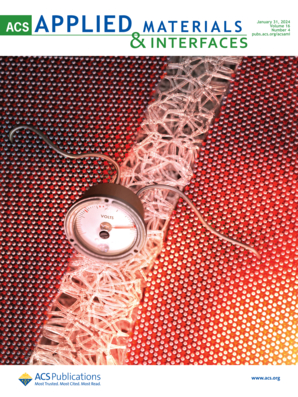
ACS Applied Materials & Interfaces is a leading interdisciplinary journal that brings together chemists, engineers, physicists, and biologists to explore the development and utilization of newly-discovered materials and interfacial processes for specific applications. Our journal has experienced remarkable growth since its establishment in 2009, both in terms of the number of articles published and the impact of the research showcased. We are proud to foster a truly global community, with the majority of published articles originating from outside the United States, reflecting the rapid growth of applied research worldwide.





 京公网安备 11010802042870号
京ICP备2023020795号-1
京公网安备 11010802042870号
京ICP备2023020795号-1

 分享
分享
 求助内容:
求助内容: 应助结果提醒方式:
 扫码关注我们
